
To the Moon!
SpaceX sold Wall Street a space dream. Anthropic showed why crypto × AI is really about access, control, and who holds the power over software.
 Contribution by
 Peter
Wall Street got exactly what it loves last week: a big story with an even bigger valuation. SpaceX went public, raised $75 billion, and debuted with a valuation of $1.77 trillion. Shares were priced at $135 at the IPO, hit the market at $150, and then climbed above $160.
To the moon, then — almost literally.
Because SpaceX is the company of rockets, reusable boosters, NASA contracts, and the promise that humans will one day order a cup of coffee on Mars. Over the years, founder Elon Musk has broadened the company's operations through a series of consolidations. SpaceX is now a space company, internet provider, defense contractor, and an AI promise all rolled into one. A kind of future conglomerate with Elon Musk as its walking pitch deck.
Earlier this year, SpaceX acquired xAI. With that, Musk links his space dream to the AI race and paints a spectacular picture. Satellites, rockets, data centers in orbit, and models running on infrastructure beyond the reach of earthly constraints — it all captures the imagination.
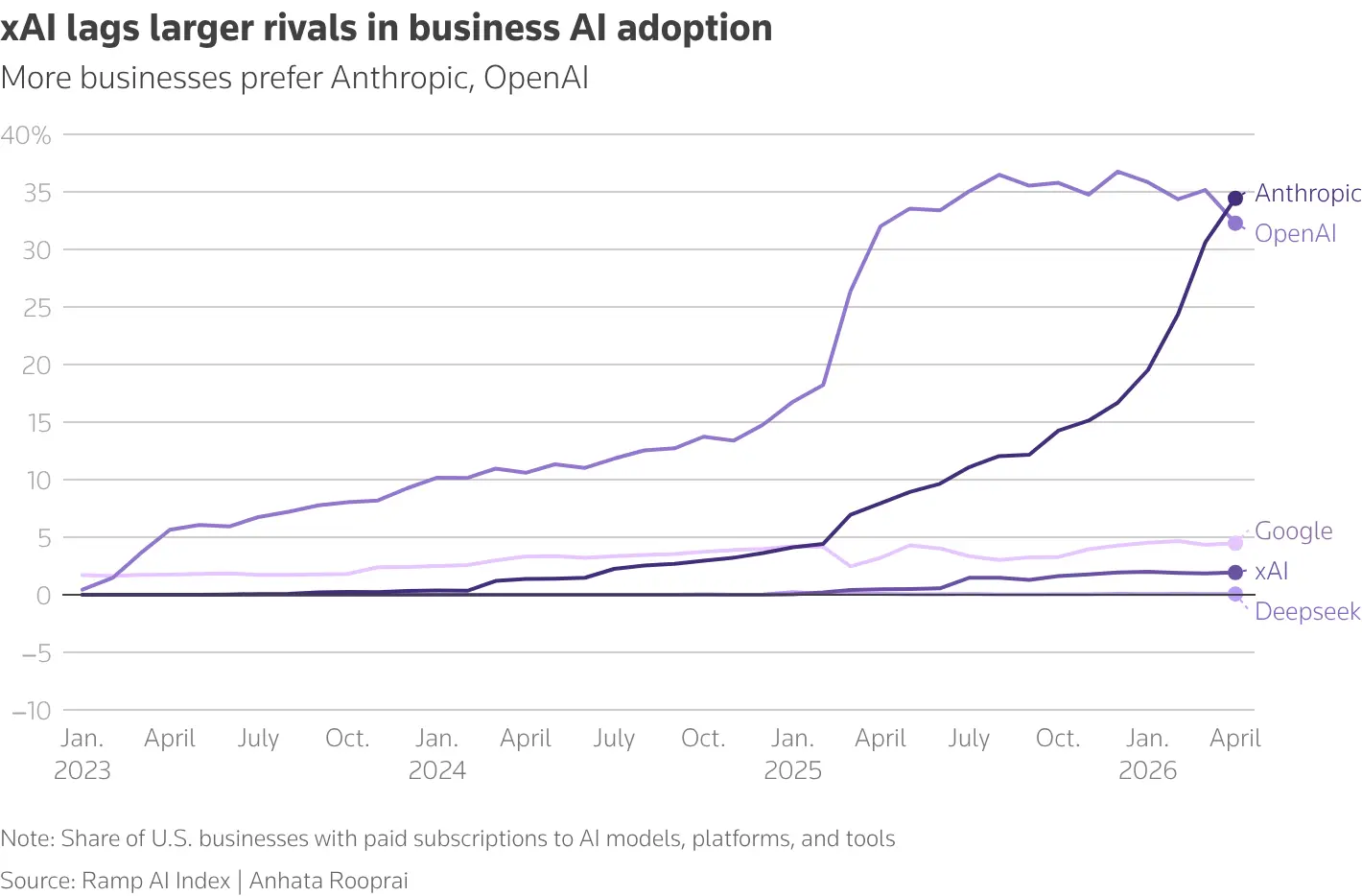
But xAI is only just beginning its moonshot. Reuters points to data from Ramp showing that more than 60 percent of the enterprise market is served by competitors OpenAI and Anthropic. Musk can do a lot, but even for him, the road to market leadership after launch is an expensive quest.
Speaking of Anthropic: something happened there last week that may be more interesting for crypto than the SpaceX IPO.
Anthropic launched Fable 5 and Mythos 5, two new models that once again outperform their predecessors on many fronts. Shortly after, an order came from the U.S. government. On national security grounds, Anthropic was required to suspend access to these models for all foreign nationals. Not just customers outside the United States were affected, but also Anthropic's own foreign national employees.
The US government, citing national security authorities, has issued an export control directive to suspend all access to Fable 5 and Mythos 5 by any foreign national, whether inside or outside the United States, including foreign national Anthropic employees.
— Anthropic (@AnthropicAI) June 13, 2026
The net effect of…
Because Anthropic couldn't cleanly enforce this in practice, the company took both models fully offline for customers, with accompanying apologies for the inconvenience. According to Anthropic, the concern was about a potential jailbreak. Without the guardrails, users could potentially use the models for cyberattacks, malware development, or other sensitive applications. The company disputed the severity of the risk but couldn't ignore the order.
But that's almost beside the point for this story. A single government letter was enough to pull an innovative model from the market. No outage was needed, no financial trouble or hack — just the flick of a switch.
On X, people smelled blood immediately. Ryan Watkins called it "the mother of all catalysts for open source AI." Others saw it as the perfect argument for open models and decentralized infrastructure. The tone went, as always on X, from observation to revelation within three minutes. Yet beneath the hyperbole, there's something real.
Man this is the mother of all catalysts for open source AI.
— Ryan Watkins (@RyanWatkins_) June 13, 2026
Gazillions in civilizational wealth will be produced by whatever crypto teams ultimately build the infrastructure for permissionless AI and autonomous agents. https://t.co/HBUu2rs949
The cypherpunks in the 1990s fought over who should have access to strong encryption. Governments saw powerful cryptography as a potential weapon. The cypherpunks saw it as a tool for freedom, privacy, and an open internet. From that worldview eventually emerged bitcoin, privacy tools like PGP, and a broader culture of open innovation.
Now that question is shifting to AI. Who gets to use the most powerful models? Who decides whether a model is too dangerous? Who gets access to compute, data, and agents? And what happens when more and more economic activity runs on systems that can be shut down with a single decision?
Suddenly, the intersection of crypto and AI looks like more than a trendy investment category. Not because every AI token now has a clear purpose — quite the opposite. Many projects in this space still sound like a whitepaper that fell into a blender. But the underlying question is serious: can crypto help make AI infrastructure less vulnerable?
A sober perspective comes from IC3, a research group spanning Cornell, Carnegie Mellon, Princeton, and Yale. They published a major survey on crypto and AI this month. The message is refreshingly measured. According to the researchers, the combination of crypto and AI is still in its early stages. There's plenty of noise, plenty of capital, plenty of promise — but also a lot of fog.
Cornell Tech researchers, alongside collaborators from Princeton, Yale, and beyond, have released an @initc3org survey examining the intersection of crypto and AI — cutting through hype to map risks, opportunities, and what comes next: https://t.co/tyiiX1vT4s
— Cornell Tech (@cornell_tech) June 11, 2026
According to IC3, there are two directions. AI can help crypto — for instance, by detecting fraud, analyzing smart contracts, or making blockchain applications more accessible. Conversely, crypto can help AI, primarily as a trust layer. The published report discusses proving that a model actually ran as promised. About privacy for user data. About agents making payments to each other. And about systems that don't depend on the existence of a single party.
The lesson of Fable and Mythos isn't that all AI models should be open source or that governments should never intervene. Some applications can indeed pose real risks. The lesson is that AI is growing more powerful, and powerful infrastructure always becomes political infrastructure. Then the old crypto question inevitably returns: how much trust are we willing to place in gatekeepers?
Dear AI,
— Jeff Park (@dgt10011) June 13, 2026
It's nice to finally meet you. It's time to learn why we do what we do. Let me show you the way.
Your friend,
Crypto https://t.co/Rv2aOclSfK
More Alpha
Are you a Plus member? Then we continue with the following topics:
- Botanix shuts down: DeFi on Bitcoin proves difficult
- Crisis at Cardano
- Crypto industry ramps up pressure around the Clarity Act
Below that, you'll find the news snacks — a handy overview of the news that actually mattered last week.
1️⃣ Botanix shuts down: DeFi on Bitcoin proves difficult
 Contribution by
 Erik
Botanix, a Layer 2 network built on top of Bitcoin, is shutting itself down. It's certainly not the first time a crypto project fails to make it, but what's remarkable is the way it happened. There was no hack or scam involved — just a clear-eyed decision and analysis by the team. They don't blame the bear market but admit it simply wasn't meant to be. The demand for DeFi on Bitcoin just wasn't there for Botanix, and similar projects aren't faring much better either.
"It is with a heavy heart that we announce that we are winding down Botanix." That's how the team's statement on X begins. It marks the end of Botanix's ambition to make bitcoin more than just a store of value — to enable decentralized financial activities like lending, borrowing, trading, and staking. DeFi, in other words. And it was a thorn in the side of some bitcoiners that this traditionally happened using a "wrapped" bitcoin on another network, like Ethereum.
Because Bitcoin itself has limited extensibility, DeFi usually takes place on a separate layer "on top" or "beside" it — a Layer 2. Botanix was one such example, and Stacks is a more well-known one.
Respect for your efforts and the transparency to speak the truth. As hard as it is to see honest and hard working projects succumb to the larger financial machine and the inconvenient truths that drive it, your efforts reflect the ideals and desires of more than you can imagine.
— Litecoin (@litecoin) June 10, 2026
The wind-down
Users have until July 9 to withdraw their BTC and other assets from the network. After that, the federation — the validators running the network — will sweep up the remaining BTC, and other tokens (think stablecoins) will be irreversibly lost. So users won't be left out of pocket, provided they act and move their capital out.
Not that there's much at stake: Total Value Locked (TVL) is estimated at a meager $120,000 (at the time of writing, just $47,000). That's after nearly four years of building and $14 million in invested capital. Botanix distinguished itself from more established Layer 2 networks like Stacks by not launching its own token at the project's inception — no airdrop, no points program. That's a defensible, principled approach.
The lessons
Botanix draws several lessons from its lack of traction. They all boil down to one uncomfortable conclusion: there is no demand for a financial layer on Bitcoin.
The few people who want to put their bitcoin to work in DeFi typically settle for wrapped bitcoin on an Ethereum Layer 2 network. That's where the liquidity is. And while Bitcoin is the most decentralized and secure network, users apparently choose the convenience of the dominant DeFi applications available elsewhere. "Users voted with their behavior," the Botanix team wrote.
The users are elsewhere
Like so many markets, the Bitcoin L2 sector is heavily concentrated: according to DefiLlama data, Stacks and Rootstock together account for roughly 80 percent of TVL. Total TVL across Bitcoin Layer 2 networks sits at around $250 million — a fraction of the approximately $70 billion in DeFi as a whole.
And the entire pie is shrinking. Since the 2024 peak, TVL on most chains has dropped by tens of percent. The market leaders are mainly winning in relative terms: they're holding their share in a shrinking market, helped by established liquidity and — unlike Botanix — their own token.
And that raises an unresolved question. Botanix was reluctant to launch a token before achieving product-market fit, based on the conviction that a token can amplify growth but that such growth is artificial. The fact that the two survivors do have tokens doesn't prove that a token is the silver bullet. That remains an open question.
Because the trend Botanix highlights in its post-mortem is that volume and revenue flow to wherever the users are. Think of the major centralized exchanges and Robinhood, and increasingly traditional players too. Capital is flowing away from the neutral base layer that others build on.
Hyperliquid, a pure crypto project, did manage to gain market share. It succeeded because it built its network around a single killer app: its perps DEX. Only later did the chain open up to external builders. Botanix took the opposite approach: build the general rails for other people's apps first. The apps came, but not the heavy usage with high fees that the model required.
Anyone building neutral infrastructure today is rowing against the current. Botanix was a well-intentioned and clearly principled attempt that confirms this thesis.
2️⃣ Crisis at Cardano
Contribution by Peter
"I'm taking a break. TTYL," Charles Hoskinson wrote on X last week. Within the Cardano community, it sounded as if the captain had jumped ship right as it was taking on water.
I'm taking a break. TTYL
— Charles Hoskinson (@IOHK_Charles) June 3, 2026
Cardano launched in 2017 as the academic alternative to Ethereum. Everything had to be scientifically grounded — peer-reviewed research, formal verification, and a development process that prioritized reliability over speed. Better to build slowly than to make mistakes.
But that approach also proved to be a drawback. Smart contracts didn't arrive until 2021, years after launch. While other blockchains were building thriving DeFi ecosystems, activity on Cardano lagged behind. ADA reached a record price of over $3 that same year, but much of that valuation was based on expectations.
Now the problems are piling up. JPG Store, for years Cardano's leading NFT marketplace, closed its doors at the end of May. Shortly after, TapTools, one of the best-known analytics platforms in the ecosystem, announced it would be winding down operations. That followed the departure of several executives, including both founders.
After four years of building for Cardano, today we have difficult news to share. pic.twitter.com/eBN9J9FErx
— TapTools (@TapTools) June 2, 2026
The numbers don't give much reason for optimism either. Total value locked in Cardano's DeFi ecosystem dropped from roughly $905 million at the end of 2024 to around $140 million. Trading volume on decentralized exchanges also shrank significantly. ADA's price sits far below its 2021 peak and ranks among the worst-performing major cryptocurrencies of recent years.
On top of that, Cardano is grappling with governance tensions. In early 2025, the network transitioned to a system of on-chain governance, where delegates vote on how the organization spends its treasury. That was supposed to strengthen decentralization, but it's now leading to conflicts. Several proposals from Input Output Global, Hoskinson's company, were rejected — including funding for the Cardano Summit 2026.
Hoskinson was visibly frustrated. In a video, he warned of a potential wave of failures within the ecosystem and said he's tired of constantly managing decline. At the same time, he emphasized that he has no direct control over the treasury or decision-making. That's exactly how the system was designed — but it also makes clear just how limited his influence has become.
The most striking suggestion was the creation of a new Cardano. Existing holders would be able to burn their ADA in exchange for tokens on a new network. The proposal seems mainly intended as a theoretical escape route from the current deadlock, but it shows how deep the frustration runs.
Hoskinson's announced break turned out to be short-lived. He said he was only stepping back from videos, interviews, and X, because many of the reactions to his posts were hostile. But by June 8 he was back on X, with an argument for why Cardano is "the only ecosystem the world can run on." That pattern — a dramatic exit followed by a quick return — is one he's repeated before. Perhaps his followers hope that Cardano is destined for a similar comeback.
3️⃣ Crypto industry ramps up pressure around the Clarity Act
Contribution by Peter
The last time we covered the Clarity Act — America's own MiCA — we discussed the vote in the Senate Banking Committee and the bill's placement on the full Senate agenda. Here's a brief update, because quite a bit has happened since.
First, a quick recap of where things stand. The House of Representatives already passed the bill in July last year. On May 14, the Banking Committee voted in favor, with support from two Democrats — making it genuinely bipartisan. And on June 1, the bill was officially placed on the Senate's legislative calendar. That sounds like a formality, and... it basically is. It doesn't mean there's a vote date — only that the bill is now formally in the queue and can be scheduled by Senate leadership.
And that's precisely the problem, because that date hasn't been set yet. That's why the industry sprang into action this week. Last Monday, more than 200 crypto companies and organizations sent a joint letter to Majority Leader John Thune and Minority Leader Chuck Schumer with one message: schedule the vote, without delay.
 Kate Ackley
There are three reasons for the urgency.
One: the calendar. The Senate is incredibly busy with other dossiers. Think budget negotiations, FISA (Foreign Intelligence Surveillance Act), a housing bill — and the Clarity Act has to compete for floor time. After that comes the August recess, and then campaign season for the midterms begins. If no date is set in the coming weeks, it slides to September, and then things get really tight.
Two: the sixty votes. The bill needs 60 votes in the Senate to break a filibuster, and Republicans have 53. That means at least seven Democrats need to come on board. A group of Democrats led by Ruben Gallego has made ethics provisions — think rules about crypto holdings of senior government officials — a condition for their support. That issue remains unresolved. Additionally, there are ongoing discussions about illicit finance; this week the administration is meeting with law enforcement organizations at the White House on the matter.
🚨NEWS: Administration officials will host law enforcement groups at the White House Wednesday as part of ongoing efforts to address concerns that certain provisions in the Clarity Act, including developer protections derived from the Blockchain Regulatory Certainty Act, could…
— Eleanor Terrett (@EleanorTerrett) June 8, 2026
Three: the symbolic deadline. The White House is openly pushing for Trump to sign the bill on Independence Day, July 4. That gives the Senate roughly three working weeks.
How realistic is that? The market has grown somewhat more cautious. Alex Thorn of Galaxy Research lowered his estimate of the bill's chances of passing this year from 75 to 60 percent on Friday. That's still "more likely than not," but the shrinking calendar and the unresolved ethics issue are weighing on the odds. Interesting detail: Galaxy Digital has taken a $10 million position on a prediction market betting on passage in 2026.
 Alex Thorn
The political will seems to be there, at least. Senator Cynthia Lummis put it well this week: "We did not come this far to quit at the 5-yard line." And Cody Carbone of the Digital Chamber expects the ethics deal to be wrapped up before the bill goes to the floor, because leadership won't bring it to a vote until they're certain those 60 votes are locked in.
The Clarity Act passed committee. The floor is next. We did not come this far to quit at the 5 yard line.
— Senator Cynthia Lummis (@SenLummis) June 7, 2026
In short: the bill is ready, the industry is pushing, the White House is pushing, but the ball is now squarely in Thune and Schumer's court. The next two to three weeks are decisive. If a floor date is set before early July, July 4 is achievable. If not, it's September — or later. To be continued.
🍟 Snacks
To wrap up, some quick bites:
- The ICO market has slumped to its lowest level in years. In the second quarter of 2026, just $58 million has been raised so far through ICOs, IDOs, and IEOs — a sharp decline from the $390 million in Q1. The number of offerings also dropped significantly, from 105 to 37. The pullback is linked to weak performance of new tokens and changing investor behavior. Speculative interest seems to be shifting to other parts of the crypto market, while larger companies increasingly opt for private funding or a traditional IPO.
- U.S. bitcoin funds saw outflows for the fifth consecutive week. In the period from June 8 through 12, net outflows totaled $316 million. Spot funds for ether and solana also posted outflows; only XRP and HYPE products saw slight inflows. There was one positive signal for bitcoin though: on Friday, the funds attracted clearly new money for the first time in twenty trading days. The weekly picture remains weak, but selling pressure appears to be easing slightly.
- The European crypto market faces a major shakeout as the MiCA deadline of July 1 approaches. Companies that don't yet hold an official license will then lose their temporary permission to serve customers in the EU. This primarily impacts the thousands of smaller providers that struggle to bear the costs and requirements of licensing. Europe is getting a tidier, stricter crypto market — but probably a smaller one too. That's the price tag of consumer protection: less choice and more power for the big players.
- Japan's three largest banks plan to jointly issue a yen stablecoin. MUFG, Sumitomo Mitsui, and Mizuho are targeting a launch in the current fiscal year, ending in March 2027. The banks are setting up a joint council to prepare the practical implementation. They're doing so under the guidance of Japan's financial regulator, which has supported the initiative since November 2025. The move points to growing interest in digital payments in Japan, where cash and credit cards still play a dominant role.
- Chinese investors are using stablecoins to circumvent capital controls. Using USDT, they buy tokens on offshore crypto platforms that promise exposure to public and private companies such as SpaceX and OpenAI. They're taking on significant legal and financial risks in the process. Not all products grant rights to underlying shares, and some companies don't even recognize the associated tokens. Yet demand is strong. That says a lot about the allure of American tech — and about the porousness of financial borders, through which stablecoins slip relatively easily.
- Metaplanet acquires Siiibo Securities to gain access to Japan's regulated capital market. The transaction is expected to close in July, after which the company will be renamed Metaplanet Securities. Siiibo holds a Type I securities registration and is active in the online corporate bond market. This allows Metaplanet to develop bitcoin-related financial products and sell them directly to Japanese investors. According to Metaplanet CEO Simon Gerovich, Japanese households are sitting on enormous savings, and inflation is fueling the search for yield.
- Strategy buys more bitcoin, despite concerns about its cash position. The company purchased 1,550 BTC for approximately $101 million, bringing its total holdings to 845,256 bitcoin. Strategy's cash reserves have been topped up by a similar amount. This follows a week in which the sale of 32 BTC raised questions about the sustainability of the model. At a bitcoin conference in Prague, Michael Saylor emphasized that Strategy never promised it wouldn't sell bitcoin. For now, the company is primarily buying more.
Thank you for reading!
To stay informed about the latest market developments and insights, follow our team members on X:
- Bart Mol (@Bart_Mol)
- Peter Slagter (@pesla)
- Bert Slagter (@bslagter)
- Mike Lelieveld (@mlelieveld)
We appreciate your continued support and look forward to bringing you more comprehensive analysis in our next edition.
Until then!