
From Zero Knowledge to Infinite Trust
From zero-knowledge proofs in 1987 to Eli Ben-Sasson's Integrity Web: how Zcash, privacy, and blockchain converge in a story about trust, proof, and vested interests.

 Contribution by
 Peter
On February 17, 1987, The New York Times brought a still-young cryptographic breakthrough to a broad audience. Journalist James Gleick, later known for his book Chaos, wrote about mathematicians and cryptographers who had devised something that sounded impossible: a way to prove you know a secret without revealing the secret itself.
Gleick made the idea tangible with everyday examples. The credit card details left behind at a store, a password someone can peek at over your shoulder, or a passport you hand over at a hotel front desk. In all these cases, identification requires trust in the other party. Zero-knowledge proofs turned that on its head and promised a way out.
For the average newspaper reader in 1987, this was probably still quite esoteric. But for cryptographers, it was a fundamental shift. A proof no longer had to be a static document, as was customary in mathematics. It could also be an interactive game between a prover and a verifier: one asks questions, the other answers, and after enough rounds, the chance of deception becomes negligibly small.
The first generation of researchers showed that a proof doesn't have to reveal everything. In the years that followed, the idea grew bigger. It was no longer just about whether someone knew a secret, but also about whether a computation had been carried out correctly. Could you have a computer prove it did its job properly, without everyone having to redo the work?
That's where Eli Ben-Sasson enters the picture. He earned his PhD under Avi Wigderson, one of the early theorists who helped develop zero-knowledge proofs into a broadly applicable proof framework. Ben-Sasson then spent years working on the mathematics behind compact, efficiently verifiable proofs. Interest was limited and everything remained somewhat abstract, until... Ben-Sasson ended up at a Bitcoin conference in 2013.
In his new book Zero Knowledge, Infinite Trust, he describes that moment as a turning point. Suddenly he saw that his theoretical work had a practical destination. Every Bitcoin user could verify everything and trace all activity. That was the system's strength, but also its limitation, he felt. All activity was visible, privacy was scarce, and if everyone has to redo all the calculations, scalability remains a problem.
 Follow
For Ben-Sasson, something clicked into place. He finally saw a world where zero-knowledge proofs could take root. A year later, he co-authored the Zerocash paper, the scientific foundation for what would later become Zcash (ZEC). In it, he described transactions on a public blockchain network that don't reveal who pays, who receives, or how much money is involved.
After years of disinterest, Zcash has recently surged in popularity among investors. In a world where more and more financial activity takes place on-chain, transparency is becoming a problem rather than a virtue for some. Bitcoin is hard money, but also traceable money. Zcash is being positioned in that narrative as the privacy complement.
It's no coincidence that Grayscale is one of the driving forces behind this narrative. The asset manager filed a request with regulators last week to convert an existing Zcash fund into a spot ETF. Barry Silbert, founder of parent company DCG, meanwhile speaks of a new "privacy era." In Raoul Pal, he has a friend who is exposing a large audience to the narrative. Well-known names like Arthur Hayes, Naval Ravikant, and Multicoin Capital are also acting as catalysts. In early May, it emerged that the fund had built a significant Zcash position.
1/ Multicoin has built a significant position in $ZEC since February.
— Tushar Jain (@tushar_jain) May 5, 2026
Zcash is a return to the cypherpunk ideals crypto was founded on.
In the space of a year, the price of Zcash (ZEC) has risen by more than 1,000 percent. For Ben-Sasson, this must be welcome momentum. His book isn't primarily about a coin, but about a much bigger idea: the Integrity Web. An internet where systems no longer ask for trust, but cryptographically prove they are trustworthy. Blockchains play a central role in this vision.
Crypto has given plenty of reasons for skepticism in recent years. Fraud, memecoins, Ponzi schemes, empty decentralization promises. Ben-Sasson acknowledges them, but hasn't become any less optimistic. Perhaps because, as a theorist, he's accustomed to ideas that need decades before they show their value. The attention and capital now flowing toward Zcash may serve as an accelerant.
Been in crypto long enough to know:
— Eli Ben-Sasson | Starknet.io (@EliBenSasson) May 26, 2026
The best tech often looks irrelevant before it looks inevitable.
First it is too hard.
Then it is too early.
Then everyone explains why it was obvious.
Never bet against best tech and patient builders.
And so a straight line seems to run from Gleick's 1987 article to today's Zcash hype. Back then it was about credit cards, passwords, and passports. Now it's about blockchains, transactions, and scalability. The question has always remained the same: how much do you have to reveal to be allowed to participate?
More Alpha
Are you a Plus member? Then we continue with the following topics:
- Political friction on three crypto dossiers
- Ethereum picks its hill
- Can Strategy sell bitcoin without consequences?
Below that, you'll find the news snacks — a handy roundup of the news that actually mattered last week.
1️⃣ Political friction on three crypto dossiers
 Contribution by
 Erik
Three crypto dossiers that had the wind in their sails ran into resistance last week: the American Clarity Act, European stablecoins, and tokenized stocks. These are likely cases of delay rather than derailment.
Mood around the Clarity Act deteriorates
The U.S. Senate Banking Committee steered the Clarity Act through a vote on May 14. But that doesn't mean the bill — which governs the division of authority between financial watchdogs the SEC and CFTC — has been passed. For the crypto sector, the law is essential, as it would finally bring a reliable end to years of ambiguity, including the persistent threat of lawsuits that hung over the industry until last year.
Now investment bank TD Cowen is pessimistic that the law will cross the finish line this year. The political climate is deteriorating, and the sticking point is conflicts of interest. Democrats want ethics rules that also apply to the president, while Republicans would rather not see amendments targeting Trump.
From financial disclosures, it emerged that over 3,600 stock transactions were executed in Trump's name during the first quarter, worth between $220 million and $750 million. According to the White House, the assets sit in a family trust managed by his children and there are no conflicts of interest. Add to that the ongoing coverage of the family's crypto ventures. The proposed ethics clause would directly impact enterprises like World Liberty Financial and American Bitcoin.
Against that backdrop, the president chose to go on the offensive.
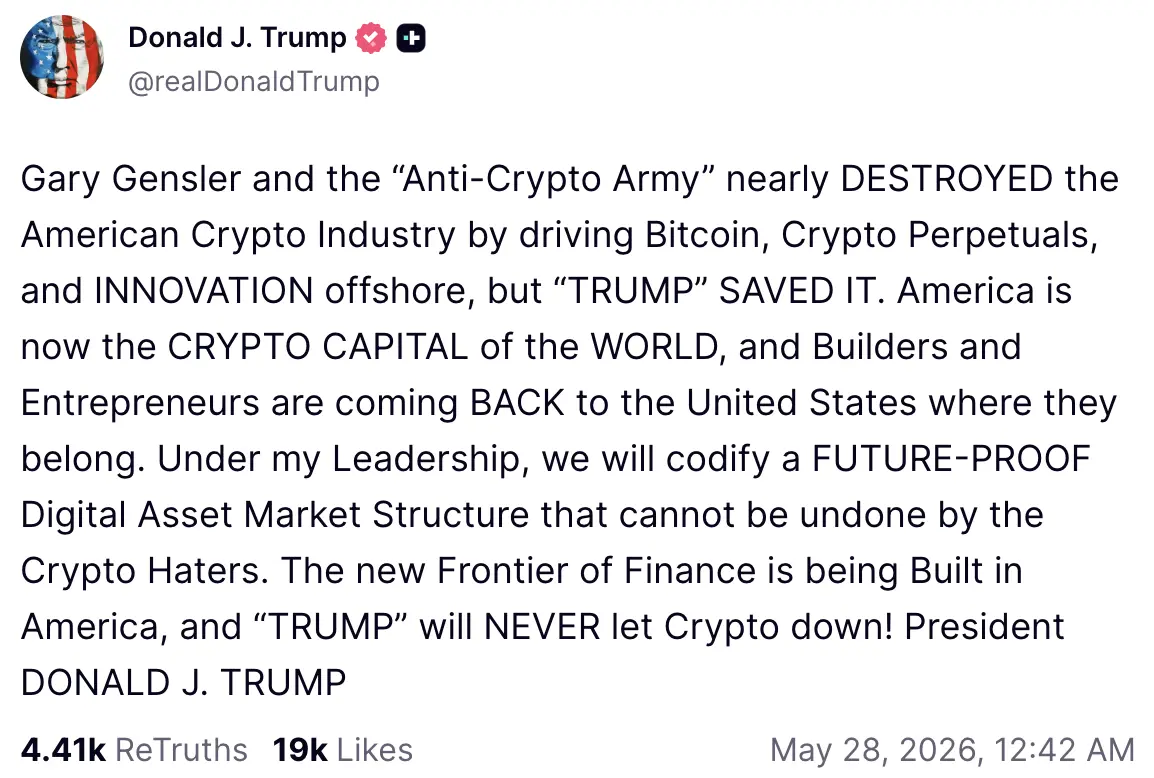
How this will play out is highly uncertain. Polymarket sits at barely more than 50-50 for the chance that the Clarity Act gets signed into law this year.
ECB rejects looser stablecoin rules
On May 22, the European Central Bank swept a series of proposals from think tank Bruegel off the table: looser liquidity requirements, access to ECB financing, and even the ECB as lender of last resort for stablecoin issuers. The aim of the proposals was to help the euro stablecoin compete with the highly dominant dollar variants.
Christine Lagarde and her colleagues rejected the proposals over concerns about bank deposit outflows and especially the idea that the ECB would become a safety net for private euro issuers. The ECB prefers to stick with two tracks of its own: the digital euro, which may arrive by 2029, and tokenized bank deposits that stay within the banking system.
Yet this doesn't mean the establishment is uniformly opposed to crypto. According to Reuters, European finance ministers were divided. Meanwhile, banking consortium Qivalis is working on a MiCA-regulated euro stablecoin that does fit within the ECB's preferences.
Stock exchanges push back against innovative tokenized stocks
The U.S. SEC has delayed the planned release of its "innovation exemption" for tokenized stocks. Not because of pushback from the crypto corner, but due to objections from stock exchanges Nasdaq, NYSE, and Cboe. Understandable, since they're defending their position as trading platforms.
Pro-crypto SEC Commissioner Hester Peirce had already tempered expectations: tokenized stocks would be limited in scope, and it wouldn't involve synthetic tokens that merely mirror a price, but tokens that actually confer rights to the underlying share.
I appreciate the interest in--but not the hyperbole about--the contemplated innovation exemption for the onchain trading of tokenized NMS stock. Keep in mind: I've always expected that it'd be limited in scope & would facilitate trading only of digital representations of the same…
— Hester Peirce (@HesterPeirce) May 21, 2026
The rollout has been delayed, not scrapped.
2️⃣ Ethereum picks its hill
Contribution by Peter
What if Ethereum succeeds, but ETH doesn't?
That's the uncomfortable question that rippled through the Ethereum ecosystem last week. The catalyst was David Hoffman, one of the faces of Bankless, who revealed he had sold his ETH. He framed the decision around a paradox: Ethereum is valuable, but ETH fails to capture that value sufficiently.
I spent the weekend putting my thoughts about $ETH and Ethereum into this article
— David Hoffman (@TrustlessState) May 26, 2026
I built my career, community, and business on Ethereum, so the decision to sell deserves a deeper explanation
I hope this is sufficient
Thank you, all https://t.co/cPCbMcz8EY
That distinction matters. Ethereum is without question one of the most important networks in the crypto world. It's the base layer for stablecoins, tokenized assets, DeFi, layer-2 networks, and all sorts of experiments that even traditional financial players are watching. The network creates value. The question is: where does that value end up?
With ETH holders? With Coinbase through Base? With stablecoin issuers? With fintechs like Square? With JP Morgan, Fidelity, or other corporates building on top of this infrastructure?
That's the core of Hoffman's doubt. Ethereum could grow into a kind of financial internet — neutral, open, programmable, and always available. But the internet itself wasn't exactly the best investment either. The big winners were the companies that built on top of it.
As it happens, Ethereum founder Vitalik Buterin came out with his own reflections at roughly the same time. Buterin's thoughts concerned the foundation behind the network, the Ethereum Foundation. His message seems at odds with Hoffman's hopes: the foundation should become smaller, sharper, and more principled. Not try to do everything. Not obsessively compete on scalability. Instead, the foundation should safeguard the properties that don't have obvious business models behind them.
Some of my perspective on where the @ethereumfndn is going.
— vitalik.eth (@VitalikButerin) May 24, 2026
First of all, this is only my own view. The board is not just me, and I have no extra special powers on the board that the other board members do not. @aerugoettinea is the one executing much of this transition. My…
This is precisely where the tension lies. For Vitalik, Ethereum only succeeds if it becomes robust public infrastructure. For ETH investors, that's not enough. They want to know whether that infrastructure also translates into rising demand for ETH itself.
It's clear that Hoffman no longer believes ETH is the right vehicle to capture that value. Vitalik sees it differently. He argues that focusing on what's commercially interesting right now leads to mediocrity. In his view, Ethereum must become the most credible neutral base layer in the world. To that end, five properties of the network take priority, which he's conveniently abbreviated as CROPS: censorship resistance, capture resistance, openness, privacy, and security.
If Ethereum proves it can be that base layer, it will naturally be reflected in the price of ETH — that's Vitalik's thesis. By putting in writing that "90% of my wealth is parked in it," he adds color to his conviction. Vitalik is picking Ethereum's hill to conquer — or to die on. The market still has to decide what that hill is worth.
3️⃣ Can Strategy sell bitcoin without consequences?
Contribution by Peter
In bear markets, you often see the leading figures of the preceding bull market get hit. In the best case, they weather the storm unscathed. Some quietly fade away, and in the worst case, they become embroiled in a scandal. Michael Saylor is one of the most important protagonists in today's Bitcoin story. He has dedicated his life's work — not least through his company Strategy — entirely to Bitcoin. Or, put differently, to owning bitcoin; as much as possible.
Never sell your Bitcoin.
— Michael Saylor (@saylor) February 2, 2025
At the time of writing, Strategy holds 843,738 BTC — over 4 percent of all bitcoins in circulation. A portion of that was purchased over the past year with proceeds from the issuance of STRC, a stock that now pays monthly dividends to its holders at 11.5% annualized. The costs have mounted significantly. Annually, Strategy must now pay out $1.2 billion to STRC holders. That's $100 million per month, or roughly $4 million per business day.
Unease about that expense is starting to build. Late last year, the company announced it had increased its cash reserve to more than $2 billion. That pushed cost concerns to the background. Temporarily. Because six months later, they've been dragged back to the foreground — after the company used over 60% of that cash reserve to retire a debt position that wasn't due until 2029.
Strategy's balance sheet looks better thanks to the early buyback of the outstanding debt. But investors now also see that the comfortable safety net has shrunk to just a few months' worth of STRC dividends. Jeff Dorman, CIO of asset manager Arca, is willing to draw conclusions: "Someone is going to get badly hurt here, and it'll happen within the next 4 months."
i'm not in Saylor's inner circle, but this $MSTR story has gotten so out of hand, my only guess is this:
— Jeff Dorman (@jdorman81) May 28, 2026
- MSTR could have sat and done nothing before they started pumping out $billons of prefs... it would have made MSTR boring (little buys, no sells), but it would have been…
Dorman calls the use of the cash reserve a "baffling decision for a company with cash flow problems." His doomsday scenario rests on the conviction that Strategy's business model collapses if the company sells bitcoin. An already weak bitcoin would then get hit hard, and the stock itself would plunge in value. In other words, Strategy would be erasing with its own hand the survival options it had penciled in.
Dorman's pessimism is countered in two ways. First, observers point out that Saylor has spent recent months preparing the market for the scenario in which Strategy sells bitcoin. By positioning Strategy as a real estate developer that nets more bitcoin than it sells, Saylor is trying to frame bitcoin sales as a positive move. In short, if Strategy chooses to raise dollars via bitcoin, the market absorbs it without issues and without panic. It's simply one of the tools the company uses to play the capital markets.
$BTC capital gains fund $STRC credit dividends.
— Michael Saylor (@saylor) May 6, 2026
Buy more bitcoin than you sell.
— Michael Saylor (@saylor) May 7, 2026
Second, selling bitcoin isn't the only tool in the toolkit. The company can issue new bonds, take out loans, or issue new shares. Together, these give Strategy the ability to stay on the financial balance beam rather than falling off.
And that's how you can picture Strategy: as an athlete on a balance beam, with a yoke on their shoulders from which an increasingly complex array of heavy financial products and liabilities hangs. Is bitcoin doing well? Then the beam gets wider. In bull markets, Strategy walks across it comfortably. But in bear markets, it slowly narrows — to the point where there's only one option left: the fall.
No one knows if it will come to that. What's certain is that Saylor will try with everything he's got to maintain his balance, hoping to get through this bear market unscathed.
🍟 Snacks
To wrap up, some quick bites:
- 'DeFi is no longer safe.' That's the argument from Manuel Aráoz, co-founder of security firm OpenZeppelin. According to Aráoz, modern AI models have become too skilled at finding vulnerabilities in on-chain apps and protocols. His statement follows a relatively short period in which DeFi projects lost more than $1 billion to hacks and exploits. OpenZeppelin itself — Aráoz departed in 2019 — distances itself from his remarks, arguing that AI actually makes defenders stronger. The company also factually disputes Aráoz's observation: most hacks occur through people, not through holes in software.
- Hyperliquid is the wunderkind of this bear market. According to asset manager Grayscale, the platform now operates in the premier league of the financial world. Last year, Hyperliquid processed nearly $3 trillion in trading volume, earning an estimated $800 million. Grayscale notes that the platform is outgrowing its origins: there are now markets for commodities, stocks, and even positions in private companies. Further growth depends in part on developments in U.S. regulation around derivatives and decentralized trading platforms.
- Bear market sentiment hits rock bottom. In May, the bitcoin price dropped more than 10% after a brief visit above $80,000, falling back to around $73,000. The hope that had briefly emerged was crushed once again. The fact that other financial markets were hitting record highs was the cherry on top — a bitter one at that. At this bottom, the first cautious forecasts for a new bull market are also emerging. "It'll probably revolve more around real products than animal spirits," argues Delphi Ventures founder Tom Shaughnessy.
- Citi sees a multi-trillion-dollar tokenization market emerging, with familiar Wall Street players taking center stage. According to the bank, the experimentation phase is over and Wall Street is starting to seriously integrate tokenization into existing systems. Players like Nasdaq, the New York Stock Exchange, and DTCC are building infrastructure for on-chain stocks and bonds. Stablecoins play a key role here, as they enable direct settlement of transactions. By 2030, this market should exceed $5 trillion in size.
- The FBI has seized $8 billion in bitcoin from international scam networks. The operation targeted networks behind large-scale online fraud, including so-called scam compounds in Asia and the Middle East. According to the FBI, hundreds of suspects have been arrested and nearly 2,000 forced laborers freed. The largest seizure involved more than 127,000 bitcoin. Starlink assisted in the hunt by shutting down thousands of terminals in Myanmar. Whether the seized bitcoin will be added to America's strategic bitcoin reserve is unknown.
- JPMorgan CEO Jamie Dimon is fiercely opposing parts of the American Clarity Act. His criticism focuses mainly on provisions around stablecoin rewards, which banks argue could function as disguised interest on deposits. This would let crypto companies compete with banks without being subject to the same rules. Dimon does acknowledge that blockchain and stablecoins are legitimate technologies. The debate once again revolves around oversight, consumer protection, and the distribution of revenue within the financial system. Behind the scenes, intense efforts are underway to steer the bill through the Senate.
Thank you for reading!
To stay informed about the latest market developments and insights, follow our team members on X:
- Bart Mol (@Bart_Mol)
- Peter Slagter (@pesla)
- Bert Slagter (@bslagter)
- Mike Lelieveld (@mlelieveld)
We appreciate your continued support and look forward to bringing you more comprehensive analysis in our next edition.
Until then!