
From Borrowed Shirts to Billions
Bitcoin's early years look surprisingly like the very first World Cup: small, improvised and still a long way from broad global adoption. What the borrowed shirts and two match balls of 1930 can teach us about a monetary network that's nowhere near done.

 Contribution by
 Peter
France played most of its opening match at the very first World Cup without a real goalkeeper. Alex Thépot broke his jaw while blocking a shot, and since substitutes didn't yet exist in 1930, midfielder Augustin Chantrel took over between the posts. France won anyway, beating Mexico 4-1, a victory reportedly witnessed by just 4,400 people.
The organisation didn't exactly impress either. When Brazil and Bolivia faced off, both teams turned out to have brought white shirts. So Bolivia borrowed blue kits from host nation Uruguay.
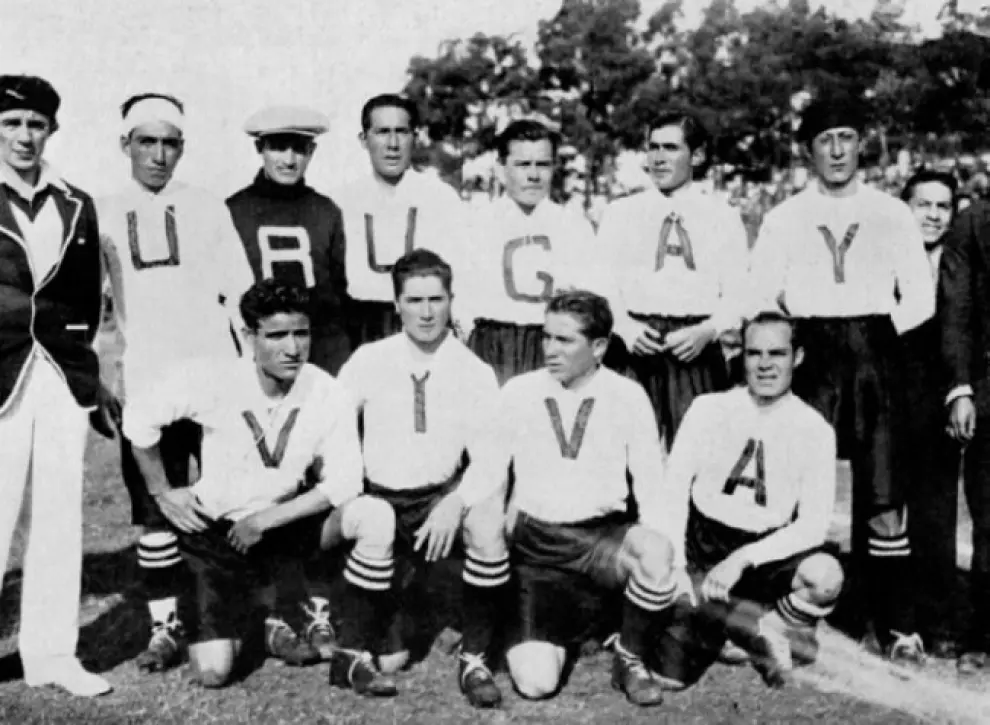
In the final, Argentina and Uruguay couldn't agree on which match ball to use. In the end, they played the first half with the Argentine ball and the second half with the Uruguayan one. Of the thirteen participating nations, only four came from Europe, primarily because the crossing by steamship took sixteen days, meaning players would be away from home for roughly two months.
For many footballers, that was simply impossible. Most had regular jobs alongside the sport. The Romanian team only made the trip after King Carol II personally guaranteed that the players would keep their jobs once they returned home. Argentine captain Nolo Ferreira even had to travel back to Buenos Aires during the tournament to sit an exam. His replacement promptly scored a hat-trick against Mexico.
Looking back, we see the borrowed shirts, the two match balls and the footballers with office jobs as charming teething problems of an institution whose eventual triumph we already know. But in 1930, nobody had that foresight. Nobody knew the event would one day draw millions of spectators, reach billions of viewers and grow into one of the biggest commercial spectacles in the world.

There wasn't even any prize money in 1930. That only arrived in 1982, more than half a century after Uruguay won the first tournament.
When I read this story – Byron Gilliam of Blockworks wrote about it on Friday – it made me think of bitcoin. It's sometimes judged as though, after seventeen years, we can already draw up the final balance sheet. Is bitcoin already being used as a means of payment on a large scale? Is the network simple enough for people who can't be bothered to understand seed phrases and private keys? Will transaction fees eventually be enough to pay miners once the block subsidy has largely disappeared?
In many cases, the honest answer is: not yet.
But how much weight should that answer carry? Aren't we simply looking at the borrowed shirts and the assorted match balls of a monetary network that's nowhere near fully developed?
The parallel with the first World Cup starts with the subsidy. Uruguay was so eager to host an international tournament that it offered to cover the travel and accommodation costs of the participating nations. Without that serious inducement, even fewer teams would probably have made it to Montevideo.
Bitcoin, too, had a built-in subsidy from the very first block. Miners were paid from transaction fees, but the revenue from those was relatively low. They also received newly minted bitcoins for the computational work that secured the network and bundled transactions into blocks. That reward attracted participants at a time when no mature market yet existed to fund their work on its own.
The setup is the same in both cases: you bankroll the infrastructure in the hope that it can eventually stand on its own two feet.
With the World Cup, we now know how that turned out. The travel allowance gave way to broadcasting rights, ticket sales, sponsorship and prize money. With bitcoin, the outcome is still undecided. The block subsidy shrinks every four years, and eventually a larger share of network security will have to be paid for from other sources. What that will look like is one of the fundamental questions about the network's future.
The shift from amateurs to professionals is familiar too. In the early years, bitcoin was mined on ordinary computers by people who were mainly fascinated by the idea that digital money could exist without a central issuer. Developers worked on it in their spare time, the first exchanges were primitive, and bitcoin was given away for free to nudge people into trying out the software.
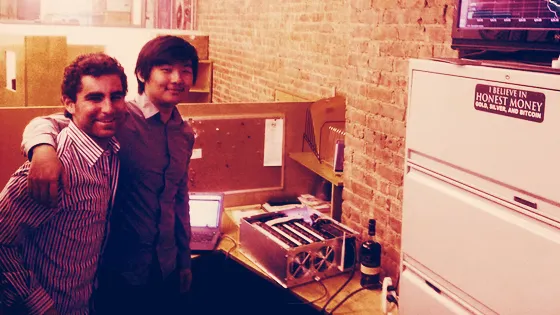
Today there's a professional industry of miners, trading platforms, custodians, asset managers, accountants, lawyers and listed companies, plus a whole host of people who've turned it into their full-time career.
Of course, the history of the World Cup doesn't prove that every experiment eventually reaches the masses. The world is full of projects that started small and stayed small. Time alone doesn't turn a bad idea into a good plan.
Despite all its limitations, the 1930 final drew 93,000 spectators. Uruguay won 4-2, after which Montevideo erupted into one giant street party and the following day was declared a national holiday. There was no prize money yet, but the significance of the World Cup was already plain to see.
Perhaps that's the more interesting yardstick for bitcoin too. Not just how many people use it every day right now, but how many people, businesses and governments already behave as though it's here to stay. That's the foundation on which mass adoption can be built – even if it takes more than 50 years.
More Alpha
Are you a Plus member? Then we're carrying on with the following topics:
- Base App project lead admits the failure of social crypto
- US asset manager launches actively managed multi-token ETF
- What America is really planning with crypto
Below that come the news snacks, a handy roundup of the news that genuinely mattered this past week.
1️⃣ Base App project lead admits the failure of social crypto
 Contribution by
 Erik
Jesse Pollak was the driving force behind Coinbase's Base App, which has been the successor to the Coinbase Wallet since July 2025. Base App runs on Base, the Layer 2 network on ethereum operated by Coinbase. Coinbase wanted to expand Base App from an ordinary wallet into a kind of all-in-one crypto app: trading, messaging, social and content creation. According to Pollak, that grand ambition never got off the ground, and now he's handing the project back to Coinbase.
Pollak will now focus on Base, the Layer 2. That hasn't failed. The usage stats show that the number of transactions is barely lower than a year ago. Normal behaviour for a bear market.
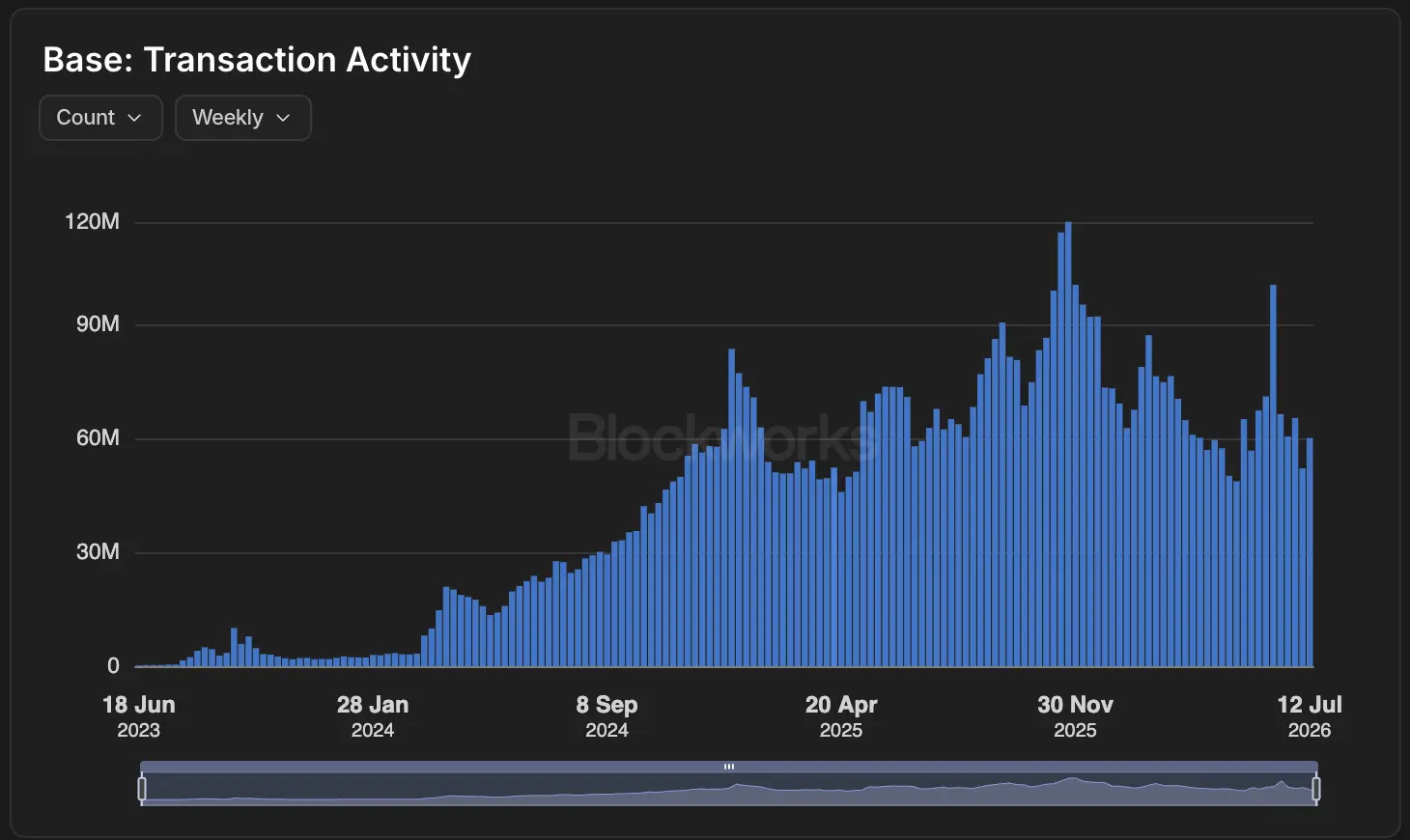
But Coinbase and Pollak had big dreams. For them, it's above all a disappointment that the social/content/messaging side never took off on the Base App.
Pollak puts it this way himself:
My strategy for Base in 2024 and 2025 rested on two assumptions. First, that a new wave of crypto adoption would come from real builders. And second, that new users would come in through onchain social experiences – creators, content, messaging. The assumption about builders came true, but social as a use case clearly didn't.”
Pollak envisioned a crypto economy in which creators could earn money on a social app from the content they produced. Through creator coins, for example: tokens tied to an individual creator.
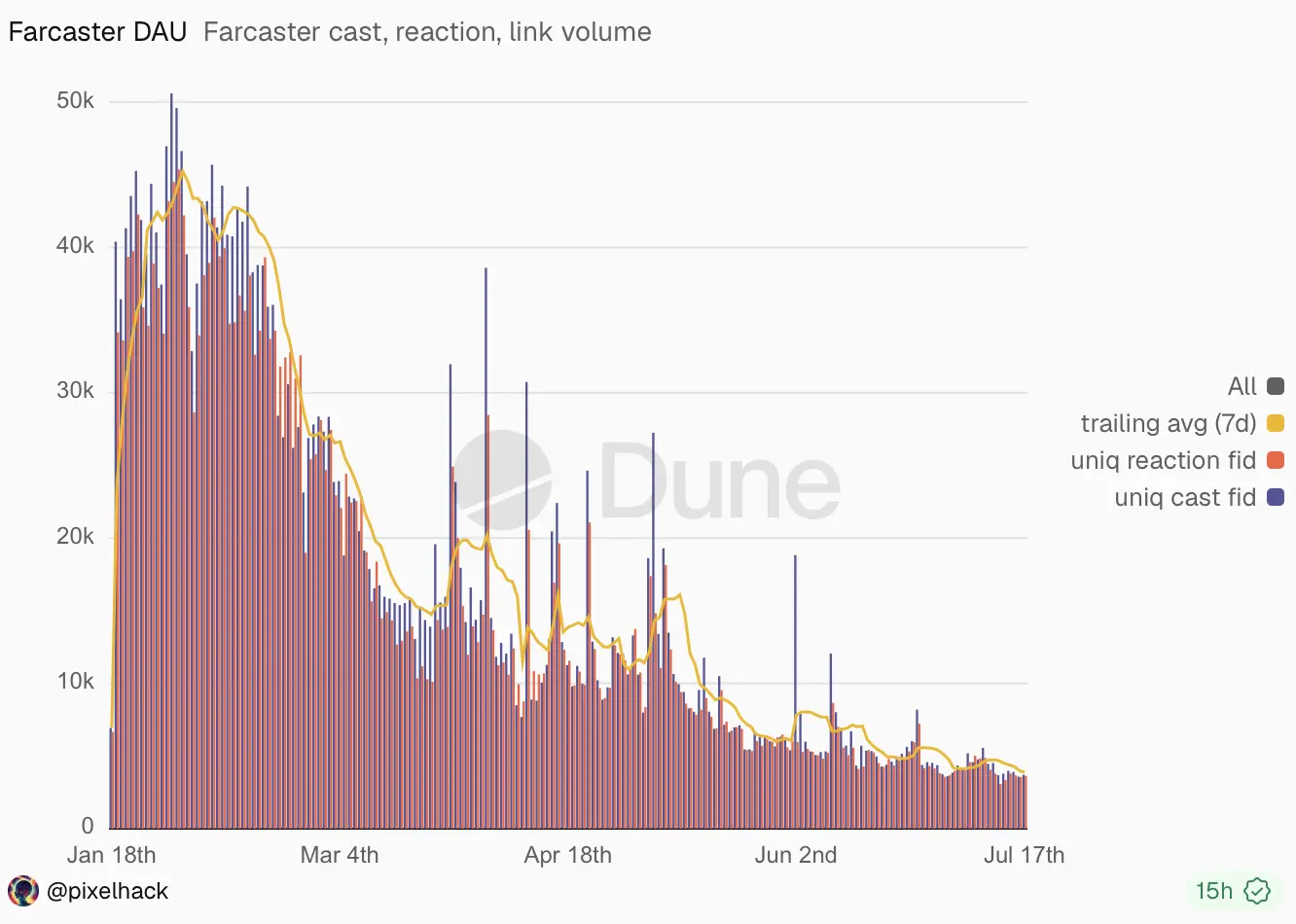
The Base App's social feed leaned on Farcaster, the best-known decentralised social media project from the ethereum world. It now has just a few thousand active users per day, a tenfold drop from six months ago. Farcaster was sold in January 2026.
Nostr hasn't broken through either
Nostr is to bitcoiners what Farcaster is to ethereum aficionados. On Farcaster, your identity is recorded in a smart contract on the Optimism Layer 2 network. With Nostr, there's no link between accounts and bitcoin itself; instead, users generate a Nostr account the same way you generate a bitcoin address: as a cryptographic key pair. Whoever controls the private key owns the account. Just as bitcoin has no central server, neither does Nostr.
For years it had an active community of mostly bitcoiners who used the protocol to post their content and zap each other small amounts of BTC via the Lightning Network. But user numbers are in the doldrums. Depending on the source you consult, you'll find anywhere from a few thousand to at most a few tens of thousands of users per day.
Social and crypto: a case of too little, too late?
The question is why decentralised social media networks haven't got off the ground so far. A protocol like Nostr or Farcaster has the advantage that decentralising the servers (relays) means there's no central authority that can delete your account.
On top of that, both Nostr and Farcaster are a protocol, not an app. A Nostr client relates to Nostr the way Gmail relates to the email protocol SMTP. If, as a user, you're no longer a fan of an app built on Nostr, you can leave – without losing your account and history: you simply move them to another app.
In practice, all those advantages proved insufficient to break through. For most people, ownership of their online identity simply isn't a priority right now.
More importantly: the network effect of the first social media giants like Facebook and X is virtually impossible to catch up with. Had Nostr and Farcaster been the first platforms? Then they might have had a decent shot at becoming dominant (although ease of use is of course far from ideal, compared to creating an account with your email).
Take the email protocol SMTP as an example. No company owns it, which means nobody can forbid you from sending emails. Fortunately, the email protocol existed before any company could build up a network effect. Nostr and Farcaster didn't have that lucky break.
2️⃣ US asset manager launches actively managed multi-token ETF
Contribution by Erik
Asset manager T. Rowe Price launched a new fund on 16 July on Arca, one of the exchanges that fall under the New York Stock Exchange (NYSE). It's a first: the first actively managed multi-token spot product on the US market. That's quite a mouthful, so let's break it down step by step.
So-called passive products already existed as ETFs. They simply follow whatever an existing crypto index prescribes. FTSE Russell's Crypto US Listed Index, for instance, which tracks the crypto market's top 10 based on total market value, excluding stablecoins.
Hashdex was the first with such a fund, released in February 2025. Grayscale got the green light for a similar basket later that year. The difference with this new product, as mentioned, lies in the management. Where the products named earlier follow the recipe of an index, T. Rowe Price's managers decide for themselves what the optimal positioning should be. That's called active management.
The goal: beating the benchmark
So the fund doesn't want to track the Russell index but to beat it, measured across a full market cycle. That ambition naturally comes with a price tag. The fund, which was given the ticker TKNZ, charges a temporary management fee of 0.75%. After May 2027, that fee rises to 0.90%. That's of course higher than the percentage of a passive fund.
The product fits the niche that T. Rowe Price wants to carve out as an active manager. While T. Rowe Price may not be a household name (with $1.89 trillion in assets under management, it sits around 15th among US asset managers), when it comes to actively invested capital they're not far behind BlackRock. So now they're applying this speciality to cryptocurrencies as well.
A slight tilt towards altcoins for now
In the prospectus, the fund managers state that they keep the allocation to BTC between 30 and 80 percent, and that other tokens can be assigned between 2 and 20 percent. At the moment the fund is underweight BTC (41 percent, whereas bitcoin currently represents 59 percent of the value of the total crypto market). Notably, Hyperliquid gets a 6 percent weighting in the fund.
The ‘institutional wave’
The news is yet another data point in a trend that's plainly underway: the assimilation of crypto products into traditional financial products. A key step in that was the first spot bitcoin ETF in 2024. So just over two years later comes an actively managed fund.
The relatively long gap between the first spot fund and this first actively managed fund is down to the uncertainties that hung over the classification of altcoins for so long. Only once those fell away did building this kind of fund become an option – a process that takes longer than setting up a simple passive fund.
Either way, traditional asset managers now get to find out what crypto traders have been discovering for years: how hard it is not to fall prey to FOMO and chasing the pump… while also not marrying your bags. Good luck, blue suits!
3️⃣ What America is really planning with crypto
Contribution by Peter
Scott Bessent used the gala dinner marking 250 years of the United States to deliver a strikingly candid message. The Treasury Secretary not only explained how America views the world economy, but also how it intends to hold on to its power within it. Stablecoins, tokenization and new payment systems, it turns out, have all been given a place in that strategy.
Bessent calls that strategy economic statecraft: the deployment of economic power in the service of American sovereignty. The postwar order, of which America was the chief architect and guardian, has in his view brought a great deal of prosperity. But the assumptions underpinning that system have gradually turned into vulnerabilities. International interdependence didn't automatically lead to shared interests, supply chains proved less reliable during crises than assumed, and cheap imports didn't fully compensate for the loss of domestic production capacity.
That's why the emphasis is shifting from efficiency to resilience. It means America wants to keep strategic industries under its own control, demands reciprocity from trading partners, and explicitly deploys the dollar and its financial markets as instruments of geopolitical power. The country is rewriting the rules, giving rise to a new economic order.
On this point Bessent is remarkably concrete. In the last century, world trade ran mainly through ports and across oceans, he says; in this century it increasingly runs through platforms, systems and protocols. Whoever sets the technical and legal standards for those therefore also acquires geopolitical influence. He then explicitly names digital assets, stablecoins, tokenization and new payment systems.
He does so not with cypherpunk-style values in mind. No, Bessent sees that these technologies are net positive for the dollar's hegemony, and that all innovation with that effect should be supported. With the necessary transparency, consumer protection and access for law enforcement, of course.
That makes clear what Washington sees in crypto. Not first and foremost an industry that happens to generate jobs and tax revenue, but a new distribution channel for financial power. Dollar stablecoins make the currency available worldwide and instantly, and the reserves behind them create demand for US Treasuries. The White House already stated bluntly that the spread of dollar stablecoins should reinforce the dollar's dominance in the digital age.
That's good news for parties like Circle, BlackRock and the financial institutions throwing themselves into tokenization. It's not automatically good news for every crypto coin, for privacy applications, or even for the original ideal of uncensorable money. The US government embraces open infrastructure only insofar as it remains usable within American rules and interests.
That also gives the Clarity Act a different meaning. The law is meant to provide the US market for digital assets with clear rules of the game, and has by now passed both the House of Representatives and the Senate's Banking Committee. From Bessent's perspective, such regulation isn't a favour to the crypto industry, but the construction of strategic infrastructure.
So Washington isn't embracing crypto to strengthen citizens' autonomy. Nor to put an end to the surveillance state that's meanwhile been built up behind money. Or to reinvent the existing financial system. Above all, it wants to use the technology to extend America's position within it.
For bitcoiners, that can have an unintended positive effect. The recognition of public networks boosts their legitimacy and their connection to the financial system. That doesn't automatically make bitcoin the winner, but as a scarce, neutral and stateless asset it stands out ever more sharply against programmable dollars. The more often states wield money as an instrument of power, the clearer the value of an asset that lies outside that power struggle.
🍟 Snacks
To wrap things up, a few quick snacks:
- Visa sees credit cards and stablecoins as the payment layer for AI agents. Cards remain suitable for larger purchases made on people's behalf, such as a flight or a subscription. Stablecoins are meant to handle the small, frequent payments between machines. According to Visa, the x402 payment protocol has already processed 109.6 million transactions, worth 15 million dollars. That activity took place mainly on Base, Solana and Polygon. According to Visa, the bottleneck for further growth isn't the payment itself, but the safety net around it: identity, authorisation, fraud prevention and liability when things go wrong.
- Dutch and Belgian officers have arrested six suspects from an international investment fraud network. The organisation operated like a company, with around twenty call centres and more than 700 staff, who posed as financial advisers. Worldwide, more than 100 million euros a month is thought to have been stolen. In the Netherlands, 550 reports have been linked to the network, together accounting for nearly 25 million euros in damages. Victims saw fictitious profits on professional-looking fake platforms and were thus lured into transferring ever more money. Consider yourself warned, and don't get played.
- ORANGE JUICE wants to buy bitcoin with company profits rather than with raised capital. The holding company founded by Lyn Alden and other partners at Ego Death Capital raised 40 million dollars to acquire profitable US businesses. A portion of the retained earnings then flows into new acquisitions or bitcoin. The businesses are held permanently and retain their own identity. That makes the model look more like Berkshire Hathaway than a classic private equity fund or a pure bitcoin treasury.
- Wall Street's central securities depository has executed real transactions with onchain shares and government bonds for the first time. DTCC, which holds 114 trillion dollars in securities in custody, tokenized assets including shares in Microsoft, Circle, the S&P 500 and US government bonds. Around forty financial and tech firms took part in the trial. In October, DTCC will open the service that lets connected institutions move securities between their traditional account and a blockchain wallet themselves. That's a considerable upgrade over traditional financial infrastructure, but not yet a freely accessible stock market.
- The Ethereum Foundation is spinning off institutional privacy into a commercial company. EthSystems was founded by three former researchers who worked within the foundation alongside banks, central banks and regulators. Their reasoning: public blockchains are transparent, but financial institutions can't simply disclose their positions and counterparties. So the company is building confidential transactions for payments and tokenized assets. After Ethlabs and Ethereum Institutional, this is the third recent spin-off within the ethereum ecosystem.
- Tether has two years to keep USDT's access to US exchanges. The Genius Act requires US trading platforms to part ways with stablecoins that don't meet the new requirements by July 2028 at the latest. Market leader Tether hasn't yet explained how USDT will comply; rival Circle is already positioning USDC firmly within the US system. Tether does have an alternative: USAT. For now, though, that coin remains tiny next to the globally dominant USDT. It's not out of the question that Tether is deliberately leaving the US and European stablecoin markets to other players.
- The digital euro enters the final European negotiation phase. The European Parliament is set to sit down with the member states to hammer out the precise shape of the digital central bank money. At the same time, the ECB has chosen 36 banks and payment firms, including Adyen, Revolut, Stripe and SumUp, for a twelve-month practical trial starting in the second half of 2027. The digital euro is meant to work both online and offline, be offered through banks, and make Europe less dependent on the American payment giants. A possible introduction is pencilled in for 2029.
Thank you for reading!
To stay informed about the latest market developments and insights, follow our team members on X:
- Bart Mol (@Bart_Mol)
- Peter Slagter (@pesla)
- Bert Slagter (@bslagter)
- Mike Lelieveld (@mlelieveld)
We appreciate your continued support and look forward to bringing you more comprehensive analysis in our next edition.
Until then!