
Why Are We Still in Bitcoin?
Why keep investing in Bitcoin after five years of stagnation? We break down the risk-reward ratio and draw lessons from gold's historic consolidation.

 Contribution by
 Erik
The most recent episode of Satoshi Radio kicked off with a question from listener Thomas:
“I remember Bert saying during the previous bull run that Bitcoin really should have ended up many times higher to keep the risk-reward ratio attractive. Is holding BTC instead of, say, the S&P 500 still defensible?”
Check out Bart and Peter's off-the-cuff musings here:
Since we're now nearly five years past the 2021 peak and, on balance, haven't budged, it's a fair thing to ponder. Was all that neurotic portfolio-app checking really worth it, given the miserable price action?
First off: if you let go of that painful window of almost exactly five years, you'll see that bitcoin is still in an upward trend, with higher highs and higher lows. The gap between successive peaks is of course getting less spectacular. The last peak was less than double the previous one, and indeed disappointing. But the gap between successive lows is still pretty impressive. Around 4k in 2018, 15k in 2022 and now… somewhere around 50k, perhaps? Buying near the bottom still pays off just fine.
Money under your mattress
It's also worth zooming out on the price chart, so far that you can't even see the price anymore. Always a comfort when the price disappoints: back to fundamentals. Why do we believe in bitcoin?
From first principles, holding bitcoin in your portfolio is defensible because of the monetary properties it has. It remains a brilliantly designed protocol for people with an interest in tech and an independent spirit. Regardless of any appreciation in value, you might simply enjoy having money entirely under your own control. Especially if you have doubts about the banking system, where you don't own your money the same way you own BTC in cold storage. BTC can serve as your ‘banknotes under the mattress'. Nobody who kept cash under their mattress did it for the returns. It was for the protection it offered against confiscation or bank runs.
Keeping banknotes under your mattress may feel safe, but it also brings all sorts of risks, from theft to damage. The same goes for storing your own bitcoins. This week a real shiver went through the bitcoin world when it turned out that COLDCARD wallets were less secure than thought. More on that after the break.
Risk-reward under the microscope
But let's be honest: most investors also want an acceptable return. And that raises the question of whether the numbers from recent years still justify the exhausting volatility. A common way to determine whether the price gain is worth the risk of price loss is the Sortino ratio. It's a cousin of the well-known Sharpe ratio and factors in only downside volatility.
Fidelity calculated this metric for the ten-year period from 2016 through 2025, and came up with 2.24 for bitcoin, 1.23 for US stocks and 1.77 for gold.
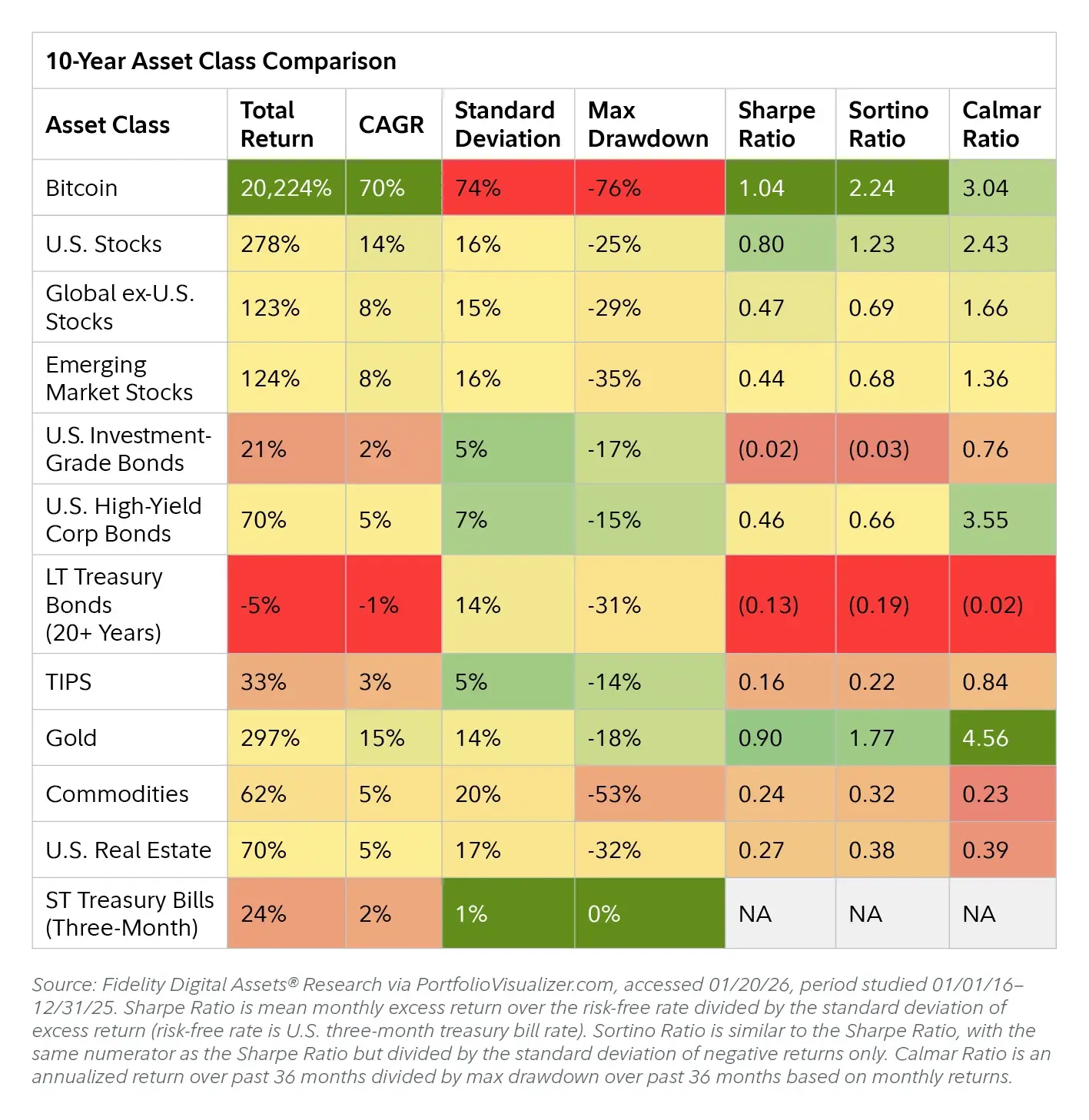
A higher value is favourable here, and anything above 1 is fine. So bitcoin actually does much better than US stocks or gold. But note this. This period captures the mega bull run of 2016 and 2017 (a factor of 50) and is therefore not representative of bitcoin's upside potential these days.
So it would be nice to have more recent data for more recent periods. I couldn't find any for the comparison I want to make. Perhaps because it paints a less rosy picture for bitcoin? If you were to calculate the Sortino ratio for 2021-2025 or 2022-2026, the S&P would probably outperform BTC. And that gives you something to think about.
A lesson from the Gold Bugs
In times of uncertainty, it's good to seek advice from an older brother: gold. Bitcoiners have spent years teasing their older, analogue brother a bit. If gold was a store of value, why did the precious metal do nothing for a decade — and that in times of heavy currency debasement? Gold's price first touched 1,700 dollars per troy ounce in 2011. It then took until 2024 before that price level was finally a thing of the past.
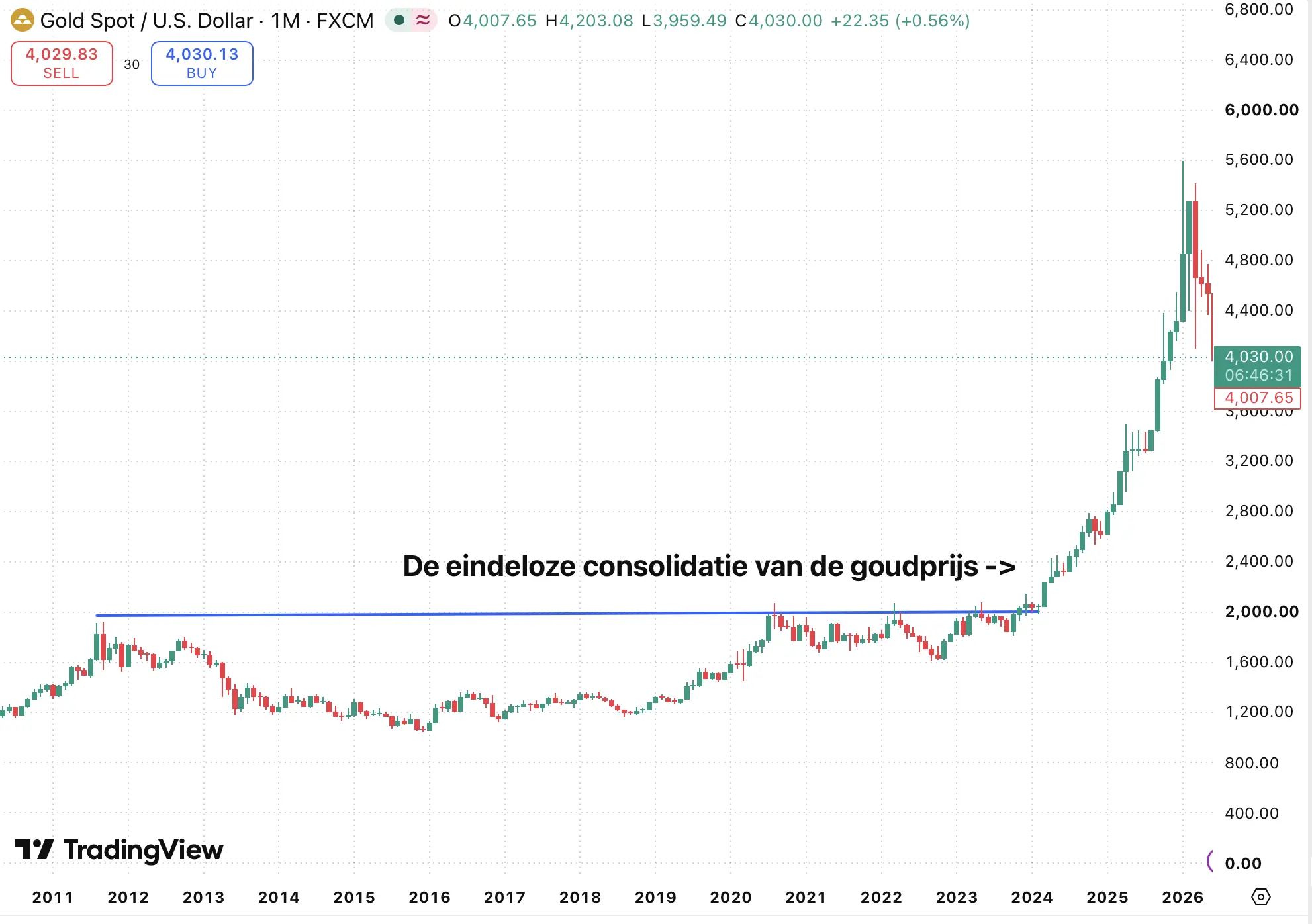
And how. In a short space of time the price exploded above 5,000 dollars. Nearly a tripling of the price… and that for an asset with well over twenty trillion in total market value.
That gives bitcoiners hope: sometimes you apparently just have to be patient. If you believe in the fundamental potential of an asset, it might be worth not bailing out when sentiment sours.
Gold and AI stocks have siphoned off a lot of attention and capital from crypto. But that tide can turn again.
More Alpha
Are you a Plus member? Then we'll continue with the following topics:
- Door still ajar for the Clarity Act
- COLDCARD hack forces an honest conversation about self-custody
- Crypto networks are growing, but earning less
Below that come the news snacks, a handy overview of the news that really mattered this past week.
1️⃣ Door still ajar for the Clarity Act
Contribution by Erik
The US crypto law that's finally meant to sort out market structure probably won't reach the sixty votes needed in the Senate before the summer recess. But the door is still ajar. On top of that, a first vote this week — even if it fails — could give the bill momentum for the follow-up process in September.
Last week we reported that the White House had presented an ethics package meant to remove the final roadblock. The Democrats swept that package off the table: it was said to be constructed so that Trump would barely have to give anything up, and enforcement rests with a department run by his own clique.
Republican Thom Tillis and Democrat Ruben Gallego built a bridge, and according to insiders their compromise text is now ready. The details aren't out yet, but the text needs to win over both the White House and a sizeable group of Democrats.
The problem is that majority leader Thune has a busy agenda to manage. He's set aside the remaining session weeks for appointments and a sanctions bill against Russia. Still, he kept the door ajar on Tuesday: there will likely be a vote on the bill. He added that whether it passes is up to the Democrats. That does sound like a mild threat. Democrats who would vote against it then have it in black and white that they oppose crypto regulation, which won't win them any friends in the powerful crypto industry.
On the other hand, a yes vote isn't easy for Democrats to sell either, because it could expose them to fierce criticism from their own ranks (and their opponents): ‘You voted along with the Trump camp?!' And that's how you see the midterm elections already casting their shadow ahead and complicating legislation.
Plenty of support, not enough votes
There's no shortage of backing in the meantime. The financial establishment (BlackRock, Fidelity, Goldman Sachs, and so on) is behind the bill. Even the chair of the American Bankers Association sees “a lot of good” in the text (though the bankers keep lobbying: in a letter to the Senate leadership they demand guarantees that stablecoin issuers won't circumvent the interest ban with rewards programmes).
SEC chair Paul Atkins let it be known that his regulator would, if necessary, draw up rules itself, though he acknowledged that a law is ultimately needed. Because whatever Atkins sets up, a future administration could just as easily brush aside.
JUST IN: 🇺🇸 SEC Chair Paul Atkins says he's confident Congress will advance the Clarity Act and President Trump will sign it into law ✍️ pic.twitter.com/urTwOR5CK9
— Bitcoin Magazine (@BitcoinMagazine) May 29, 2026
It all comes down to the final week now. Polymarket puts the odds of a signing this year at 27 percent, the lowest level so far. But under pressure things turn fluid, as often proves true in these final days. According to Coinbase boss Brian Armstrong, we're just one yard from the finish line. He keeps radiating optimism, while with others the frustration is starting to seep through. Republican senator Cynthia Lummis:
The Clarity Act is good for the country, good for consumers and good for the people we represent on both sides of the political spectrum.
After nearly eleven months in which we've given up virtually everything that was asked, I honestly don't know what more my Democratic colleagues want before we can move ahead with this.
2️⃣ COLDCARD hack forces an honest conversation about self-custody
 Contribution by
 Peter
First things first:
The attack on vulnerable COLDCARD wallets is still ongoing. If you haven't yet replaced a potentially affected seed, act immediately. A firmware update alone is not enough. Know someone with a COLDCARD? Let them know.
Since Thursday, more than 1,300 BTC has been stolen, according to Galaxy Research's latest count. The attackers managed to drain over 4,500 addresses, spread across four (and counting...) recognisable waves of hacking. The largest took place overnight from Wednesday into Thursday: within 41 minutes, more than 1,000 BTC vanished from nearly 1,200 wallets. Addresses holding smaller amounts are now being targeted too. As a result, the eventual losses will likely keep climbing over the coming weeks.
To be abundantly clear,
— Dylan LeClair (@DylanLeClair) August 1, 2026
The coldcard exploit is ongoing.
PLEASE rack your brain and contact everyone you know who may self custody, directly. Even if you haven’t spoken in years. A DM is not enough. Call them. Most people are not on X and have no idea.
Every second counts. https://t.co/I7PXFudeF3
The cause lies in the way COLDCARD wallets generated their seeds. Because of a flaw in the firmware, far less randomness was used for this than intended. A seed that looked perfectly fine to people therefore actually came from a relatively small pool of possible seeds. Attackers can search through that pool and inspect the addresses they find for ‘profitability' via a bitcoin explorer. They never need to get their hands on the hardware wallet to do so.
Coinkite has now released improved firmware for all affected models. From now on, secure seeds can be generated with it again. But the update doesn't make an existing seed any stronger. Importing such a seed onto another device doesn't help either: the weakness lies in the seed itself.
Do you use a COLDCARD Mk2, Mk3, Mk4, Mk5 or Q, and was the seed created by the device before the improved firmware? Then move your bitcoin to a safe place NOW. Do the same if you can no longer say for certain when and with what the seed was created. Coinkite names a few exceptions, such as seeds to which at least fifty genuinely random so-called dice rolls have been added. When in doubt: migrate.
 Coinkite Inc.
This event changes nothing about our confidence in bitcoin. From the network's perspective, nothing broke; it's working exactly as designed. This is a serious flaw in one manufacturer's product line.
Still, this hack draws a jet-black, thick line under something we already knew: self-custody carries risks too. The bitter part is that many victims did exactly what they'd been advised to do for years. Save up, pull their sats off an exchange and store them on a reputable hardware wallet. The accompanying sense of independence and security has taken a serious knock.
That said, it doesn't mean self-custody suddenly no longer matters. But it is important to look at it soberly. Self-custody removes counterparty risk, but in return it demands knowledge, maintenance and trust in hardware and software. Extra security layers can help, but they also bring new challenges and a larger surface for human error. In short, there's no universally safe setup, and anyone who takes up self-custody must be aware that they carry an ongoing responsibility.
Decentralised storage does have one important advantage: attackers have to find and drain wallets individually. That gave thousands of holders time to secure their funds. It worked within our community too. One member turned out to be using a vulnerable Mk3 while on holiday. Together with Bart he drew up an emergency plan and managed to move his entire pension pot in time.
Seeing a lot of people saying “self custody is over” thanks to the Coldcard hack.
— Nick Neuman (@Nneuman) August 1, 2026
Couldn’t disagree more. ~1,100 BTC has been stolen so far (est). And ~11,000 BTC went to exchanges yesterday. Potentially 10x more BTC was saved thanks to the fact that it was held in self…
Got questions, or unsure about your own situation? Then reach out on Discord. We'd also love to hear whether you'd like a more formal role for Bitcoin Alpha: an independent point of contact that acts as a kind of self-custody sherpa, helping you assess and implement a suitable setup.
3️⃣ Crypto networks are growing, but earning less
Contribution by Peter
Bitwise has released a new sector report taking a close look at the staking market. The company boils it down to one word: divergence. Even as prices fell, activity on crypto networks rose. Not only did the number of processed transactions increase, the amount of assets in staking also grew to new records. And yet… fee income declined. According to Bitwise, that was largely the intended result of network upgrades, which led to, among other things, faster processing times and cheaper blockspace.
We read the report and lined up the five key takeaways.
1. Staking yield is mostly compensation for dilution
Of ethereum's staking yield of 2.84%, 93% came from newly issued ETH. With solana, well over 90% of the yield was funded by inflation. The popular comparison with interest therefore falls flat: staking usually produces barely any economic cashflow. Above all, it protects holders from the dilution that non-stakers undergo.
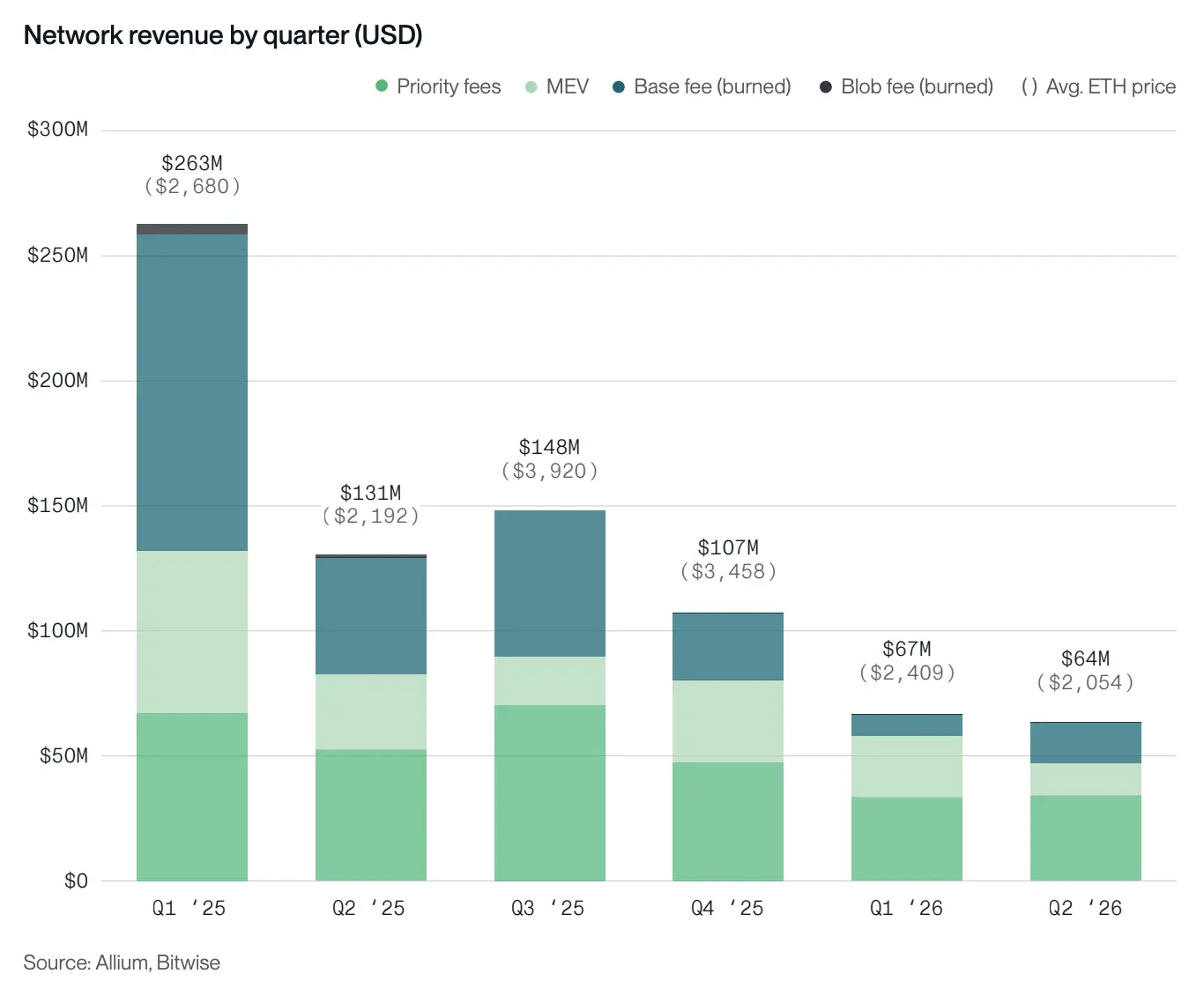
2. More usage means less income for now
Ethereum processed 68% more transactions than a year earlier, while fee income halved. Solana also kept its transaction volume up, but saw income fall by 81%. The networks expanded their capacity faster than demand grew. That's nice for users, but it also shows that technical success doesn't automatically translate into more value for the underlying token.
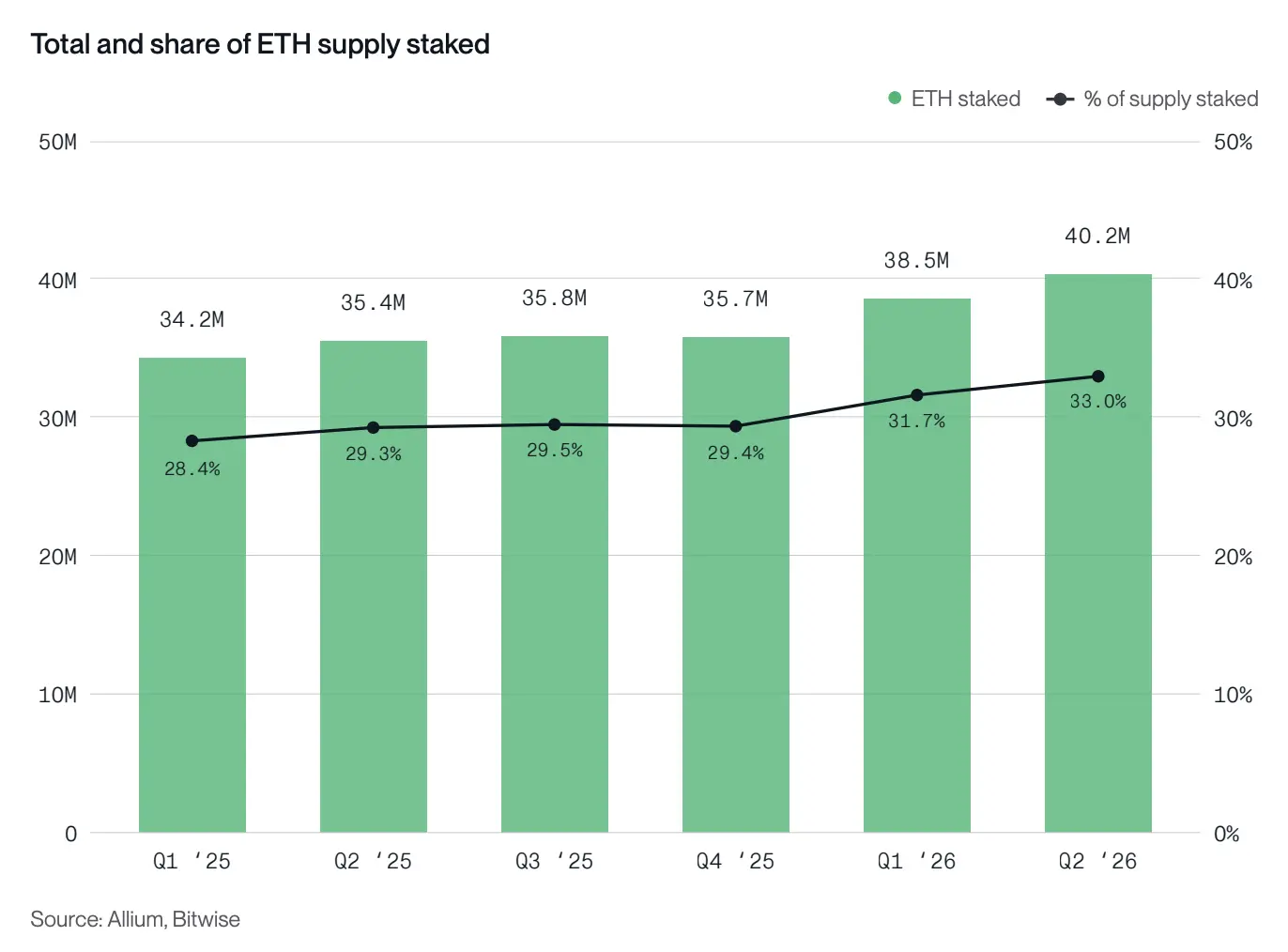
3. Financial institutions are becoming the ‘marginal' staker
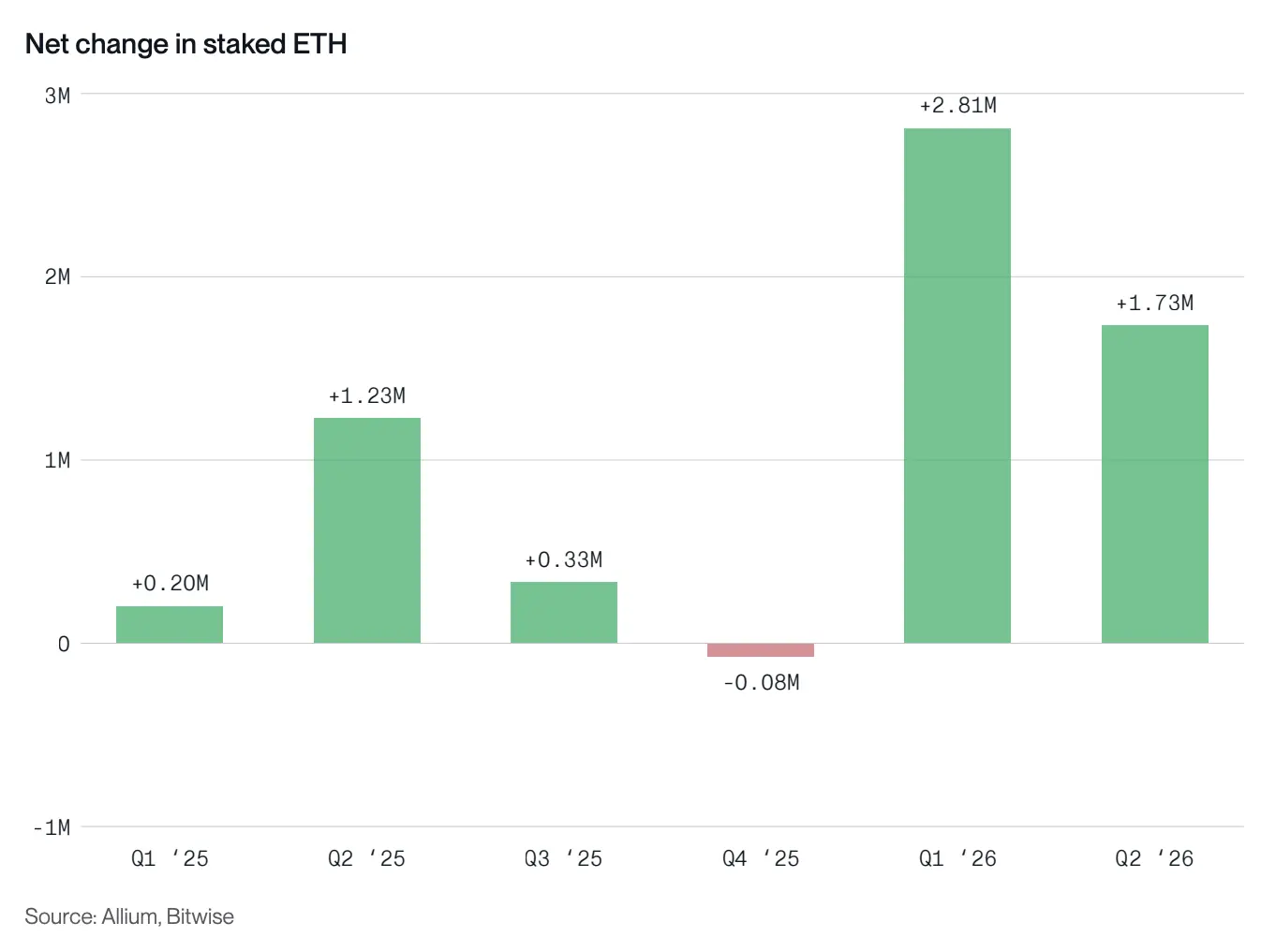
Ethereum added a net 4.54 million staked ETH in the first half of 2026. Bitwise attributes that growth mainly to ETFs and treasury companies. To illustrate: Bitmine alone has already bought nearly 1.5 million ETH so far in 2026. On hyperliquid, Coinbase and Circle each staked 500,000 HYPE.
4. Solana scales, but also centralises
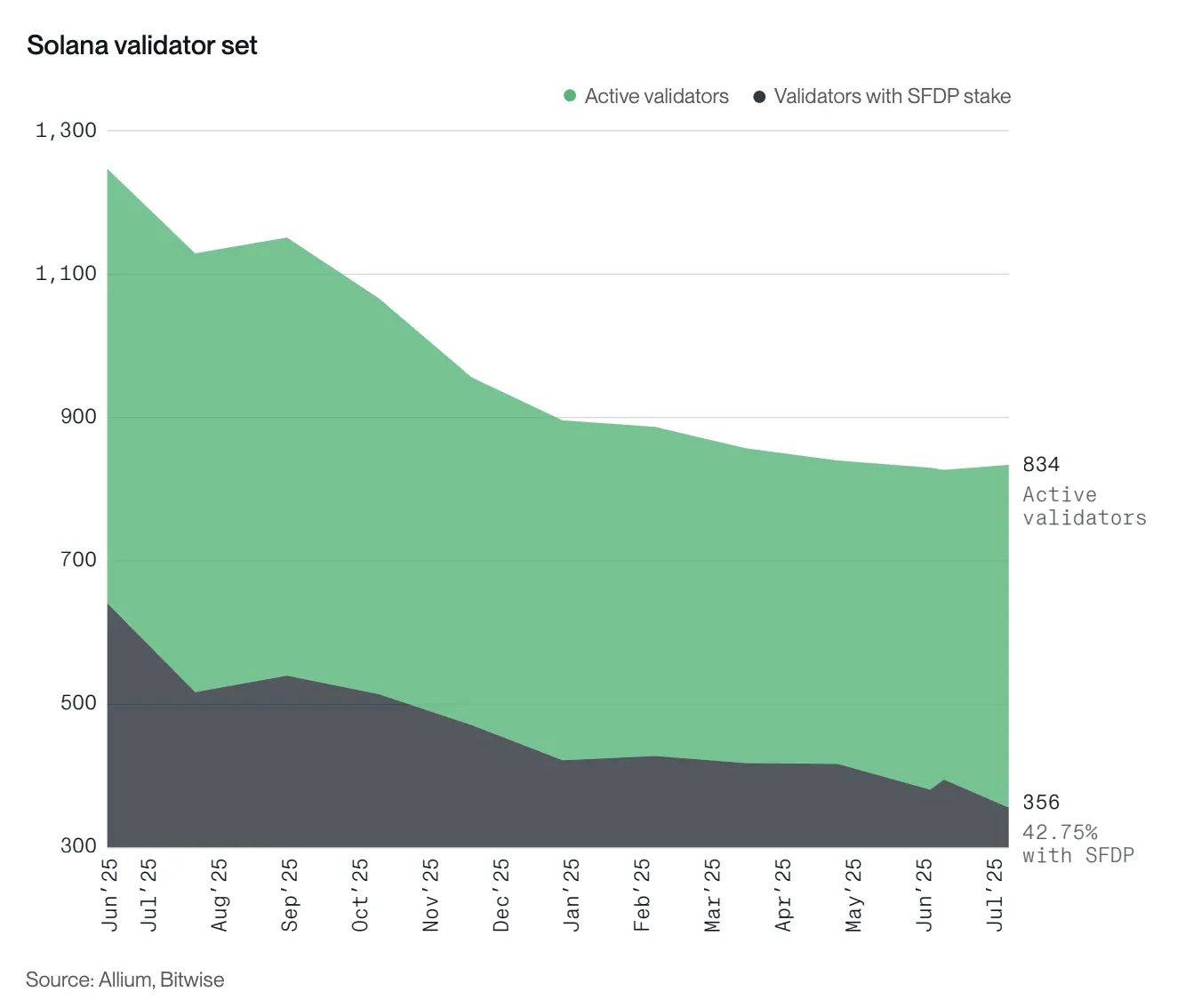
The number of active Solana validators fell by 34% in a year, to 834. Two providers, Jito BAM and Harmonic, together account for 56% of all staked SOL. The infrastructure is getting faster and more professional, but small operators are disappearing and a majority of transactions is now processed through two privately managed systems.
5. The strongest growth is in specialised financial products
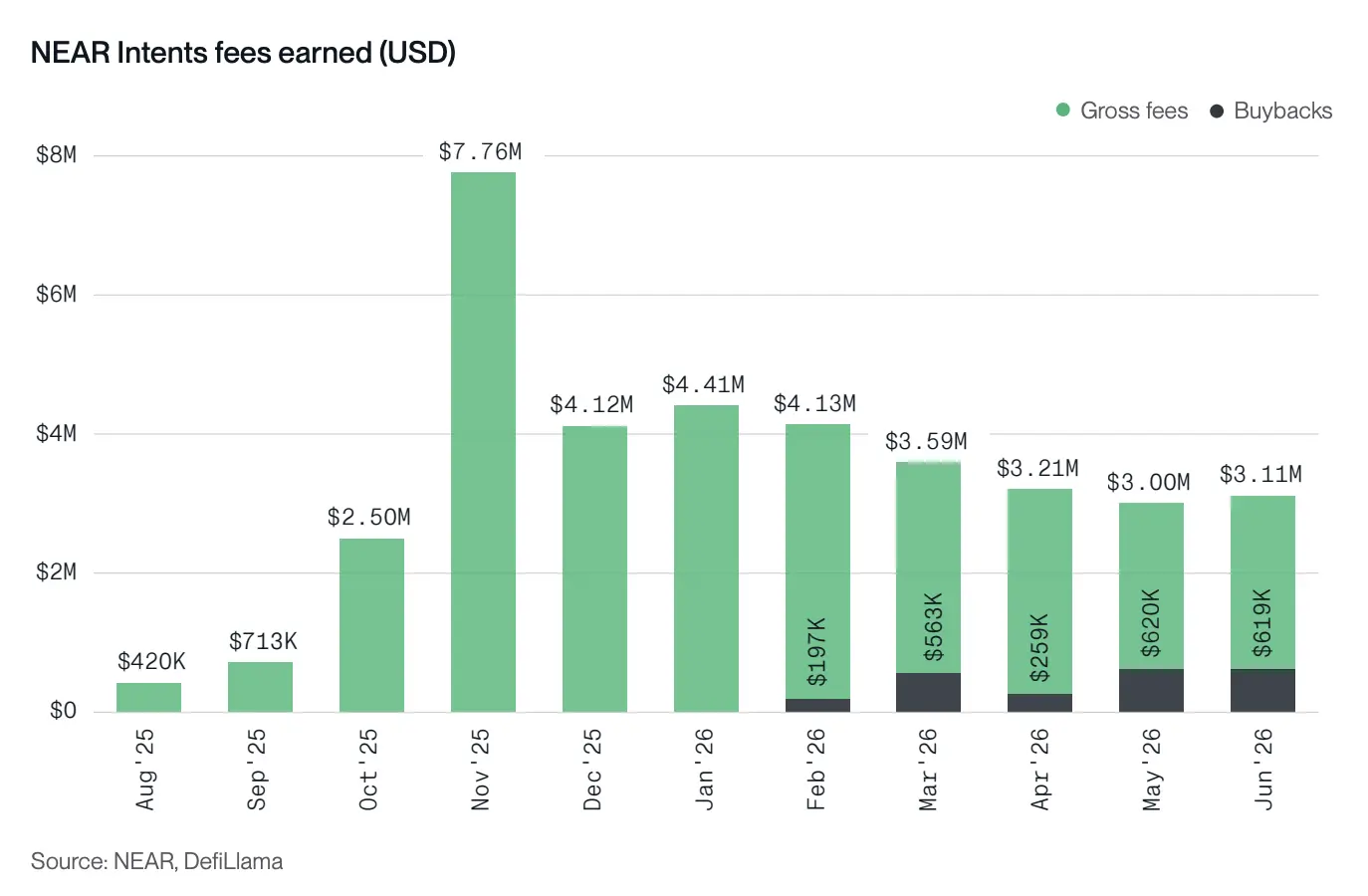
For this, let's take a quick look at NEAR Intents. It's an application where users specify what outcome they want to achieve, such as swapping or moving a cryptocurrency. Specialised parties, known as solvers, then compete to carry out that order at the best price.
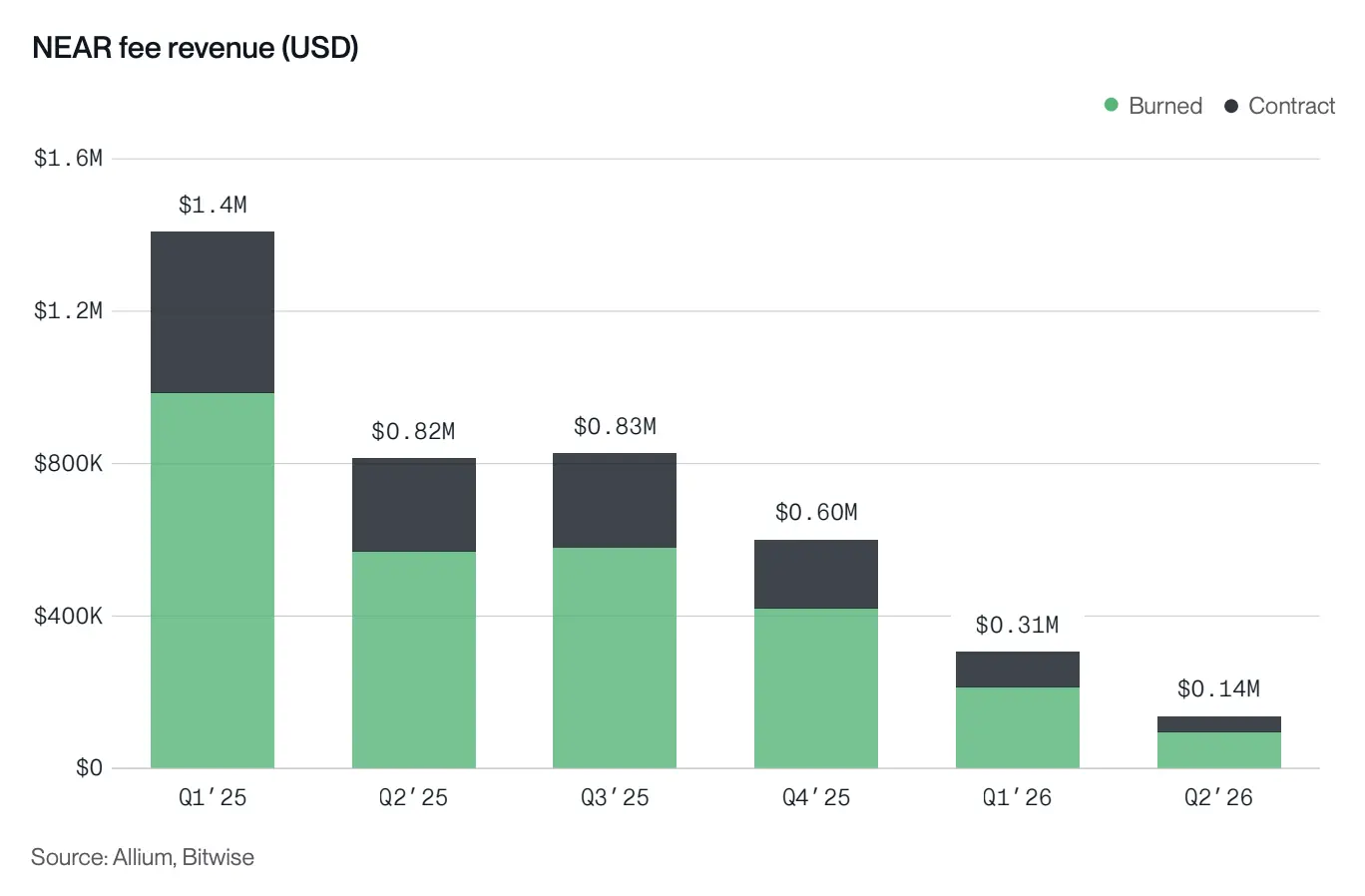
Intents' revenue was 68 times higher than what was earned in fees on the NEAR base layer. This pattern can be seen on more and more networks: the income from usage flows back to the application rather than the underlying network. Therein lies a challenge, because the network also benefits from generating a cashflow.
🍟 Snacks
To wrap up, a few quick snacks:
- The fallout from the bear market is becoming visible. Over the past month, the number of bankruptcies increased. Rounds of layoffs are also a consequence of the shrunken market. Movement Labs, Storj and mining pool Poolin recently filed for bankruptcy. Several exchanges voluntarily closed their doors. And companies like Bybit, Gemini and Coinbase reduced their headcount this year. For the market, this can have a cleansing effect: the sector is working its way back to the foundation on which a new bull market can emerge.
- Strategy is once again using newly issued shares to shore up its financial buffer. Newly raised capital is first and foremost used to cover existing dividend obligations. Last week the company raised $500 million; its dollar reserve grew to $3.7 billion. That's enough for about two years of obligations. In addition, Strategy for the first time bought back its own Stretch shares. The price of STRC now sits around $90. With an mNAV around 1, a new bitcoin purchase is unlikely for the time being.
- New Bitcoin Security Consortium boosts the further development of bitcoin. Major players like BlackRock, Fidelity, Galaxy and Block are first funding developers focused on protection against quantum computers. In total, $15 million in capital has now been pledged. One small blemish on the initiative: participants largely decide individually what they fund. The diversity within the consortium reduces the risk of a single dominant direction, but the fundamental question remains what the ‘further development' of bitcoin actually means to these parties.
- Morgan Stanley launches competing ETH and SOL ETFs. The funds put the purchased coins into staking, pass all the proceeds on to investors and charge just 0.14 percent in fees. That makes the funds cheaper, and often simpler, than comparable investments at crypto service providers. For crypto as an asset class, that's good news: existing capital rotates to a new destination and the funds may attract fresh capital. But for trading platforms the shift is painful: departing volume puts pressure on their revenue.
- Ether ETFs attract more money than bitcoin ETFs for the second week in a row. In the week to 24 July, $103.8 million flowed into spot ether funds, compared with $33.9 million into bitcoin funds. The difference was mainly down to BlackRock: ETHA took in $96 million, while IBIT lost $95 million. The flows had, incidentally, little effect on the prices of bitcoin and ether. After months in which bitcoin dominated institutional attention, the ETF dollar is now, for a moment, choosing ether.
- The number of active venture investors in crypto has fallen to its lowest level since November 2020. According to CryptoRank, 150 unique venture parties took part in funding rounds in July, compared with 1,177 at the peak in May 2022. On a quarterly basis the decline is steep too: in the second quarter, 651 parties participated, roughly 75 percent fewer than in the same period of 2022. The drop points to a smaller and more selective funding market, in which mainly larger funds remain active. Their money flows above all to infrastructure projects and tokenised assets.
Thank you for reading!
To stay informed about the latest market developments and insights, follow our team members on X:
- Bart Mol (@Bart_Mol)
- Peter Slagter (@pesla)
- Bert Slagter (@bslagter)
- Mike Lelieveld (@mlelieveld)
We appreciate your continued support and look forward to bringing you more comprehensive analysis in our next edition.
Until then!