
‘This Is Never Going to Get Better’
Bitcoin slides below $62,000 and the mood turns to despair. From Binance conspiracies to Democrat fears and AI meltdowns, everyone has a theory. What's really behind the sell-off, and how do you keep a cool head when the timeline screams doom?

 Contributed by
Peter
The mood on social media this weekend was decidedly gloomy. Timelines overflowed with disbelief, anger and despair. The reason? Bitcoin took a beating on Saturday. It was a seemingly relentless slide to just below $62,000, enough to shake the conviction of even seasoned investors.
What the hell is going on? Just completely brutal. Zero mercy. pic.twitter.com/t2OJqA0vs3
— Autism Capital 🧩 (@AutismCapital) November 14, 2026
Every price move comes with a story. Investors watch their wealth shrink without knowing why. That uncertainty is uncomfortable, so the hunt for explanations begins. The drop gets a cause, a main character and, ideally, a resolution. That offers something to hold on to: if you understand what's happening, maybe you can also figure out what to do.
This weekend, the explanations were all over the place. Investors were supposedly positioning for the political shift in the US that hands the Democrats more power. Others went looking for a big seller. Binance in particular took the heat: the exchange was allegedly manipulating the price and using the proceeds from forced liquidations to plug the hole left by the hack. The announced removal of Strategy from the MSCI indices also came up as an explanation for the selling pressure.
Binance crashed Bitcoin Friday night 10/10/25.
— Fred Krueger (@dotkrueger) November 15, 2026
Binance is again responsible Sat 11/14/26.
wait until market closes
crash the perps.
Fingers were also pointed at the Anthropic IPO. Investors were said to be selling existing positions to free up dollars, just as happened around the SpaceX IPO. And the recent slump in AI stocks produced a related explanation: investors who built positions with borrowed money would need extra funds to protect them, and would turn to markets that are always liquid. On top of that came worries about sticky inflation, rising policy rates and a stronger dollar.
All the reasons Bitcoin is tanking
— James Van Straten (@btcjvs) November 14, 2026
US10Y above 5%
DXY above 103
25bps rate hike December
MSTR kicked out of MSCI
Anthropic IPO next week
Oil remains elevated
AI meltdown
Jensen resigned
Gold making new lows
Binance hack
Democrat sweep
Four year cycle theory
US choking off…
The sentiment boiled down to an almost depressive ‘this is never going to get better’. The danger in that is different from what you might expect.
The biggest risk is getting swept up in the emotion of the moment. Once you start staring at the chart, the drop can take up a disproportionate amount of headspace. Every new leg down demands your attention. You speed-read through other people's panic and hunt for news that might explain the fall. Before you know it, you're worrying, just like everyone else, about the ominous end of bitcoin that the doomsayers proclaim at the bottom.
Your investment strategy is your most important weapon against this dynamic. It takes just a few minutes to check whether your own plan calls for any action. More often than not, it turns out you don't need to do anything. In that case, the advice is simple: phone off, laptop shut, and go get some fresh air. Does your strategy call for an adjustment? Execute it, then do the same. Trust the decisions you made when things were calm.
Anyone who dives into the doom-laden narratives anyway will quickly discover that none of them single-handedly explains the price drop. The Democrats have no plans to strangle crypto, Binance has more to gain from a recovery than a collapse, and Strategy won't leave the indices until the end of November (and besides: that involves selling shares; the bitcoins simply stay put in Strategy's vault).
With all eyes on the red numbers, the reasons you got in in the first place fade into the background. Bitcoin as digital gold. Bitcoin as a scarce asset you can hold and transfer yourself. Bitcoin as sovereign, neutral money, with no central gatekeeper deciding who gets to participate. One red weekend doesn't change any of those properties.
Across the wider sector, work continues on other use cases. Payments between AI agents, moving existing securities to onchain service providers, global stablecoin payments, financial services via DeFi platforms, prediction markets and deeper integration with traditional finance. Naturally, these come with expectations that still have to prove themselves, but development doesn't stop just because investors are airing their temporary disappointment in an online echo chamber.
1 BTC was $3,600 when I wrote this essay for TIME Magazine
— Alex Gladstein 🌋 ⚡ (@gladstein) November 15, 2026
It is up 1,700% since then
And a much more robust freedom tool
Zoom out ✌️ https://t.co/qfhLREbUcL
Chances are we're in for some more turbulence in the coming weeks. Another big IPO is on the calendar, and after that we head into the holidays, a period when trading volumes are traditionally a lot thinner. Then a new Congress is sworn in in the US, one that will once again have to come to terms with a world that is far less malleable than many politicians would have you believe on the campaign trail.
Nothing stops this train!
Got a question or thought you'd like to share in the meantime? Come join us on Discord. There you'll be alongside other Plus members and a bit closer to the action with us.
More Alpha
Today we have the following extra articles lined up for you:
- Crypto treasuries in rough waters, especially the smaller ones
- Trump is suddenly in a hurry with the SEC and CFTC
- Work on quantum-safe bitcoin has begun
After that come the news snacks, a handy roundup of the news that actually mattered this past week.
1️⃣ Crypto treasuries in rough waters, especially the smaller ones
 Contributed by
Erik
MSCI is removing Strategy and Metaplanet from its equity indices as of November 30. In the same week, two smaller treasury companies got into trouble with their loans: Nakamoto was granted a repayment extension, while BTCS sold ether at a loss.
What we saw coming in mid-October is now a done deal. On Wednesday, index provider MSCI announced that Strategy will be dropped from the MSCI USA Index. Japan's Metaplanet, another BTC holder, has to leave the MSCI Japan Small Cap Index. MSCI's view is that companies whose balance sheets consist mainly of investments don't belong in an equity index. This doesn't just affect bitcoin companies: UK-based Yellow Cake, which holds physical uranium, and Solana company Upexi are also out.
Bitcoin is below Saylor's cost basis
The timing is unfortunate. As of November 8, Strategy held 850,364 bitcoin, bought at an average of just over $75,000 apiece. Since early last week, the price has been below that level. That doesn't put Strategy in immediate trouble. At the end of October, the company had more than $5 billion in cash reserves, enough, by its own account, to cover roughly 3.4 years of dividends and interest.
That makes Strategy the least badly off of the bunch. The table below lines up six treasury companies. For all six, the price is below their cost basis. Three of the six also have a loan backed by their crypto as collateral. Metaplanet has the most breathing room: by the end of September it had drawn about $650 million, against bitcoin holdings now worth just over $3 billion.
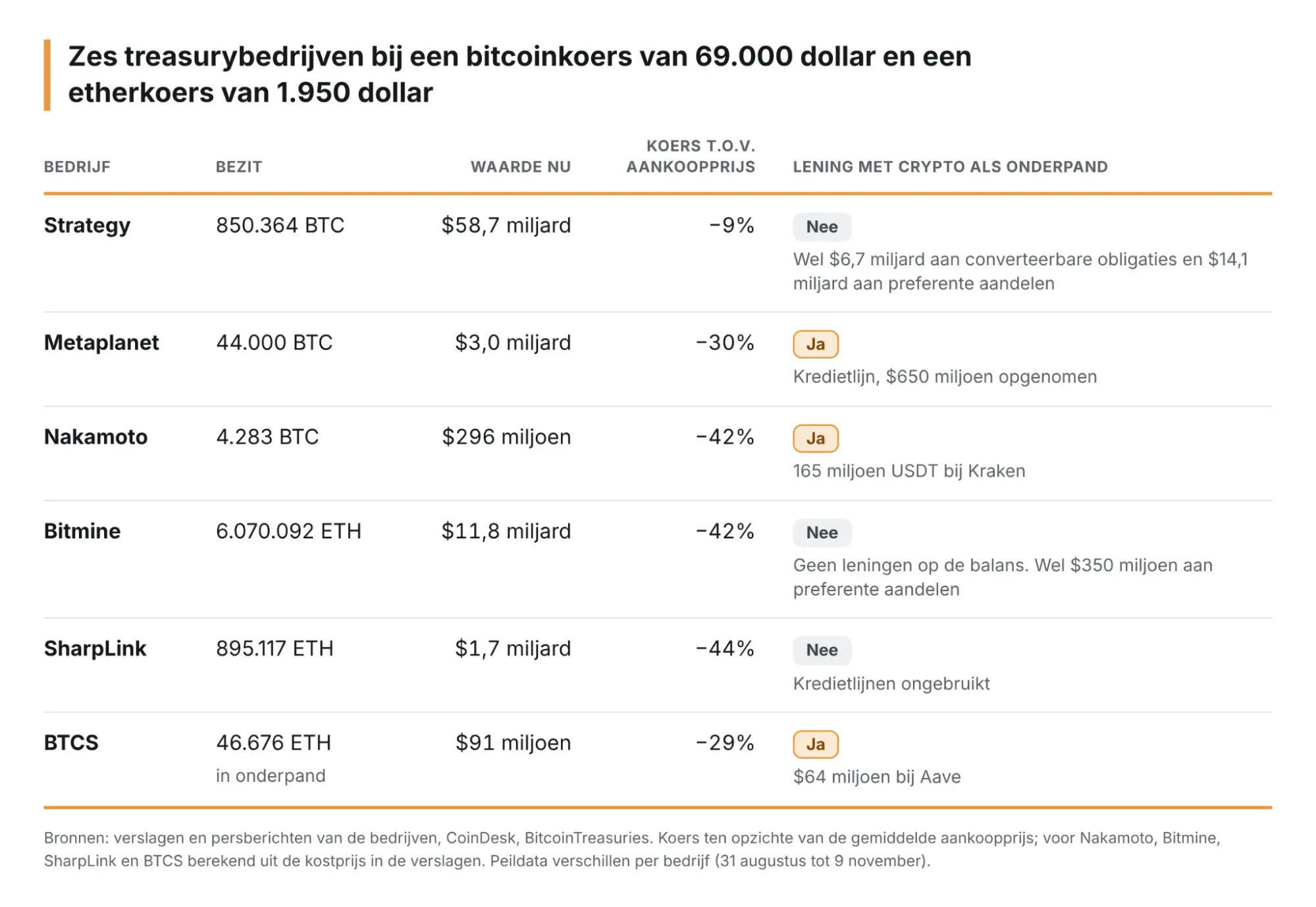
Nakamoto: debt exceeds market cap
For smaller treasury companies, the situation is more precarious. Nakamoto, David Bailey's company that already had to sell bitcoin in the spring, has borrowed 165 million USDT from crypto exchange Kraken. That's more than the company is worth on the stock market: just over $100 million. On Wednesday it was granted an extension. A $60 million repayment due on December 4 has been pushed back a year. The remaining $105 million must be repaid by June 30, 2027. Of the more than four thousand BTC Nakamoto held at the end of September, three thousand are pledged to Kraken.
Ethereum companies: billions in paper losses
The picture is similar for the companies stockpiling ether. Bitmine, by far the largest with over 6 million ether, reported last week a loss of $6.3 billion for the fiscal year ending in August. Virtually all of it is a write-down. SharpLink, by contrast, reported last Monday a quarterly profit of $751 million, but that was measured at end-of-September prices. Neither is known to have a loan that could force them to sell.
It's a different story for the much smaller BTCS. It borrows from DeFi protocol Aave. According to CoinDesk, as of November 9 it had $64.1 million outstanding against 46,676 ether in collateral. BTCS sold ether below its purchase price to keep the loan healthy. CoinDesk calculates that the position becomes eligible for liquidation at around $1,717 per ether.
For the fourth time already, we're getting together in a small group for a culinary evening in Amsterdam. We're inviting a number of Alpha Plus members, on us, to join the team for a fully catered dinner.
What? An evening of fine dining
When? Wednesday, December 9 | 7:45 PM
Who? Bert, Peter, Bart, Mike and Stijn + a number of Alpha Plus members
Location? Surprise (central Amsterdam)
Cost? None (you're our guest)
Sound like fun and want to join us sometime? Let us know via the form below, and who knows, you might be there next time.
👉 https://btca.nl/uiteten
2️⃣ Trump is suddenly in a hurry with the SEC and CFTC
Contributed by Erik
Nine days after the election defeat, the White House is nominating four commissioners, including, for the first time, two Democrats. The timing is hard to separate from the result: from January 3, Trump can still nominate regulators, but the Democrats will decide on the appointments.
For months, seats sat empty at US regulators the SEC and CFTC, without the White House showing any visible urgency. The SEC has two of its five commissioners in place, while the CFTC has a lonely chairman, Mike Selig. Then on Thursday, four nominations suddenly arrived, the first in about a year. For the first time in Trump's second term, two Democrats were among the nominees.
Why now?
The White House offered no explanation, but the political calendar speaks volumes. Until now, there was no reason to rush. Selig and SEC chair Paul Atkins could push through their crypto rules even with an understaffed team, and as long as Republicans held the Senate, an appointment could always wait. On January 3, the Democrats take over the Senate. SEC appointments always go through the Banking Committee. That committee is currently chaired by Republican Tim Scott and, from January, is expected to be led by crypto skeptic Elizabeth Warren.
Seen that way, this is the last chance to lock in two Republicans for years: Steven Levine at the SEC until 2030, Nathan Anonick at the CFTC until 2031. And the Democrats get what they asked for: their senators had complained that the White House was leaving their party's seats empty.
What it means for crypto
For the crypto sector, there's more at stake than four names. Since the Clarity Act stalled in September, US crypto policy rests on regulators' rules rather than on legislation. Whatever Selig decides on his own now, a successor can scrap. Coin Center already warned in August that a CFTC without both parties would have a harder time with crypto decisions. A commission that includes Democrats makes the rules of the past two years more resilient to the next transfer of power.
Republicans do have to give something up in return. Democrat Johnson believes that DeFi platforms acting as intermediaries “can and should be regulated”, and with her the dissenting vote returns. Meanwhile, Warren is preparing investigations into, among other things, the Trump family's crypto businesses.
Dan Tapiero says there’s not much Elizabeth Warren can do to roll back crypto now.
— The Rollup (@therollupco) November 11, 2026
“Five years ago we had nothing.”
“You have many institutions, Morgan Stanley, but then of course you have BlackRock, you have many different ETFs.”
“So there’s nothing that Elizabeth Warren… pic.twitter.com/JMDogJ3FQ9
How much can Warren roll back? Not much, says crypto fund manager Dan Tapiero. “Five years ago we had nothing. Now we have Morgan Stanley, BlackRock and a whole range of ETFs. The genie is out of the bottle.”
For the funds and the banks, that's plausible: a committee chair can't revoke approved ETFs. Nor can Warren roll back the rules of Atkins and Selig herself. A future administration with a different commission, however, can. That's why it matters who sits at the table in the coming years: Levine until 2030, Anonick until 2031.
3️⃣ Work on quantum-safe bitcoin has begun
 Contributed by
Peter
Remember? Over the summer, a number of major companies in the crypto sector launched a new initiative, the Bitcoin Security Consortium. ARK Invest, BlackRock and Strategy, among others, put up money to spend on bitcoin's security. Last week, the first result came into view: a report on quantum computers.
Quantum Computing 101
— Bitcoin Security Consortium (@BTCconsortium) November 11, 2026
A Bitcoin Security Consortium report, in collaboration with Presidio Bitcoin. https://t.co/MrU4SsVnGy
The report, Quantum Computing 101, isn't an introduction to the basics of quantum mechanics, but a summary of where things stand in defending bitcoin against the risks posed by mature quantum computers. It builds on research carried out by Presidio Bitcoin earlier this year.
In short, the consortium writes that progress in quantum computing is real, but that ‘cryptographically relevant’ quantum computers don't exist yet. Bitcoin's exposure to the risks such computers would introduce is limited to signatures. But ‘rest assured’, the authors seem to suggest, solutions are being actively worked on.
The main problem is the so-called at-rest attack: deriving private keys from public keys that are visible by default in bitcoin's underlying blockchain data. The harder in-flight attack is also discussed. That one can only be carried out once a public key reveals itself in the mempool, for example because a transaction is being made.
The consortium outlines three solutions to fend off these attacks. First, bitcoin held in old addresses needs to be moved to addresses that don't publish their public key. Second, a quantum-safe signature algorithm needs to be developed. And finally, consensus needs to be reached on what to do with lost coins; after all, they won't move themselves to safety.
The second solution is a technical one and the most straightforward. SHRINCS is named as a candidate algorithm, unsurprisingly the work of consortium member Blockstream. Here, timing is the biggest challenge: nobody wants to introduce a new algorithm too early or too late, on top of the changes the broader ecosystem of exchanges and wallets will then have to implement.
Can today's hardware wallets make post-quantum signatures? @n1ckler of @blksresearch tested hash-based SHRINCS on devices including @BlockstreamJade: yes, in a few seconds to a minute and a half.
— Blockstream (@Blockstream) November 13, 2026
In principle, no new hardware needed. From our workshop at @DAF_Global. 🇺🇸 pic.twitter.com/ztTvAg7yK7
The first solution can start right now. Anyone holding bitcoin on a vulnerable address can choose to move their coins to a safer address type. Mind you, that's a stopgap, because definitive protection only exists once the new algorithm is introduced.
Either way, one way or another, the third and toughest problem comes into focus: the debate over coins that nobody controls anymore. Satoshi's, for example, whose public keys glitter like gold nuggets in the blockchain data. Every option, from leaving them vulnerable to freezing them entirely, comes with its own drawbacks that touch on some of bitcoin's fundamental properties. That's a notoriously difficult debate for the bitcoin community. In other words, the complexity of the problem shifts from the technical domain, the signatures, to the social one.
There's no acute crisis yet. We're still years away, at the very least, from the moment a quantum computer could be unleashed on bitcoin. The problem is also well-defined, the risk can already be reduced today, and no entirely new cryptographic breakthrough is needed.
The best news is that a pressing question hanging over the market has been answered: the bitcoin community has started serious preparations. That was the first deadlock that needed breaking.
🍟 Snacks
To wrap up, a few quick snacks:
- OKX and NYSE parent ICE launch onchain stock trading on November 23. The joint venture (OKXICE) takes advantage of the room the SEC created in September for experiments with onchain products. The lineup consists of 59 ETFs and just 11 stocks, most of them from crypto companies. More than 65 companies used the objection period to keep their shares from getting an onchain listing. Their reasons range from competing plans of their own to fears about volatility and liability.
- Strategy buys again: 1,035 BTC and $188 million worth of STRC. The company now holds a total of 850,364 BTC, acquired for a combined $64 billion. On average, Strategy paid nearly $75,500 per coin. Alongside the bitcoin purchase, Strategy bought back almost 1.9 million STRC shares, worth nearly $190 million. To fund the purchases, the company sold more than 2 million MSTR shares. STRC is hovering around $100 a share. Reaching that target price took deep pockets: in total, more than $2 billion has gone into buybacks.
- Major banks pour $270 million into mysterious stablecoin project. Goldman Sachs, Citi, Santander and Deutsche Bank, among others, are committing to the initiative codenamed “Project Faro”. The capital injection should fund the project for the next five years. Earlier this year, it emerged that 21 financial institutions want to jointly issue a stablecoin. According to Bloomberg, this funding is a concrete next step. Launch is slated for the first half of 2027.
- Deutsche Bank opens the doors to its crypto custody service. According to the bank, it was preceded by five years of preparation, including obtaining a MiCA license. Corporate and institutional clients can now park their bitcoin, ether and the stablecoins USDC and EURC with the bank. Retail investors are left out for now. Over the medium term, the bank plans to expand the platform with tokenized financial products and offer the service in Asia as well.
- Bitcoin Core patches flaw that could have stalled mining. The developers of the software bitcoin runs on have fixed three vulnerabilities. One of them had the potential to disrupt the mempool, where new transactions wait to be processed. The other two concerned privacy and network stability. None of the vulnerabilities were exploited. The developers advise node operators to update their software.
Thank you for reading!
To stay informed about the latest market developments and insights, follow our team members on X:
- Bart Mol (@Bart_Mol)
- Peter Slagter (@pesla)
- Bert Slagter (@bslagter)
- Mike Lelieveld (@mlelieveld)
We appreciate your continued support and look forward to bringing you more comprehensive analysis in our next edition.
Until then!