
The Hodlers Appear to Be Back
While Wall Street is offloading bitcoin, long-term holders are stepping back in. The hodlers appear to be back—though a true bottom is far from proven.

 Contribution by
 Peter
On the surface, bitcoin looks weak. For eight consecutive weeks, money has been flowing out of U.S. bitcoin funds. Since the week of May 15, net outflows have totaled over $8 billion. In the week ending June 26 alone, $1.79 billion left the funds. The week ending July 2 added another $526 million to that tally.
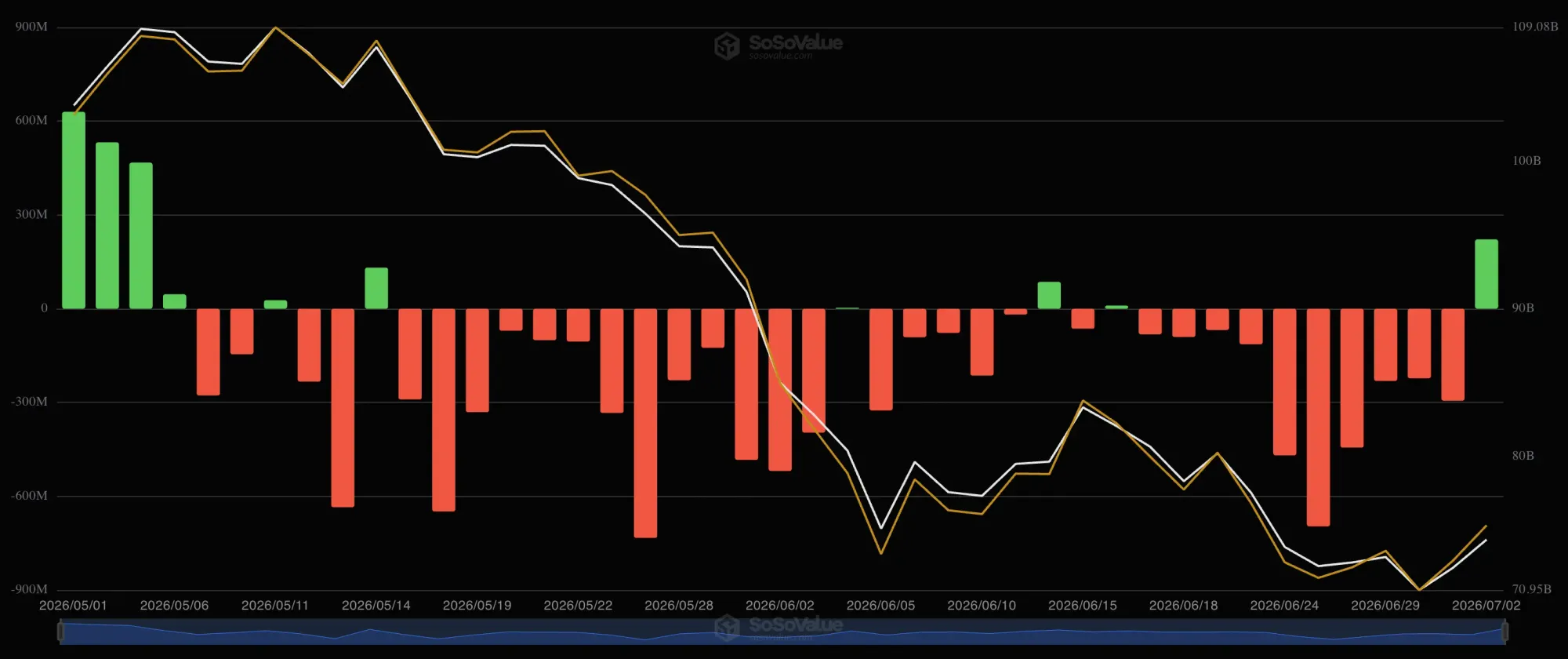
The funds are liquid, easy to buy, and just as easy to sell. For large investors, they're a convenient vehicle to build bitcoin exposure—but also to unwind that exposure quickly when circumstances call for it. And that appears to be happening. Glassnode calls it "institutional de-risking": institutional investors playing defense, amplifying recent price weakness rather than cushioning it.
Just beneath the surface, something else is happening. According to Glassnode, long-term holders have started accumulating again. These are investors who hold their bitcoin for extended periods and historically are less likely to sell when the market is under pressure. Their net position has turned positive again, after a prolonged period of distribution.
The red candles in the fund flow chart above don't tell the whole story. That makes sense—for every seller, there's a counterparty who finds the price attractive enough to take the other side. Liquid institutional allocations are exiting the stage, while under the hood, coins are shifting to more patient hands.
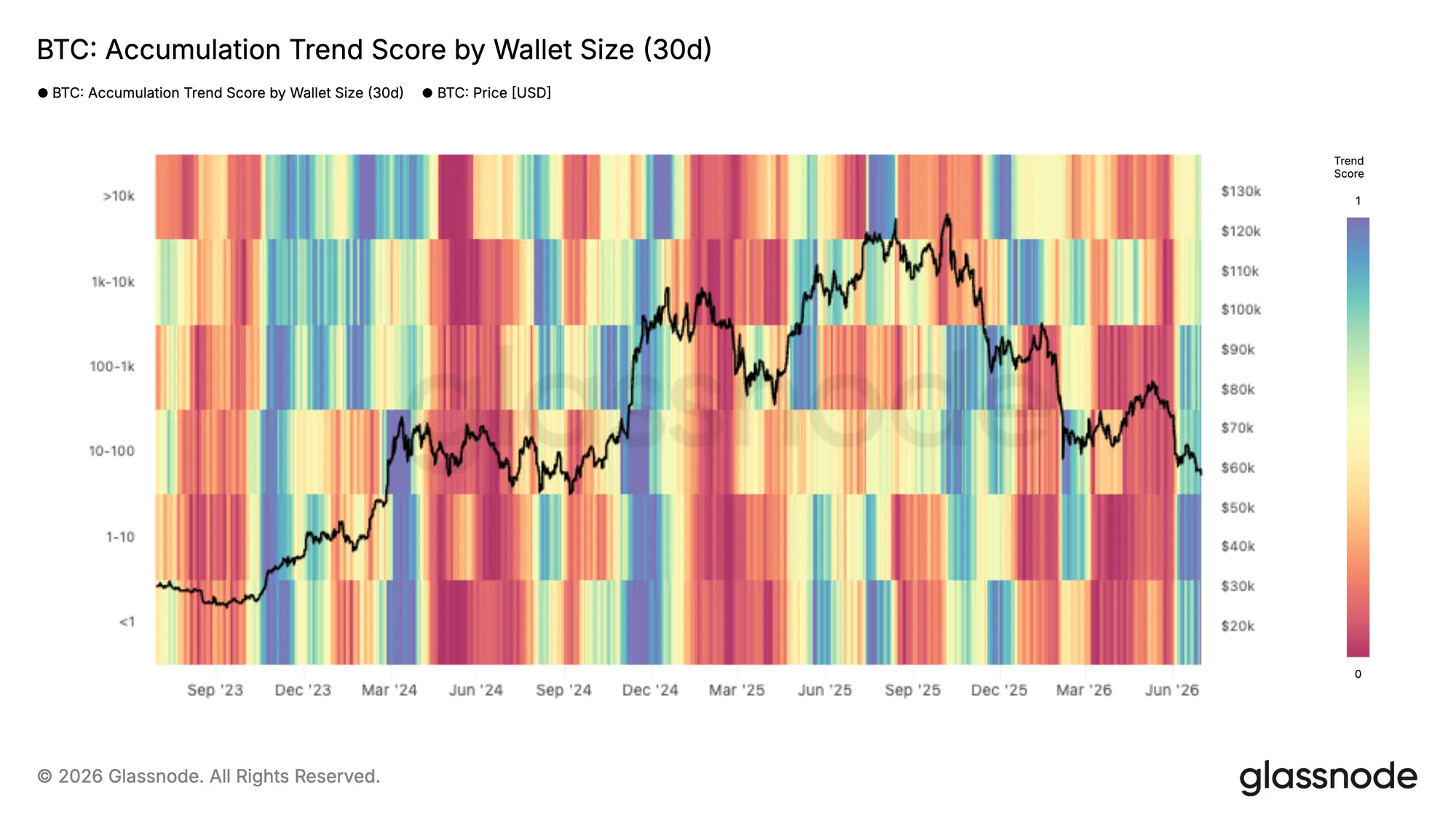
It's too early to call this a definitive line of defense for the current price range. While Glassnode notes that this behavior has historically preceded recoveries, it also adds the caveat that the signal needs to stay blue—denoting the strongest accumulation in the chart above—for longer before it qualifies as a "full accumulation regime."
A second signal that aligns with this comes from the research division of exchange K33. Nearly 80% of all bitcoin in circulation is reportedly held by long-term holders. That's a record. The reactivation of old coins is also relatively low. Through June 6, only 218,421 bitcoin aged two years or older had moved this year. For comparison: around the same date in 2024, that figure was 1.18 million BTC.
 Micah Zimmerman
And that brings us to a word much older than the on-chain terminology of Glassnode and K33: HODL.
The term was born in December 2013 on BitcoinTalk.org, when user GameKyuubi posted a message during a crash titled "I AM HODLING." It was a typo, but one that stuck. The core of the message was simple: I'm not a good trader, so I'm not trying to time the market. I'm just holding.
Since then, HODL has grown into a cultural shorthand for what is now a classic bitcoin strategy: don't sell because the price moves—hold because the underlying conviction hasn't changed. That conviction ultimately traces back to bitcoin's design itself:
"A purely peer-to-peer version of electronic cash would allow online payments to be sent directly from one party to another without going through a financial institution."
The idea of self-custody and sovereignty is a logical extension of that. Long-term holders accumulating now are acting in line with this principle: they see bitcoin as property they manage and hold themselves, even through difficult periods.
In short, the hodlers appear to be back. One swallow doesn't make a summer—but it is, at least, a first swallow.
More Alpha
Are you a Plus member? Then we continue with the following topics:
- Securitize goes public, tokenizes shares on day one
- Trump reports $1.4 billion in crypto income
- Open USD attacks Circle's business model
Below that, you'll find the news snacks—a handy overview of the news that actually mattered last week.
1️⃣ Securitize goes public, tokenizes shares on day one
 Contribution by
 Erik
Securitize, the company that issues regulated tokenized securities, has been listed on the New York Stock Exchange since Thursday. On the same day, the on-chain version of its own stock became tradeable on Solana and Avalanche.
"Our focus is unchanged: building the regulated infrastructure for the next generation of capital markets." So says Securitize. A company with this mission practically owes it to itself to issue its own shares on the newest infrastructure.
Securitize is now officially a public company, listed on the @NYSE under the ticker SECZ.
— Securitize (@Securitize) July 2, 2026
Our focus is unchanged: building the regulated infrastructure for the next generation of capital markets.
To everyone who helped us get here, thank you.
Tokenize the World. pic.twitter.com/XVhjA5udA9
And so it was done. By the end of the first trading day, $295 million in tokenized SECZ was outstanding. That instantly made it the world's largest on-chain stock by market capitalization.
Securitize has the backing of BlackRock and Morgan Stanley, which helped forge connections with institutional players. It built the infrastructure behind tokenized funds for BlackRock among others, and has now brought over $4 billion in assets on-chain. In March, the company entered a partnership with ICE, the parent company of the New York Stock Exchange.
Benefits of on-chain stocks
A major advantage of on-chain trading of traditional securities is that it can happen 24 hours a day, seven days a week. An additional benefit is that transactions settle instantly, meaning capital can be redeployed immediately.
In theory, stock tokens could also be used in decentralized finance protocols—for example, as collateral for a loan. Securitize's chairman: "I think that business is totally disruptible." He said this in the context of brokers who lend client positions to short sellers for a fee.
Same rights as shareholders
Securitize's token carries the same rights as a traditional share. It is the company itself that issues the shares on-chain. This is not a token issued by a third party that's merely designed to track the stock price. A holder of an on-chain SECZ token has the same voting rights as a holder of the same share in traditional form, and is entitled to the same dividends.
This approach, the issuer-central model, is where Nasdaq and other exchanges want to head. The SEC still needs to make a decision on this—specifically, on who gets the rights to tokenize.
The future of the market
Where does this market go from here?
You can define stock tokens in two ways. A broad definition covers tokens that provide economic exposure to a stock. This includes derivatives and certificates, such as xStocks from Kraken and bStocks from Binance. But these tokens don't give you voting rights, nor a legal claim on the underlying company.
The narrow definition covers only tokens like SECZ that are comparable to traditional shares. But these tokens are not freely tradeable, and trading only takes place on specific platforms.
To truly disrupt existing stock trading, the underlying model needs to move from permissioned to permissionless. Only then will the space emerge where stocks can be used as building blocks in DeFi products.
Until then, the question remains whether stock tokens will truly take off. The total of $2 billion in tokenized equities is still minuscule compared to the traditional market.
2️⃣ Trump reports $1.4 billion in crypto income
Contribution by Erik
Crypto was the largest source of income for the U.S. president last year, according to his annual financial disclosure. The revelation is sensitive against the backdrop of the ongoing tug-of-war over the upcoming Clarity Act crypto legislation.
The 927-page document lists at least $1.4 billion in crypto-related income for 2025. The TRUMP memecoin is perhaps the first thing that comes to mind. And indeed, it accounts for more than $635 million in royalties. But there are also more defensible income sources, such as the nearly $200 million raised from a stock issuance by the stablecoin company behind USD1.
"Nothing illegal"
Trump defended the income Thursday in an interview with CNBC: "There's nothing wrong with it." According to him, management lies with his sons, and the appearance of conflicts of interest is unavoidable. Trump:
"Whatever they do, there will be conflicts of interest, because of the power of my office. Say they buy a cupcake company. To produce cupcakes, you need energy. Then the question arises: what do they know about my energy policy?"
Critics see it differently. Senator Elizabeth Warren called it "shameless crypto corruption," and even The Wall Street Journal's editorial board wrote that the family is monetizing the office in an unseemly way.
There are obviously serious questions to be raised about a president who launches his own memecoin and pockets the royalties. It damages trust in the crypto sector and fuels doubt about the pure intentions behind the president's pro-crypto policies.
The balance after eighteen months
Eighteen months after the optimism in much of the crypto world about Trump's inauguration, we've arrived at the opposite point. Trump has enriched himself with crypto income, while the crypto world still awaits approval of the Clarity Act. Democrats are blocking progress on the ethical point: they want an ethics provision in the law that prohibits the president from profiting from crypto.
If the legislation does pass in the coming months, you could argue that Trump's election was still a net positive for the crypto industry—albeit with a sleazy edge.
3️⃣ Open USD attacks Circle's business model
Contribution by Peter
At first glance, the Open USD announcement looks like yet another stablecoin launch. A new digital dollar, a long list of partners, a few big words about faster and cheaper payments. But behind it lies a deliberate strategy. Open USD isn't a stablecoin from one company—it's intended as shared infrastructure for businesses that actually want to use stablecoins.
Introducing Open USD: a stablecoin built for the internet economy, designed by the businesses growing it.https://t.co/jqgDRs6mKf
— Open Standard (@openstandard) June 30, 2026
The difference is most visible in how reserves are managed. A classic stablecoin works simply. A large party deposits dollars with the issuer, receives stablecoins in return, and can later redeem them for dollars. Meanwhile, the issuer manages the underlying reserves—often short-term U.S. Treasuries. Interest is earned on those. For Circle, that's the core of USDC's business model.
Open USD flips that model. The stablecoin is managed by Open Standard, an independent entity governed by the participating partners. Companies can use Open USD without mint and redeem fees, and the revenue on reserves flows largely back to the parties that distribute and use the stablecoin. The issuer is thus less the beneficiary of the revenue and profit, functioning more as the steward of a shared network.
That explains why the announcement immediately put pressure on Circle. Open USD targets precisely the part of the market where Circle is strong: regulated, institutional stablecoin infrastructure for payments, trading, and settlement. Tether occupies a different position with USDT—that coin is primarily dominant in markets and countries where dollar access is scarce. Circle sells trust, compliance, and institutional connectivity. And now suddenly a large consortium stands beside it with names like Visa, Mastercard, Stripe, BlackRock, BNY, Google, Shopify, Adyen, and Coinbase.
We've had lots of questions from our investor community looking for thoughts on OUSD, and so I thought I'd share my direct views here for anyone.
— Jeremy Allaire - jerallaire.arc (@jerallaire) July 1, 2026
Stablecoin networks are platform and network effect businesses that are established over a long period of time, tend towards…
After the Open USD announcement, Circle's stock dropped more than 17%. Circle CEO Jeremy Allaire felt compelled to defend his company, leaning primarily on network effects: those are hard to break.
Good news for Circle is that the first cracks in the Open USD consortium became visible quickly. It turns out the announcement names companies that, when asked, weren't even aware they had signed onto a new initiative. That immediately brings back some memories—of Libra, for instance, a similar stablecoin initiative from Facebook that collapsed early on.
Several Korean Companies Say They Have Not Formally Joined Open USD Alliance, Express Confusion Over Inclusion
— Wu Blockchain (@WuBlockchain) July 3, 2026
According to Chosun Biz, several Korean companies listed as Open USD (OUSD) alliance members, including Samsung Electronics, Dunamu, KakaoBank, Hyundai Card, KB Kookmin… pic.twitter.com/hdkJA6Kd9Z
But it's too easy to dismiss it on those grounds. Christian Catalini, one of the co-founders of Libra, reflected extensively on X about the announcement. He sees an ecosystem with different characteristics, and a zeitgeist where the chances of success are much greater than when Libra first emerged. "The question now is mainly whether they can execute," writes Catalini, adding that stablecoins were never meant to be cash cows.
And with that, he touches precisely on the battle that Open USD has started. It's no longer just about who issues the safest digital dollar—but also about who gets to keep the economic upside.
🍟 Snacks
To wrap up, some quick bites:
- Ethereum gets its own front door for major financial institutions. The new non-profit Ethereum Institutional aims to help banks, asset managers, and other large players with questions about tokenization, stablecoins, and on-chain infrastructure. The organization wants to offer a neutral point of contact for institutions that currently often lack a clear entry point into the decentralized ecosystem. The launch fits a broader shift in which the Ethereum Foundation focuses more on the core protocol while independent organizations take on tasks around adoption, research, and communication.
- Solana gets World, a prediction market that lands directly with users. The mysterious project behind the slogan "Trade Everything" turns out not to be a memecoin, but a fully on-chain prediction market. After the reveal, trading in so-called 'event contracts' went live immediately, including in Phantom, a popular Solana wallet. Chainlink provides the data and settlement, Phantom handles distribution. World starts with crypto and sports events but plans to quickly expand into geopolitical and macroeconomic domains.
- Drift Protocol relaunches as Velocity DEX after mega-hack. The perps exchange suffered a roughly $295 million exploit in April and is now opting for a restart with a new name, a closed beta, and a simpler product. Users affected by the hack are to be repaid through a recovery program funded by protocol revenue and a cash injection from Tether. All transactions on Velocity are settled in USDT. The question is who will dare to provide liquidity again.
- Cloudflare launches payment rails for an internet where AI agents are the customers. The so-called Monetization Gateway makes it possible to charge per-use for access to web pages, datasets, APIs, and MCP tools. Transactions initially run via stablecoins and the open x402 protocol. Cloudflare is trying to solve a problem that AI is making bigger: agents extract value from content and infrastructure without seeing ads or signing up for subscriptions. Payment becomes part of the web request itself.
- Dutch prosecutors have filed for the bankruptcy of crypto broker Knaken. According to the Public Prosecution Service, the situation at the Rotterdam-based company and the affiliated Stichting Knaken Payments is deeply concerning. Knaken had no license from the AFM and had reportedly stopped paying out customers. The FIOD is additionally conducting a criminal investigation into possible offenses and has seized laptops and assets during searches. The court has yet to decide on the bankruptcy petition. For customers, it remains unclear whether their funds are safe.
- Strategy tries to restore confidence with a more active capital policy. Early last week, Michael Saylor's company came out with new plans. The dividend on STRC was slightly raised and the dollar reserve was reported to be replenished to more than $2.5 billion. A program was also set up that allows for selling bitcoin, up to a maximum of $1.5 billion, to replenish the dollar reserve from which STRC dividends are paid. With this, Strategy acknowledges that its bitcoin strategy also simply has a capital structure that needs maintenance. Investors seem to appreciate it: MSTR and STRC have risen more than 20 percent since the announcement.
Thank you for reading!
To stay informed about the latest market developments and insights, follow our team members on X:
- Bart Mol (@Bart_Mol)
- Peter Slagter (@pesla)
- Bert Slagter (@bslagter)
- Mike Lelieveld (@mlelieveld)
We appreciate your continued support and look forward to bringing you more comprehensive analysis in our next edition.
Until then!