
The Alphabet Economy
The alphabet economy reveals why growth doesn't feel the same for everyone. From K and E to C and I: if you own assets, you ride the wave up. If you don't, you're the one stuck with the bill.

 Contribution by
 Peter
Financial markets love their letters. After a crisis, investors hope for a V: a sharp drop followed by a swift recovery. Sometimes it turns into a U, where the bottom takes longer to form than expected. Or a W, where the first bounce after the crash turns out to be a false dawn. And when things really go south, the L appears. The economy hits the floor and stays there.
For a long time, that alphabet was mainly about the path of recovery, usually in the context of individual investments. But new letters have entered the mix. K, E, F, and C apply to the entire economy. They're not just about growth or contraction, but about distribution. About who benefits, who gets left behind, and whose wallet is slowly but surely falling apart at the seams.
The K-shaped economy is the best known of the four. Its upper leg points upward and represents stockholders, homeowners, high-income earners, large corporations, and people with access to cheap capital. They watch their wealth grow, keep traveling, keep dining out, and keep investing.
The lower leg points in the opposite direction. That's where you find renters, lower-income workers, small business owners, first-time buyers with no assets, households with little savings, and people hit hard in their budgets by rising prices. After paying for weekly groceries, rent, and the energy bill, there's nothing — or increasingly less — left over.
The K-shaped economy is now the market's macro engine.
— Forward Guidance (@ForwardGuidance) May 17, 2026
The top leg keeps spending because portfolios are up. The bottom leg faces higher financing costs, weaker real wages, rising delinquencies, and pressure on Main Street-exposed equities like retail, regional banks, and… pic.twitter.com/Z7z0pzGd3u
The result is a strange economy. In newspapers and on social media, the story is about growth, jobs, and stock market records. And in the supermarket, it's about whether you can still afford chicken breast, coffee, and laundry detergent. Both stories are true — they just don't play out in the same household.
That's what makes the K-economy so deceptive. The top half weighs heavily in the numbers. Those who earn a lot and own a lot tend to spend a lot too. A wealthy consumer flying business class, buying a new kitchen, and watching their stock portfolio climb can mask enormous economic pain at the bottom. The economy appears to be doing just fine, while a large portion of the population is mainly focused on cutting costs.
Which brings us to the letter E. Where the K described the trend, the E shows its consequences. The upper arm represents the wealthy. In the U.S., this relatively small group — 20% of earners — accounts for 60% of all spending. The crossbar represents the middle class. "They were able to keep pace with the upper class fairly well until the end of 2025," says economist Heather Long in an interview with CNBC. "But now an affordability crisis is becoming visible there. They're nervous." The lower arm describes the group that can only get by with financial assistance and debt. People who find themselves trapped in a stressful buy-now-pay-later economy out of necessity, just hoping to make it through the month.
 Kamaron McNair
The fear is that this devolves into an economy shaped like an F. In internet culture, the F — "F in chat" — stands for failure, loss, or deep misfortune. That aligns fairly well with the reality of this type of economy. The wealthy class stands tall, but the middle class is shrinking and the bottom tier has nothing left to stand on.
The K shaped economy is turning into an F shaped economy. https://t.co/Pik5kMmOp7
— Zach Tratar (@zachtratar) May 11, 2026
For a hopeful yet biting outlook, we arrive at the letter C. The idea is that the economy's diverging legs bend back toward each other. Prosperity rises again, spending increases. Inflation cools, interest rates come down, and demand broadens. It's not just luxury hotels and fine dining that thrive; the average consumer joins in again. This impressive piece of wishful thinking came from Christopher Nassetta, CEO of hotel chain Hilton, during the latest quarterly earnings presentation.
This hope primarily concerns the middle class, which Nassetta expects will soon start participating again. His competitors, however, have a different view and are increasingly focusing exclusively on people and companies that can afford luxury. The sting in Nassetta's outlook lies at the bottom of society. He conveniently leaves them out of the picture; the C suggests they're no longer in the game.
 Tristan Bove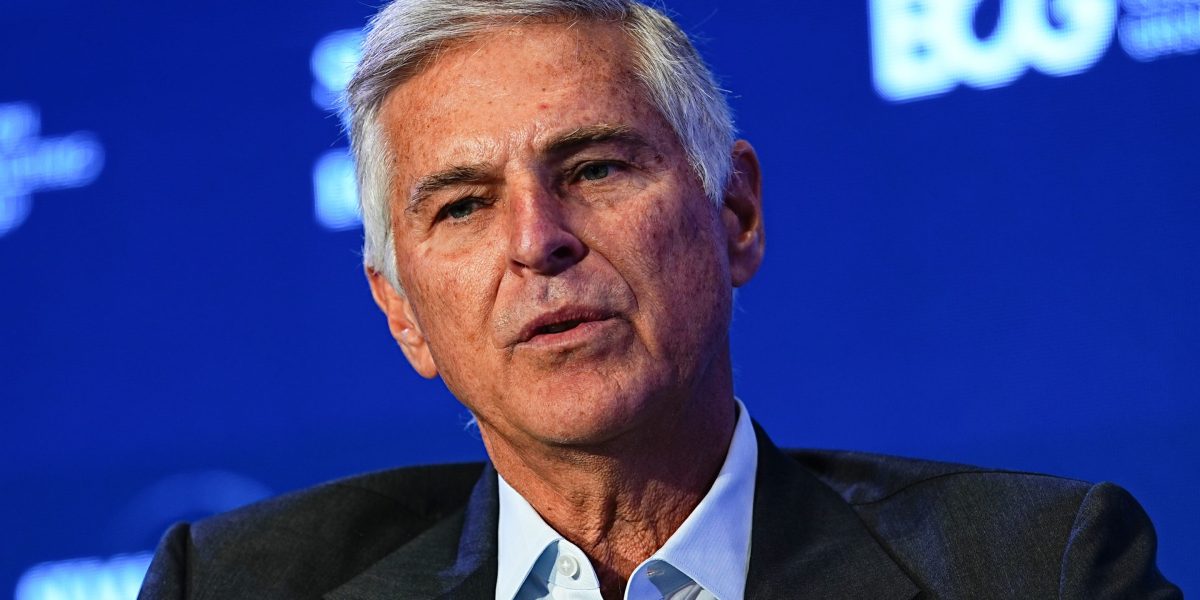
A healthy economy doesn't need an alphabet at all. But if we had to pick one letter, it would be an italic I. A single line going up. Not perfectly straight. Not without crises, corrections, or painful periods. Not at the same pace for everyone either. But broad enough to give people the sense that working, saving, investing, and planning ahead is worth it.
Bitcoiners recognize that shape immediately. The only way is up. In reality, that path runs through crashes, panic, doubt, and years where nothing seems to happen. But the direction is the point — a direction that right now, even for bitcoin, seems temporarily lost.
More Alpha
Are you a Plus member? Then we continue with the following topics:
- Clarity Act passes Senate committee
- Amazon introduces payment infrastructure for AI agents
- JPMorgan launches second on-chain money market fund
Below that, you'll find the news snacks — a handy overview of the news that actually mattered this past week.
1️⃣ Clarity Act passes Senate committee
 Contribution by
 Erik
On May 14, the U.S. Senate Banking Committee voted in favor of the Clarity Act, the bill designed to finally give the crypto industry a clear regulatory framework. Several steps remain: a vote by the full Senate, followed by reconciliation with the House of Representatives, which already passed its own version in July 2025. Only then does the bill land on Trump's desk for a presidential signature. The White House is targeting July 4th, and that's going to be tight.
The American crypto industry has rallied together in recent weeks to push the bill through. Coinbase CEO Brian Armstrong published a video from Capitol Hill before the vote, calling on senators to get it done. That was a notable reversal. Back in January, we wrote here that Armstrong "could not support the bill in its current form." Among other things, because of a ban on passive interest on stablecoins. On that point, he has made concessions.
CLARITY is closer than ever.
— Brian Armstrong (@brian_armstrong) May 13, 2026
The bill is strong. It will benefit the American people by making the US financial system faster, cheaper and more accessible. It will also ensure that the US leads in the global race to build the next generation of our financial system.
Huge thank… pic.twitter.com/mt8lkJ4W3v
Earlier this year, the sentiment on 'Crypto Twitter' was also that the banking lobby was getting its way on too many points. Four months later, that same Armstrong is standing on Capitol Hill pushing for that same bill, with some of the very same limitations he previously called unacceptable.
Armstrong, from crypto pioneer to lobbyist in the suit-and-tie brigade… That's no disgrace. It simply shows how mainstream the American crypto industry has become. Robinhood's Vlad Tenev was similarly active.
There's real momentum now to finally get CLARITY across the finish line. One more small push and we establish the legislative foundation to ensure American dominance in digital finance.
— Vlad Tenev (@vladtenev) May 7, 2026
Let's go! https://t.co/YEv2GXky4e
The crypto industry's motivation is easy to understand. The sector needs to capitalize now on the fact that Trump is president and the midterms are still ahead. After that, the balance of power will likely shift. As long as the Clarity Act gets through, crypto companies seem to be thinking. And so they're settling for a bill that falls short on some points.
For instance, interest on stablecoins has been partly stripped out. Users may still be rewarded for platform activity, but can no longer earn passive interest on stablecoin balances. For banks, who feared an exodus of savings toward crypto, that was a crucial point.
On the Democratic side — some of whom are outspoken opponents of anything crypto-related — Senator Elizabeth Warren pulled out all the stops. More than forty amendments were filed, many of them purely performative. Together with Senator Jack Reed, the Democrats also submitted more targeted proposals: for example, stripping protections for developers of non-custodial software. In the final weeks of the legislative process, it's all give and take. Republicans need a few Democrats to get the bill across the finish line.
Senators File Clarity Act Amendments on DeFi, Trump Family, and Jeffrey Epsteinhttps://t.co/sHOii2NW2D
— Decrypt (@DecryptMedia) May 13, 2026
That realization has now landed in the crypto industry as well. The industry has been asking for regulation for years. Now that it's on the verge of arriving, it's no longer about whether it's the perfect bill. It's about the fact that a bill is coming at all.
2️⃣ Amazon introduces payment infrastructure for AI agents
Contribution by Erik
Earlier this year, we wrote twice about the search for a payment system for AI agents. First about Stripe's experiment with machine payments in February, and later about the Machine Payments Protocol (MPP). The first for one-off, small transactions between an agent and an API. The second for longer work sessions where an agent sets aside a budget upfront. "Two flavors for different kinds of digital labor," we wrote at the time.
Now that the infrastructure is in place, the question is where the users will come from. On May 7, part of the answer arrived. Amazon launched, together with Coinbase and Stripe, so-called Bedrock AgentCore Payments. Quite a mouthful for a system that allows AI agents to independently pay for content, software, API access, and other online services. This is the first flavor we described earlier: one-off, small transactions between an agent and an API.
Bedrock is Amazon's AI platform, giving developers access through a single interface to models from OpenAI, Anthropic, Meta, and others. Developers were already using it to build a wide range of applications, from chatbots to autonomous agents. Anyone who now brings an agent to life via Bedrock gets payment functionality included as standard. No need to set up your own wallet, and no need to think about the underlying infrastructure.
And so the barrier for AI agents making autonomous stablecoin payments has dropped significantly. AWS handles the wallet, the protocol, and the necessary security measures. One button to give an AI agent a budget, after which it can settle payments on its own.
$AMZN is making the biggest strategic reset of the Jassy era with one clear goal to make AWS the infrastructure layer for the AI economy:
— Shay Boloor (@StockSavvyShay) May 15, 2026
• Agreed to invest $50B in OpenAI
• Already has own AI stack with Nova, Trainium & Bedrock
• Building $25B Mississippi data center… pic.twitter.com/UXUnaQK9k1
HTTP status code 402 finally brought to life
The designers of the HTTP protocol knew more than thirty years ago that a payment function would be useful. They introduced code 402, with the idea: 'pay first, then you get to see this page.' But it was never clear how that payment would actually work. There was no global, programmable money. And so, when we order something on an e-commerce site today, the process isn't internet native: processing your payment requires an 'old-fashioned' payment giant like Visa or your bank as an intermediary.
Thanks to the fusion between crypto and AI that's now underway, that can finally change. And agents are leading the way. Because under the hood of Bedrock AgentCore Payments runs x402, an open-source payment protocol for AI agents built on stablecoins and other cryptocurrencies.
As of March, x402 had already processed more than 119 million transactions on Base and 35 million transactions on Solana. A week after the Amazon announcement, NEAR AI followed with a variant that can execute the same payments with privacy, specifically for companies that don't want the costs incurred by their agents visible on a public blockchain.
In the near future, payments for consumer products and travel bookings will be enabled. We'll keep following this!
3️⃣ JPMorgan launches second on-chain money market fund
Contribution by Peter
The money market fund's name sounds like it was dreamed up in the bank's legal basement: JPMorgan OnChain Liquidity-Token Money Market Fund. Ticker: JLTXX. But behind that somewhat dull packaging lies an interesting development.


The fund runs on Ethereum and invests in U.S. Treasuries and short-term repos collateralized by cash. Investors who put money in receive tokens representing their position in the fund. In the future, those tokens could potentially be used in the crypto world — for example, as collateral in other protocols. To give the new fund a flying start, JPMorgan is seeding it with $100 million at launch. Anchorage Digital is also opening its wallet.
A money market fund is a bit like a savings account. You park your dollars, earn a return, and JPMorgan takes a cut. But the comparison quickly breaks down.
A savings account is a safe pot at the bank — often insured, immediately accessible, and nearly frictionless. A money market fund is an investment product with savings-like characteristics. The money goes into short-term, relatively safe instruments. That normally comes with a higher return, but also slightly more risk and usually more hassle. You pay management fees, there are more rules attached, and you often have to wait a day to liquidate the money locked in the fund. The familiar sluggishness of the old financial system.
Tokenization aims to strip exactly that friction from the product. It's still a fund, but because the tokens are usable around the clock and instantly available, it behaves more like digital cash than a dusty share. This is particularly interesting for stablecoin issuers. They're looking for safe places to park reserves, with yield, but without capital getting stuck in legacy infrastructure.
The costs are also noteworthy. According to Bloomberg analyst Eric Balchunas, the fund charges 16 basis points, or 0.16% per year. That's cheap enough for this type of product that Balchunas calls it a "big deal." There are a handful of cheaper money market funds out there, but none of them are on-chain. That's the key point: this is primarily about usability, not yield.
JPMorgan filed for a tokenized money market fund. Big deal bc JPM inching further into crypto and big deal bc fee is pretty low 16bps for a stable NAV (imposs to do in ETF). Cheaper than most money funds altho Vgrd's is like 11bps. Great scoop from @isabelletanlee pic.twitter.com/yGPkwiAxT0
— Eric Balchunas (@EricBalchunas) May 12, 2026
JPMorgan isn't the only Wall Street giant making moves. Last Tuesday, Schwab Crypto opened its doors to its first group of retail customers. They can now trade bitcoin and ether through the bank, alongside their stocks and ETFs, on the same screen. The rollout will continue in phases over the coming months.
On the same day, Franklin Templeton announced plans to bring more traditional financial products on-chain. They're joining forces with Payward, Kraken's parent company. "Our goal is to blur the line between traditional and digital assets," the CEOs write in a joint statement.
🍟 Snacks
To wrap things up, some quick bites:
- Senate confirms Kevin Warsh as new Fed chair. Warsh was put forward by Trump as his preferred candidate to succeed Jerome Powell. The Senate confirmed him with 54 votes in favor and 45 against. Powell remains chair until Warsh is sworn in by Trump. The date for that has not yet been set. Trump has positioned Warsh as a chair who will help boost the economy. That looks difficult: the room to cut rates appears much narrower than earlier this year due to rising inflation.
- Under the hood, the crypto market is hitting new records. The bitcoin price is often used as the benchmark for success. It's still well below its previous all-time high. But behind it, strong growth is visible. Analytics firm Artemis tracked 59 records last week, from total open interest on prediction markets to payment volume via crypto debit cards. That picture fits this phase of the market. The hype is missing from the price chart, but elsewhere the machine is running at full speed.
- Crypto funds end impressive streak of inflow weeks. Last week, a total of just over $1 billion flowed out of spot bitcoin ETFs. Ether funds lost more than $250 million. Notably, Solana and XRP funds managed to attract tens of millions of dollars in inflows. In 10 of the past 11 weeks, crypto funds posted positive numbers; that streak has now come to an end. Concerns about inflation and the Iran conflict appear to be the main drivers of investor caution.
- Iran launches maritime insurance platform that accepts bitcoin payments. Ship captains looking to sail their tankers through the Strait of Hormuz can arrange their insurance through 'Hormuz Safe' and pay with cryptocurrency, bypassing the traditional financial system. Iran aims to reduce its dependence on SWIFT and Western banks. The move fits within Iran's broader efforts to limit the impact of international sanctions. Roughly one-fifth of global oil trade passes through Hormuz.
- One of South Korea's largest banks invests $670 million in the owner of crypto exchange Upbit. Hana Bank is buying a deep stake in Dunamu and wants to collaborate on a stablecoin pegged to the Korean won. The move is part of the global trend of traditional financial institutions expanding their position in the crypto market. Banks see a new financial infrastructure emerging beyond the current market cycle — and they'd prefer to be the ones in control of it.
Thank you for reading!
To stay informed about the latest market developments and insights, follow our team members on X:
- Bart Mol (@Bart_Mol)
- Peter Slagter (@pesla)
- Bert Slagter (@bslagter)
- Mike Lelieveld (@mlelieveld)
We appreciate your continued support and look forward to bringing you more comprehensive analysis in our next edition.
Until then!