
Our Internet Is Broken
The internet is under fire. AI agents are uncovering vulnerabilities in hardware and software at industrial scale, and crypto is squarely in the crosshairs. How do you protect yourself from the barrage? Our guide gets you started.

 Contribution by
Peter
No, don't worry, you didn't miss a book launch. Then again, publishing a book with this title wouldn't have been a bad idea. For months now, internet problems have been flying at us from every direction, and the pace only seems to be picking up. Tellingly, October has already earned the nickname Black October, a label normally reserved for days of genuine disaster.
 Ashley Capoot

The underlying dynamic isn't new. Someone finds a flaw, and that flaw is either responsibly reported and fixed, or exploited in the most profitable way possible. Which path it takes depends on who found the bug first.
The speed at which this happens used to have a human bottleneck: the limited pool of programmers with the skills to track these flaws down. AI has more or less removed that bottleneck. Every time yet another smarter model sees the light of day, finding new vulnerabilities gets easier. On top of that, an AI agent switches effortlessly between programming languages and environments, and you can spin up thousands of them at the push of a button.
The result: swarms of bug hunters being unleashed on a digital world built on decades of structures, some well maintained, many crumbling. As you can imagine, the flood of discovered vulnerabilities won't dry up anytime soon. This is happening across the entire market, and naturally it's hitting cryptocurrencies and crypto companies too. Just a few hours ago, for example, hardware wallet maker Foundation announced that one of its systems had been abused to send emails that were indistinguishable from the real thing.
The Foundation team is actively working on this. Tag me with any questions and I’ll work to answer as fast as possible. We will share a formal report when we have all details.
— Zach Herbert 🇺🇸 (@zherbert) October 26, 2026
Passport devices are safe and secure.
What we know so far: some of our backend infrastructure was… https://t.co/W5paP0HjRq
Because there's a real risk that we'll get caught in the crossfire one way or another, we're taking precautions. These are precautions you can take too. Our urgent advice: make time for this. Today. To make it as easy as possible, we've laid out exactly what we do.
Update all your devices. Every ‘smart’ device runs software. Your laptop, your phone, your TV, your router, your fridge, your PlayStation. Make sure the software they run is up to date and that updates are installed automatically.
Make regular backups. Make sure your important data can be recovered. Think of the files on your laptop. The paperwork scattered around somewhere. The family photo archive you've spent years building. Or access to your hardware wallets.
Use a password manager. It lets you store important personal information securely. Think passports, credit cards and, of course, the – often hundreds of – accounts you have with companies and government agencies.
Give every account its own strong password. Make sure that if one password leaks, all your accounts aren't suddenly exposed. A password manager makes it easy to generate a strong password for each account.
Set up two-factor authentication. Most services now let you enable a second layer of security on top of your password. A one-time code or a passkey. Password managers can help here too.
Learn to recognise scams. Attackers exploiting bugs often still need a helping hand from their target. A click in an email, a reply to a text message, a phone call. If you recognise those patterns, you won't be fooled.
Implement these measures thoroughly and strictly – and yes, that can be quite a job – and you'll have built yourself a kind of three-tier defence:
- You reduce the chance of getting hit, because your devices are up to date and your locks need more than one key.
- You stop damage at one provider from spilling over to another, because you always use unique credentials.
- You make sure you can recover, no matter how hard the blow, because you have backups to fall back on.
No security system is perfect. You can't stop a service you use from being hacked. Your defence is about lowering the risk of getting hacked and, if it happens anyway, limiting the blast radius and keeping the damage recoverable.
Do this and you'll be ahead of the crowd. And that, however unfortunate for the naive, gives you an extra layer of defence too, simply because you're a harder target than others.
Ready to get started? Begin by reading LaatJeNietHackMaken.nl (in Dutch). Set aside an evening for this guide, get familiar with the concepts it covers, and then start building your own line of defence.
Need help? Feel free to ask your question on Discord. Wherever we can, we, or a fellow Alpha, will help you along.
More Alpha
Are you a Plus member? Then read on for the following topics:
- Bitcoin hashrate bounces back
- Banks and payment giants go onchain
- Not every company wants its stock tokenised
After that come the news snacks, a handy roundup of the news that really mattered this past week.
1️⃣ Bitcoin hashrate bounces back
 Contribution by
Erik
In early September, we reported on a first: for the first time in its history, bitcoin was in a genuine hashrate bear market. The computing power miners contribute to the network hadn't set a new high in almost eleven months. The prevailing explanation at the time: the machines had simply become unprofitable at the low bitcoin price. That picture needs revising.

According to CryptoQuant data, the hashrate bottomed out in early July at around 726 EH/s. On 22 October, the seven-day average was back just above 1 ZH/s, or 1,000 EH/s. After nearly a year of contraction, the network is growing again.
The machines moved
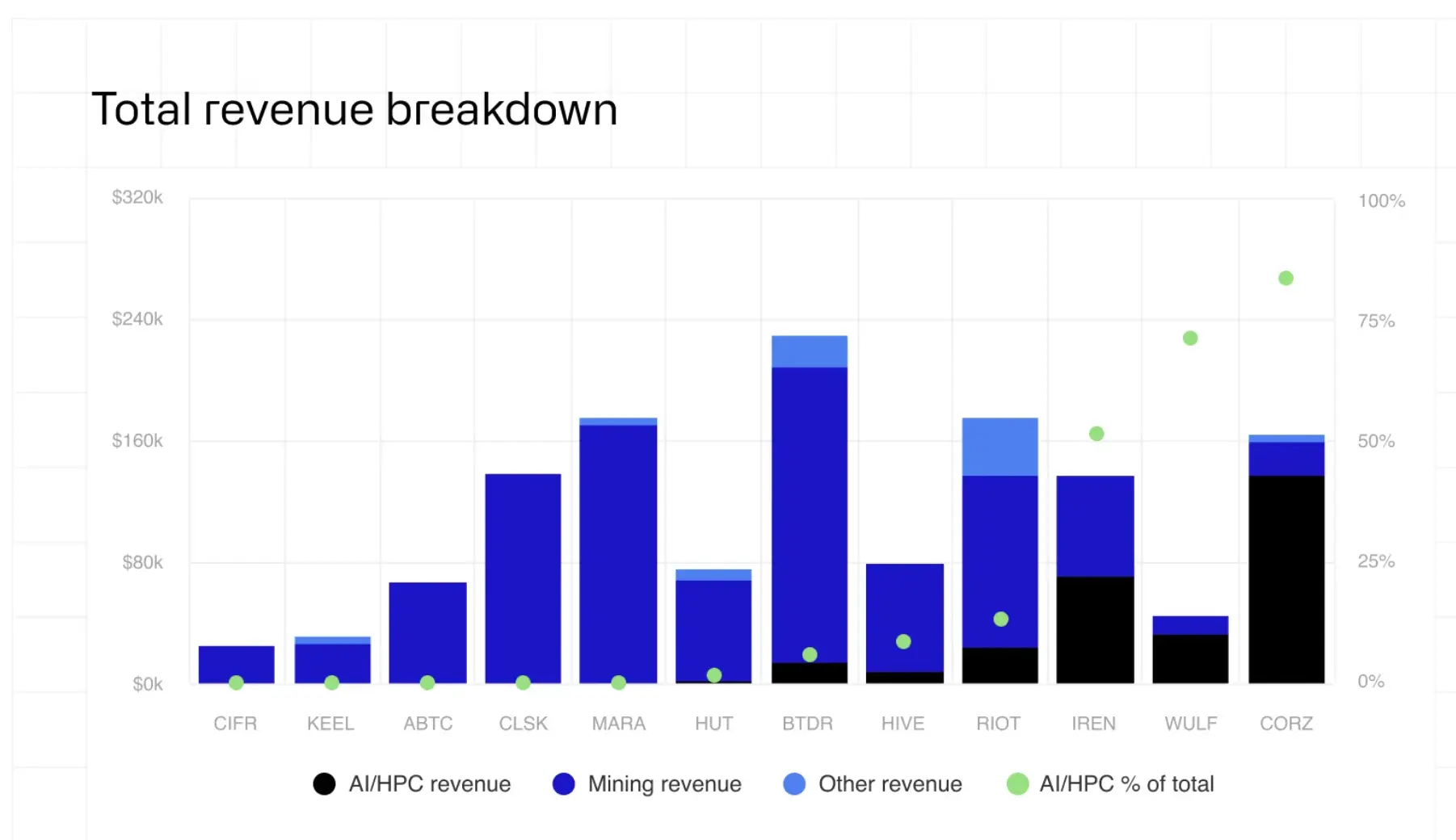
The cause of the decline was well known: the pivot to AI. In the first half of 2026, publicly listed miners cut around 56 EH/s of computing power. That's a 15 percent drop, while the network as a whole shed 10 percent. In other words, they scaled down faster than everyone else. At the same time, their directly reported revenue from AI and high-performance computing rose 52 percent quarter-on-quarter.
The big players pulled their miners out of the racks and leased the freed-up power and space to data centres. A converted facility doesn't return to the bitcoin market in a hurry. Once the machines are gone and the power is locked into AI clients, that capacity won't sit around waiting for a better hashprice.
If that capacity is gone for good, the recovery has to come from somewhere else. Part of it is easy to spot. Bitdeer, for instance, didn't turn its back on mining but actually expanded: its self-mining hashrate grew to 82.3 EH/s in September, and together with the machines it hosts for third parties, it added around 9.5 EH/s in a single month.
An echo of the 2021 hashrate crash
There's also another, somewhat more speculative explanation for the hashrate rebound: smaller players snapping up the equipment the departing listed miners no longer need. In countries and locations where power is cheap and there's no developed AI industry, there was real demand for barely used ASICs sitting in warehouses waiting for a new owner.
Hosting company Sazmining, for example, is advertising used Antminer S21 XPs for facilities in Paraguay and Texas, though there's no way to tell whether they came from the big miners.
Earlier explanations for the hashrate bear market emphasised the contrast with China's 2021 mining ban. Back then, the hashrate crashed and the computing power resurfaced elsewhere within a few months, mainly in the US. Although the underlying dynamic is different, the same thing seems to be happening now. The only difference is that back then a ban drove the machines across borders; this time it's a gap in returns compared to AI, a competing buyer.
And here's the unexpected twist. The listed giants that dominated mining in recent years now account for a smaller share of the hashrate. They scaled back their capacity, while the recovery came largely from outside that group. Whether that decentralises the network as a whole remains to be seen; geographically, three countries together still control around seventy percent of the hashrate.
2️⃣ Banks and payment giants go onchain
Contribution by Peter
News-wise, it was a quiet week. Work-wise too, for me, because I took a week off. Off to the mountains; there's very little that makes me happier. For those interested: below you can see what the Swiss Alps look like in autumn. One of the two dark figures is yours truly.

The calm leaves room to take a look at what the banks are up to.
On Monday, the digital dollar of JPMorgan, the largest bank in the United States, went live on Ethereum. JPM Coin is a so-called deposit token: each token represents a dollar held in an account at JPMorgan, and only business clients can use it.
On Thursday, SoFi, a US online bank, launched a deposit token for retail customers. Each SOFIE token earns interest and is covered by US deposit insurance up to 250,000 dollars. Customers can convert the tokens one-to-one into SoFiUSD, SoFi's stablecoin, to buy crypto or send money. Doing so, however, means giving up the interest and the insurance.
In Hong Kong, HSBC launched its first stablecoin on Friday: RedCoin, pegged to the Hong Kong dollar. More than 3.3 million users of the PayMe payment app will be able to activate a wallet for it over the coming days. RedCoin isn't a public stablecoin like USDT or USDC; it runs on HSBC's own network.
On Wednesday, Standard Chartered signed a deal for the full acquisition of Zodia Custody. The bank was itself involved in founding the company in 2020 and is now choosing to integrate the technology Zodia developed into its own offering. The reason? Standard Chartered wants to step up its role in the crypto world, starting with expanded services for institutional clients. The purchase price was not disclosed.
On Thursday, Axios reported that Visa is in advanced talks to acquire Fireblocks for around 2.5 billion dollars. Fireblocks provides the software banks and exchanges use to store and move crypto. The company responded the way companies usually do when unwelcome rumours leak: by denying any negotiations are taking place. “This is news to us, and not true at this time,” a spokesperson said.
We wrap up the tour with venture capital firm Andreessen Horowitz, which dropped the word crypto from the name of its crypto fund. a16z Crypto will henceforth be called a16z Frontier, and will invest in AI, robotics and biotech alongside crypto. Chris Dixon, who leads the fund: “Wall Street and fintech companies now regularly launch products on blockchains. Does that make them crypto companies? The label matters less.”
Banks, payment companies and funds moving towards the crypto world, and vice versa, is nothing new. That shift has been gathering steam for a while now. You might think we're nearing the point where it starts to slow rather than accelerate. But judging by just one week of banking news, that's clearly not the case!
3️⃣ Not every company wants its stock tokenised
Contribution by Peter
In previous News editions, we wrote about the SEC's innovation exemption. Under that exemption, platforms are allowed, among other things, to trade token versions of US stocks without having to register as an exchange. On 4 October, OKX and ICE, the parent company of the New York Stock Exchange (NYSE), announced their intention to make use of this arrangement.
The plan: make shares in 62 major US companies, from Nvidia and Apple to Coinbase and Strategy, available as stock tokens. The advantage is that these shares can trade 24 hours a day, including among Americans. Trades are settled in stablecoins, and the tokens issued come with dividends and voting rights. No launch date has been set yet.
 Helene Braun and Krisztian Sandor

In principle, OKX and ICE don't need the companies' permission to go ahead. They do, however, have to notify them in advance. If a company objects within 30 days, its stock may not be offered. According to the SEC, such an objection can be as simple as: “we don't want this.”
Initially, only one company objected. But by Monday of last week, the count had reached sixteen, including Microsoft, Alphabet and Goldman Sachs. By Friday, 22 were on the list, with Wells Fargo, Cisco and chip designer ARM joining in. Of the 62 companies on the original list, nearly a third have now said no. Nvidia, Tesla, Apple and Amazon have yet to respond.
The companies aren't saying why they're opting out. What stands out is that they were warned about the initiative by NYSE rival Nasdaq. In that message, the proposed platform was painted as a “shadow market” that isn't required to display the best price. The idea, according to Nasdaq, is that if investors get a bad price there, they may blame the company.
Andrew Cuomo, the former governor of New York who heads the OKX-ICE platform, described the objections as “a very natural response.” According to him, the model was designed to let companies decide for themselves whether to take part. Hester Peirce, then still an SEC commissioner, said in September that many of the companies she'd spoken to were “really excited.”
Perhaps that enthusiasm will suddenly return among the companies that pulled out, as soon as Nasdaq shows up with a similar initiative.
🍟 Snacks
To wrap up, a few quick snacks:
- The US has its first final stablecoin rules. Regulator OCC published on Wednesday the requirements issuers must meet under the Genius Act, passed in 2025. The rules take effect on 18 January 2027. Stablecoins must be backed one-to-one, and anyone redeeming them must get their money back within two business days. The Genius Act prohibits issuers from paying interest on stablecoin holdings. Crypto companies that hold such balances on behalf of their customers are still allowed to pay out ‘rewards’ on them.
- Strategy and Strive expand their bitcoin holdings further. Notably, Strive, the bitcoin company founded by US politician Vivek Ramaswamy, made the biggest purchase. It added 4,045 BTC, worth 335 million dollars, to its treasury. In total, the company now holds 36,818 BTC. Strategy issued new MSTR shares. With the proceeds, it bought 267 BTC and 192 million dollars' worth of STRC shares. The preferred stock closed Friday at 99.36 dollars, just below the $100 Strategy is targeting.
- JPMorgan includes bitcoin in its annual long-term outlook for the first time. Professional investors use the report when building their portfolios. The asset manager expects a 10 percent annual return, with hefty price swings along the way. Even so, the bank isn't giving bitcoin a place in its model portfolios yet. The reason? JPMorgan still struggles with bitcoin's shifting correlation with other assets. That said, the bank acknowledges the market is maturing and has firmly put bitcoin on the radar as an asset class.
- Strategy is likely to be dropped from MSCI's stock indices. The index provider has concluded that the bitcoin company looks more like an investment fund than an operating business. Since companies that primarily invest can distort the composition of a stock index, exclusion is the obvious step. The final, revised version of the index follows on 11 November. If Strategy is excluded, funds tracking the index may have to sell shares. Saylor calls that selling pressure manageable. By his estimate, it amounts to roughly 3.1% of outstanding shares.
- Exchange MEXC shuts its doors in the Netherlands. The company doesn't have a MiCA licence and was presumably asked by the AFM, the Dutch financial regulator, to cease its activities. Customers are being asked to move their assets before 31 October. Final ‘offboarding’ takes place on 16 November. It's unclear exactly what will happen to funds belonging to Dutch users that remain on the exchange after that date. In total, the exchange has now withdrawn from 13 jurisdictions, including the US, Canada and the UK.
Thank you for reading!
To stay informed about the latest market developments and insights, follow our team members on X:
- Bart Mol (@Bart_Mol)
- Peter Slagter (@pesla)
- Bert Slagter (@bslagter)
- Mike Lelieveld (@mlelieveld)
We appreciate your continued support and look forward to bringing you more comprehensive analysis in our next edition.
Until then!