
Only One Million BTC Left
The 20 millionth bitcoin has been mined. With roughly one million BTC left to go until 2140, bitcoin's inflation is plummeting fast. What does that mean for miners, network security, and the experiment of absolute scarcity?
 Contribution by
 Erik
For over 17 years, bitcoin miners have been competing with each other for the so-called block reward: the total of transaction fees plus newly issued bitcoin that goes to the finder of the latest bitcoin block. The size of that reward, however, is not tied to their hard work. The number of mined BTC continues to follow a predetermined issuance schedule.
Last Monday, the 20 millionth bitcoin entered circulation. Mining pool Foundry USA was the lucky finder. It happened without much fanfare. You might expect the first sat of the 20 millionth bitcoin to have been auctioned off for a hefty sum.
But that overlooks the fact that bitcoin has its own 'calendar,' which matters more than boring, 'worldly' round numbers. The reason an epic sat was auctioned for $2 million in April 2024 is that it was in the first block after the fourth halving. That's what matters in the eyes of collectors.
INSIGHT: Bitcoin's total supply has now reached 20 million.
— CoinDesk (@CoinDesk) March 9, 2026
It will take another 114 years before the final 1 million BTC are fully mined.
(h/t @glassnode) pic.twitter.com/NvPdhgNKYn
So seventeen years for the first 20 million, and roughly 114 years to go for the last million. It shows just how sharply monetary inflation drops thanks to the halvings. Bitcoin's inflation has now fallen below 0.82 percent per year (20 million divided by 164k new BTC per year). If you subtract the estimated 3 million lost BTC from that total, we're still above 1 percent. For comparison: gold's monetary inflation sits just under 2 percent.
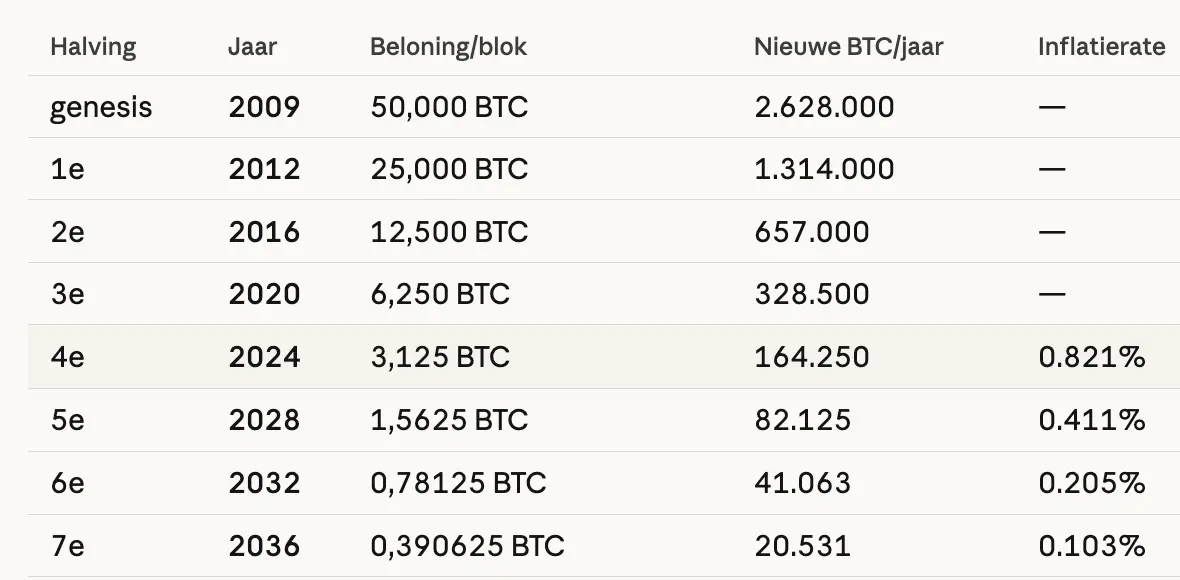
As is well known, BTC will continue to be issued until the year 2140. But only the next ten to twenty years truly matter when it comes to this issuance. Just look:
- 2036: Annual inflation drops to 0.1%
- Around 2072: only about 100 BTC left to mine.
- Around 2096: only 1 BTC total left to mine
This means we'll very soon reach a situation where inflation is effectively zero. Consider that every year BTC is 'taken out of circulation' by holders who lose their private keys. Even if that's only 0.1% per year, inflation will effectively be zero around 2036. And negative after that.
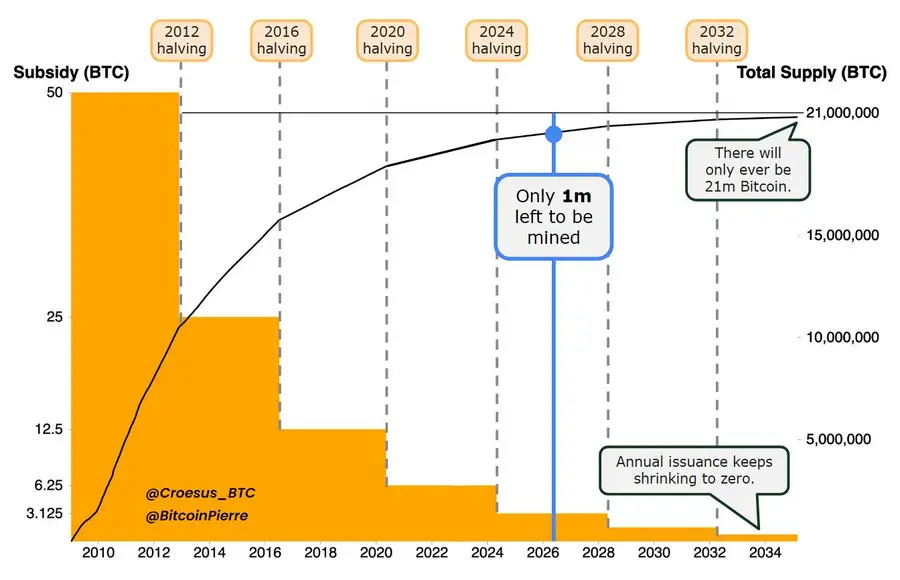
So we shouldn't expect a higher price driven by ever-fewer new bitcoin entering circulation each year. But the fact that just under one million BTC will still be issued over the coming decades still matters for a couple of reasons.
First, because it pays the miners who secure the network. Although the issuance of 20,500 BTC per year between 2036 and 2040 doesn't seem like much, it can still add up. A bitcoin price of $500,000 per coin is not unthinkable in ten years and would translate to a 'security budget' of over $10 billion per year. That would be comparable to the current security budget. Yet there will come a time when issuance is no longer high enough to fund miners at levels similar to today.
Another reason, though less important than it used to be, is the issuance of 'virgin bitcoin' for buyers who don't want sats 'tainted' by prior transactions. The reasoning was: freshly mined bitcoin has no transaction history by definition and therefore nothing to hide. But ETFs have solved this problem differently. They simply buy on the open market and work with blockchain analysts who screen every coin for links to sanctions or hacks. An approved coin is therefore a clean coin.
The greatest importance of issuance continuing in ever-smaller amounts is that bitcoin remains faithful to Satoshi's design. The experiment of a monetary system with built-in absolute scarcity would lose its unique selling point if the issuance schedule were tampered with. Mining the last fractions of a BTC primarily serves as a reaffirmation of the continuity of that vision.
We'll see (if we live long enough) whether it indeed unfolds that way!
More Alpha
Are you a Plus member? Then we continue with the following topics:
- Who gets the power: AI or bitcoin?
- SEC and CFTC make peace
- The digital euro gets company
1️⃣ Who gets the power: AI or bitcoin?
 Contribution by
 Peter
It's not just the bitcoin price and issuance schedule that weigh on the functioning of bitcoin miners. Some see the rise of other technologies as the biggest threat. Artificial intelligence, for example. Because AI data centers are chasing the same resource as miners: electricity. And right now, they appear willing to pay significantly more for it.
On social media, finfluencer Ran Neuner calculates that a megawatt of power in an AI data center generates two to eight times more revenue than in a mining facility. From that perspective, the conclusion seems logical. If electricity is scarce and AI pays more, then power naturally flows in that direction.
AI has killed Bitcoin forever.
— Ran Neuner (@cryptomanran) March 15, 2026
It became Bitcoin mining's biggest competitor.
Not another crypto.
AI.
Because both industries compete for the same thing:
electricity.
And right now, AI is willing to pay much more for it.
Bitcoin mining revenue per MW:
$57 – $129
AI data… pic.twitter.com/gN23lvRSl2
There are also examples that confirm this reasoning. Core Scientific signed a major deal for hosting AI infrastructure. To fund the required investments, they're willing to sell their stockpiled bitcoin. Competitor Hut 8 signed a multi-billion-dollar contract for the use of their data centers. And Cipher Mining also announced it would partially scale back its hashrate to focus more on compute.
But reality is far more nuanced than Neuner's alarmism suggests, responds mining expert Daniel Batten.
Be very skeptical of any claims such as "Bitcoin mining is unprofitable beyond this threshold" or "AI is killing Bitcoin".
— Daniel Batten (@DSBatten) March 15, 2026
Not only is it more nuanced than that, but the research tells us that AI datacenters increasingly need Bitcoin mining (see 7. below)
For example
1. In… pic.twitter.com/G5UvbTUmCc
Many analyses assume that all miners and AI data centers compete for the same power. That's often not the case. A significant portion of bitcoin miners operate precisely in locations where other users can't easily set up shop. They run on flared gas at oil fields, on landfill gases, or on surplus wind and solar power that would otherwise go to waste. They can also switch their machines on and off without any issues when the grid demands it.
For an AI data center, the situation is different. Such facilities need a stable, continuous power supply. That makes them less suited for the intermittent energy sources miners often rely on.
There's more to it as well. According to Batten, an increasing number of mining companies are acquiring their own energy production: gas plants, solar farms, or other facilities. In that model, the question shifts. It's no longer about who can pay the highest electricity price, but about what you do with power you already have.
This shift is also becoming visible at the state level.
In South Africa, state utility Eskom recently announced it wants to sell surplus electricity from solar farms during the day to bitcoin miners. This is power that would otherwise barely be used. The irony is that Eskom was long a symbol of the country's energy problems. The company was plagued by corruption, debt, and chronic power shortages.
Yet this example shows a different side of the story. Africa has enormous power potential. The problem often lies less in production than in demand at the right moment. When the sun shines and demand is low, electricity can become literally worthless.
Bitcoin mining can play a useful role in such a situation. It offers a flexible buyer that can absorb energy when there's a surplus and can stop when that power is needed elsewhere.
That doesn't mean AI and mining aren't competitors. Sometimes they are. But the idea that artificial intelligence will simply push bitcoin mining out of the market overlooks the way the market for bitcoin miners has evolved in recent years.
2️⃣ SEC and CFTC make peace
Contribution by Peter
For years, it was a recurring headache for the crypto industry in the United States: two regulators both claiming jurisdiction over the same playing field. The Securities and Exchange Commission (SEC) and the Commodity Futures Trading Commission (CFTC) maintained different definitions and rules, resulting in companies sometimes dealing with two regulatory regimes simultaneously — or with neither at all.
Last week, the two agencies announced they had signed a new cooperation agreement. In a joint statement, they called it a "historic" moment. The watchdogs aim to better align definitions, coordinate oversight, and share data between both organizations.
The era of turf wars, duplicative registrations, & differing regulations between @SECgov & @CFTC is over.
— Paul Atkins (@SECPaulSAtkins) March 11, 2026
By aligning regulatory definitions, coordinating oversight, & facilitating data sharing, @ChairmanSelig & I will ensure we deliver the clarity market participants deserve. https://t.co/N9tshJkaRM pic.twitter.com/PoscPXO8s6
It all sounds rather technical, but the backdrop is political. Under the previous administration, tensions between the two regulators flared up regularly. The SEC was particularly known for its hardline approach toward crypto, trying to bring the market to heel through lawsuits. The CFTC generally took a more pragmatic approach, but was forced to push back against a competitor trying to claim 'their' commodities bitcoin and ether.
The result was a form of bureaucratic rivalry known in Washington as a "turf war" — a fight over jurisdiction. Companies complained that innovation was being pushed to other jurisdictions as a result.
The new agreement is meant to break that pattern. SEC Chairman Paul Atkins explicitly spoke about the end of territorial battles and duplicate registrations when making the announcement. Instead, the market gets clear product definitions, a "fit-for-purpose" framework for crypto and other emerging technologies, and reporting to regulators becomes simpler.
Notably, the regulators are getting ahead of the politicians here. In Washington, there has been extensive discussion about legislation that should finally clarify how the market works and who oversees what. But the legislative process moves slowly. As long as Congress is still debating, we'll go ahead and build a workable practice, the SEC and CFTC seem to be saying.
This is not a definitive solution, however. The memorandum doesn't change the legal authorities of either agency. But the regulators couldn't send a clearer signal: American crypto companies are no longer caught between rival regulators.
3️⃣ The digital euro gets company
Contribution by Peter
The Dutch Central Bank (DNB) recently published its Vision on Payments 2026-2028. At first glance, the document reads like a technical policy paper on debit cards, fraud prevention, and PIN infrastructure. But behind it lies a different story, one that centers on the question of who will own and manage the infrastructure of money and payments going forward.
The common thread throughout the entire vision is geopolitics. According to DNB, payments infrastructure has become vulnerable, partly due to increased dependence on foreign parties. European consumers overwhelmingly pay via systems owned by American companies like Visa and Mastercard. In a world where alliances are increasingly fragile, DNB considers this a strategic risk.
That's why Europe needs to build its own alternatives, according to the central bank. This means introducing European payment solutions such as Wero (formerly: iDEAL) and, eventually, the digital euro. The digital euro is presented as a digital version of cash, intended to keep public money available in a digital economy.
Een digitale euro blijft onnodig en onwenselijk wat mij betreft. De afhankelijkheid van Amerikaanse betalingsinfrastructuur kan worden verminderd door de uitgifte van euro stable coins. Wat de linkse lobby met een digitale euro wil, is precies de reden om er niet aan te willen:… https://t.co/r36EXqqmf1
— lex hoogduin (@lexhoogduin) March 15, 2026
The risk of a digital euro, according to former DNB board member Lex Hoogduin: the loss of freedoms. "Control over your economic actions would then end up in the hands of a non-democratically controlled club of central bankers/EC bureaucrats."
Notably, DNB isn't betting solely on central bank money. The vision explicitly makes room for private forms of digital money. European stablecoins and other forms of commercial money should, according to the central bank, "be given ample room to prove themselves in the market." In terms of tone at least, that's a break from how the central bank has positioned itself in the past.
DNB sketches a future in which multiple forms of money coexist. Public money from the central bank, traditional bank deposits, but also new digital forms such as stablecoins and bank balances that travel the world as tokens. The idea: the central bank remains in charge, but private parties are free to innovate.
Behind this vision lies another concern: the rise of dollar-denominated stablecoins. In the United States, stablecoins are increasingly seen as a tool to strengthen the dollar's international role. For Europe, that's a reason to encourage euro-stablecoins, so the continent doesn't become dependent on foreign infrastructure once again and prevents its grip on its own monetary instruments from slipping.
Company for the digital euro, then. Europe wants a seat at the table as the 'new money' takes shape. The future will tell whether we show up as decision-makers or as paper tigers.
🍟 Snacks
To wrap up, some quick bites:
- Mastercard launches global program with 85 crypto companies. Participants include Asian exchanges and major names like PayPal, Ripple, and Circle. Together, they aim to explore how blockchain payments can connect to existing infrastructure for international payments and business transactions. Blockchains don't need to replace the traditional payment system, is Mastercard's message. The ambition is rather to plug the new rails into it.
- Bear market or not, bitcoin companies keep buying. Strategy purchased another nearly 18,000 bitcoin last week for $1.28 billion and now holds over 738,000 BTC on its balance sheet. In Japan, meanwhile, Metaplanet raised approximately $255 million through a share offering, with warrants that could generate an additional $276 million. The proceeds are earmarked for new purchases. For these bitcoin companies, the lower bitcoin price so far appears to be more of an opportunity than a reason to step back.
- ETF inflows persist as geopolitical tensions rise. Bitcoin funds attracted $767 million in new capital last week, the third consecutive week of net inflows. Ethereum funds saw $161 million come in. It's notable that the inflows are occurring while the conflict between the US and Iran escalates and many traditional markets are under pressure. This feeds the volatile narrative that bitcoin is slowly taking on a different role — less as a pure risk asset, more as a neutral reserve in turbulent times.
- Bitcoin network proves surprisingly resilient to cable failures. Research from Cambridge shows that even if 72% to 92% of all international undersea internet cables fail simultaneously, the network largely continues to function. Historical data on cable breaks show that 87 percent of such failures affect less than 5 percent of nodes. Targeted attacks on critical infrastructure pose a more serious risk. According to the study, the use of the Tor network contributes to this resilience.
- Alibaba invests in stablecoin and payments company from Singapore. The Chinese e-commerce giant is investing $35 million in MetaComp, a Singaporean company developing infrastructure for using traditional currencies and stablecoins for international payments and wealth management. MetaComp processed more than $10 billion in transactions last year and is now profitable. The company plans to expand across Asia, the Middle East, Africa, and Latin America.
- BlackRock launches ether fund with built-in staking returns. The asset manager brought the iShares Staked Ethereum Trust (ETHB) to market on Wednesday. The fund buys ETH and then locks it up for staking. Investors receive approximately 80 percent of staking returns on a monthly basis. On its first trading day, $43.5 million in new capital flowed into the fund; total assets peaked above $100 million.
- Tether invests in infrastructure for bitcoin payments. Ark Labs has raised a total of $7.7 million from investors, including Tim Draper and Anchorage Digital. The company is building a new payment layer for bitcoin. Ark bundles transactions so users can pay instantly without using complex payment channels — as is the case with the Lightning Network. For Tether, the goal is clear: bring USDT back to the bitcoin network.
- AI model with 72 billion parameters trained via decentralized network. The project Templar trained the model via Bittensor, without a central data center. A total of 70 participants contributed computing power through the network. The training took six months and used more than 1.1 trillion tokens. The experiment shows that AI models can also be trained outside of big tech companies, though the hardware is far from cheap.
Thank you for reading!
To stay informed about the latest market developments and insights, follow our team members on X:
- Bart Mol (@Bart_Mol)
- Peter Slagter (@pesla)
- Bert Slagter (@bslagter)
- Mike Lelieveld (@mlelieveld)
We appreciate your continued support and look forward to bringing you more comprehensive analysis in our next edition.
Until then!