
No Bitcoin Is Becoming a Career Risk
More and more large investors see bitcoin as a permanent portfolio position. Not buying it is slowly becoming a career risk, Bitwise concludes. Once a forbidden word among the pros, now the question is: why didn't we have it?

 Contribution by
 Peter
For years, bitcoin was a forbidden word among professional investors. Bring it up and you could expect trouble. If an institutional investor bought bitcoin and things went south, everyone would of course remember exactly who had proposed it. Doing nothing was the safer bet.
Slowly but surely, the opposite is starting to happen. Anyone who doesn't hold bitcoin in their portfolio increasingly has to explain why not.
That's one of the conclusions from a new report by Bitwise. This spring, the asset manager spoke with fifteen large investors, including pension funds, family offices and sovereign wealth funds. Anonymously, because these are parties that prefer to fly under the radar. That's also why it took Bitwise until now to report on their motivations; earlier attempts to gather a group of any real size fell flat.
 Matt Hougan and Ryan Rasmussen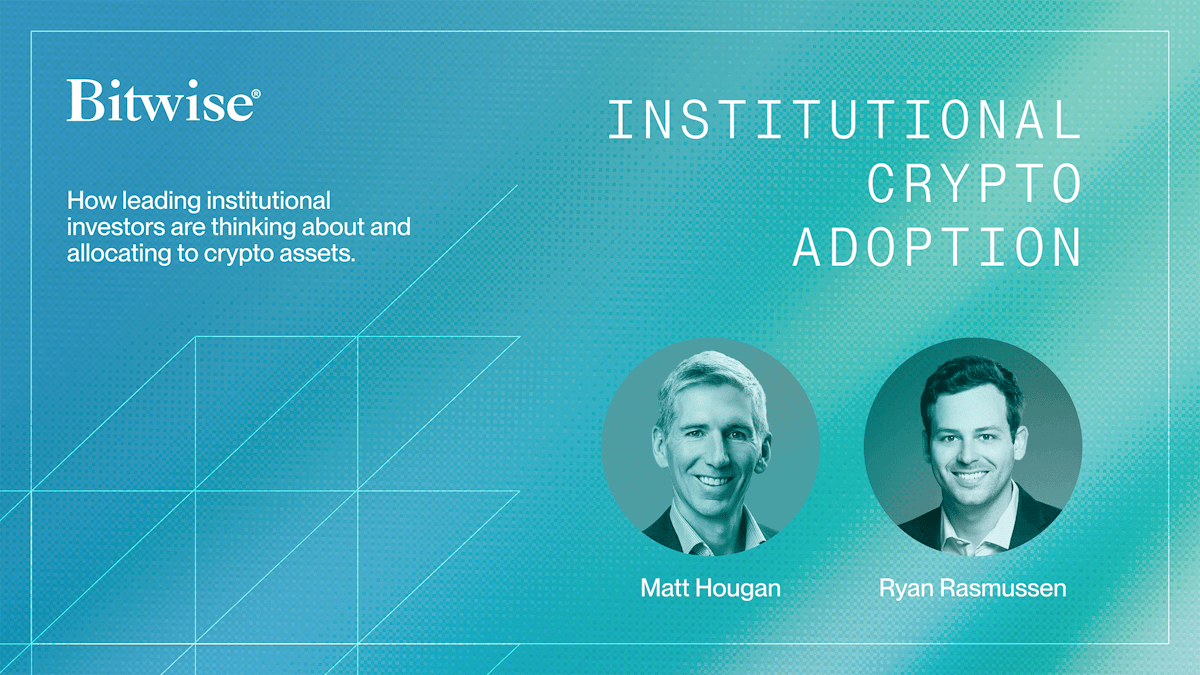
The first thing that stands out is that this type of investor is anything but jittery. Between October last year and April this year, not a single one of the institutions lowered its allocation, even as the crypto market went through a hefty correction. Some did what consumers often forget to do in such periods: they bought the dip.
As you'd expect, price is not an exit criterion for these investors. They only step out when something fundamental changes. An unfavourable shift in laws and regulations gets mentioned, for example, but so does a sector-wide crisis of confidence or the collapse of the original investment thesis.
In that thesis, bitcoin plays a role at every institution Bitwise interviewed. For nearly all of them, it's the first and largest position they hold. These are modest allocations, mind you; 1 to 2 percent of investable assets is typical. The extremes range from 0.5 to 13 percent.
The fact that they apparently only have their toes in the bitcoin water has little to do with conviction, according to Bitwise. It comes down to something more familiar: meetings. The more people who have to sign off, the smaller the position tends to be. Logically, you see the largest positions at family offices, and the smallest at sovereign wealth funds. In practice, the latter have to deal with committees, board members, regulators and central banks.
At that end of the spectrum, career risk is still a limiting factor. The average central banker still reacts to the word bitcoin like a bull in a stadium full of red flags. But on the other side, Bitwise sees the reverse. At family offices and endowments, institutions are asking one another more and more explicitly how much crypto they hold. Internally, this question is increasingly moving to the foreground: why didn't we have it, when our competitors had already taken a position?
The arrival of ETFs has accelerated that turnaround. An investment committee no longer has to form an opinion on crypto-specific infrastructure that's often obscure to them. Buying bitcoin can now be done with a product comparable to everything else already in the portfolio.
A larger survey by Coinbase and EY-Parthenon among 351 institutional investors points in the same direction. Nearly three-quarters of respondents said they wanted to increase their crypto allocation this year. The accompanying volatility is both the appeal and the point of attention: risk management, liquidity and position sizing remain subjects of debate.
 Coinbase and EY-Parthenon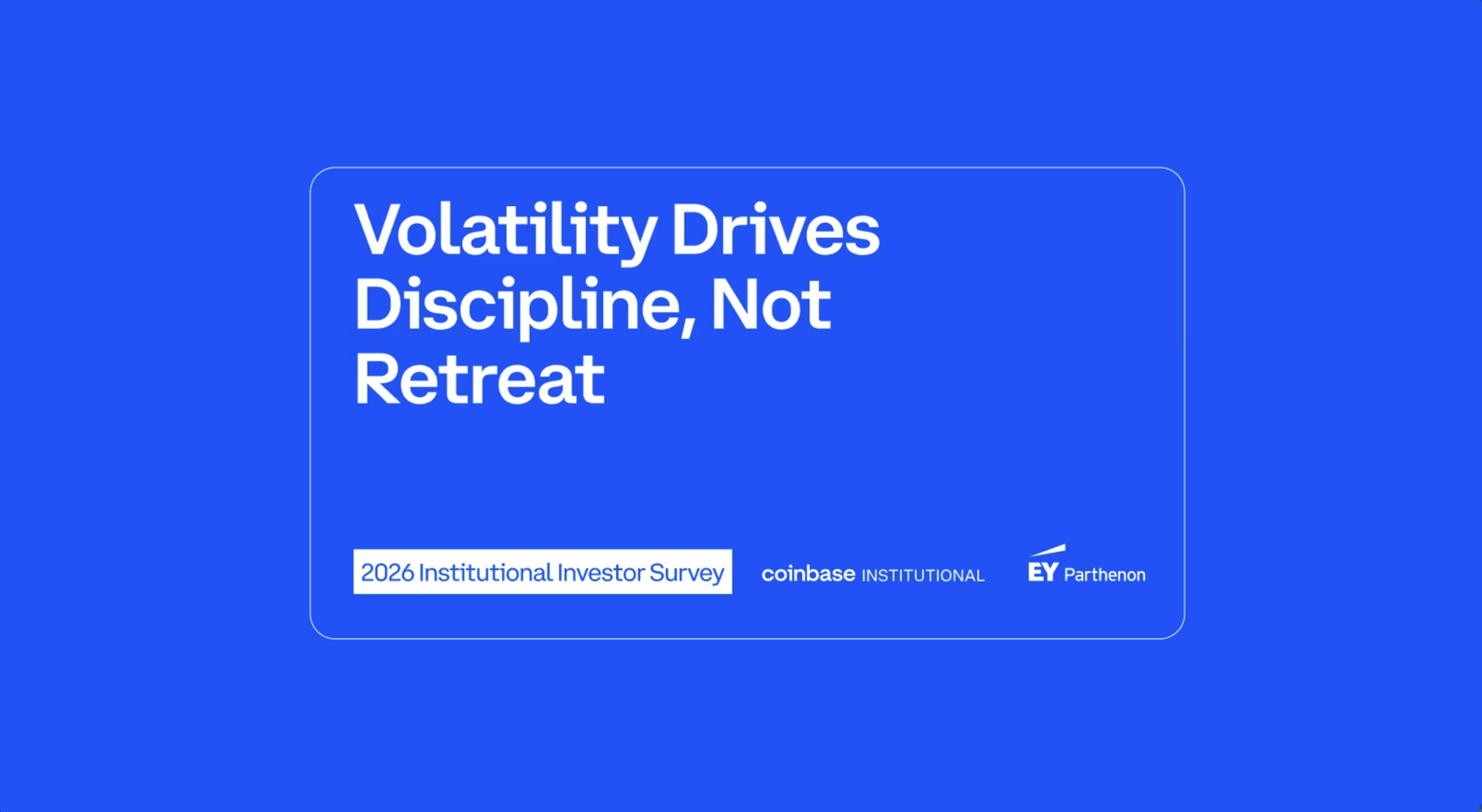
Bitcoin is treated differently from altcoins like ether and solana. Those latter two are viewed in the Bitwise study as tech investments. They have to be used, and the economic value that arises from that has to flow back to the token. Bitcoin is much more often placed alongside gold. Some even see the two as a single category: protection against currency debasement and monetary uncertainty.
More Alpha
Are you a Plus member? Then let's move on to the following topics:
- Bearish analysts capitulate: a new bull market is now the most likely scenario
- Knaken's alleged embezzlement, with a rebuttal from the founder
- BlackRock: AI and crypto can reinforce each other
After that come the news snacks, a handy overview of the news that really mattered this past week.
1️⃣ Bearish analysts capitulate: a new bull market is now the most likely scenario
 Contribution by
 Erik
From respected veterans like Fidelity's Jurrien Timmer and Peter Brandt to the young guns among the analysts: for the past week, the consensus has been that the bottom of the bear market is behind us. That said, caveats keep getting added: not all the signals are green yet. But the fact that the weekly close came in above the 50-week moving average is an important data point for many.
Even the analysts who were still leaning bearish in recent weeks have now turned. Benjamin Cowen, for one. He's been around for years and is respected for a number of solid calls, but also for his lack of hype. Yet now he's donning the sackcloth and ashes, because until recently he still saw no end to the bear:
I was wrong
— Benjamin Cowen (@benjamincowen) September 21, 2026
Not going to make excuses
I deserve to be dunked on
CryptoCon was previously convinced of a move to $30,000 later this year or early next year. Now he writes:
“There must be a limit to every idea and now mine has been reached. [..] So I was wrong that the bear market would continue and I did not buy the lows at 60k.”
The comments under his post are mostly conciliatory in tone. Jamie Coutts of Real Vision offers him some encouragement: “markets humble us all. I appreciate your post and analysis over the years.” For Coutts, it's still fresh in the memory that he and his colleagues had to eat humble pie when, back in the autumn of 2025, they bet on the bull market continuing.
The tone on X is milder now. The end of a bear market is like the start of spring. No one holds it against you for eyeing the first crocuses a little sceptically. Whereas the reverse situation, around the top of a bull market, is far more emotional. The mood is euphoric, and the number of people peering over the analysts' shoulders is much larger. That pressure is absent now.
What may be at play here is that the mistake of failing to take intended profits near the top feels more painful than not getting in near the bottom. That may not be rational, but psychologically it makes sense. A missed selling opportunity at the top is a number in a portfolio app that stays burned into your retina for months afterwards. Whereas the missed profit after a bear market bottom isn't visible as a number on a screen.
The caveats
As mentioned, most analysts add a caveat to their optimism that the new bull market has begun. You'd expect that kind of balance from those still active around the bottom of the bear market. That's why you hear from Alex Thorn: “Regaining the 50w MA has historically served as strong confirmation that bear market lows are in.” Historically you can expect… which indeed offers no guarantee.
🟠 BTC CLOSES WEEK ABOVE 50-WEEK MOVING AVERAGE FOR FIRST TIME IN 45 WEEKS
— Alex Thorn (@intangiblecoins) September 21, 2026
regaining the 50w MA has historically served as strong confirmation that bear market lows are “in”
bitcoin is up 29% in 35 days pic.twitter.com/HzKVUrxMVz
The aforementioned Benjamin Cowen: “I said I was wrong about the May high which I was, and ever since then I have said to watch the weekly close. If this fades back down, then we still go down into Q4.”
2️⃣ Knaken's alleged embezzlement, with a rebuttal from the founder
Contribution by Erik
Just as, according to Tolstoy, every unhappy family is unhappy in its own way, so too is every bankruptcy a unique blend of bad decisions and/or possibly criminal intent. Anyone who reads the FD's reconstruction of the bankrupt Dutch crypto broker Knaken will recognise elements of the mismanagement at the now-defunct FTX and Celsius.
 David van de Velde
You could see Knaken as one of the last bankruptcies from the wave that began in 2022. The fact that Knaken is the little brother of the infamous collapses like FTX and Celsius is of no help to the four thousand customers who can't access their funds. The Public Prosecution Service filed for bankruptcy on 30 June, which the court granted on 16 July. The bankruptcy report shows that customers were collectively owed almost 8.64 million euros; of that, according to Knaken itself, at least 5 million was no longer available. The receiver had earlier called the chance of full repayment exceedingly slim.
The founder's story
An important caveat to the reconstruction that follows is that it's based on an interview with founder Ronald J.
According to him, the misery began with a hack on 6 April 2020. One of Knaken's wallets is hacked, leading to a loss of roughly 20 BTC. The crucial mistake was to not disclose the hack at the time, but instead try to plug the hole.
In a panic, Knaken took up an offer via Telegram to earn BTC. It turned out to be a scam. The hole was now 23 BTC: a major problem for a small crypto broker.
The next attempt to plug the hole was an aggressive growth strategy. From 2021, Knaken signed sponsorship deals with six football clubs, including Feyenoord, through the marketing company Meier Media, also owned by J. According to the AFM, Knaken lent 2.3 million euros to Meier Media, with which J., according to the court, “partly himself” caused the shortfall. Though he fiercely denies having lined his own pockets and showed the FD statements without any private withdrawals.
Less defensible is the attempt by J. and his business partner to, just like Celsius back then, work away a hidden shortfall with increasingly risky positions. J. says he didn't keep the books “all that well administratively.”
Until the end of 2022, Knaken had no separation of assets. Receiver Carl Hamm confirms that business costs and losses were for a time paid out of a single pot that also held customer money. That is a key element of what constituted the fraud case at FTX.
The curtain falls
Knaken's founder saw obtaining a European MiCA licence as the last way out to keep his status and growth prospects. But a compliance firm hired by Knaken itself discovered the problems and went to the AFM. Only then did J. confess to the shortfall. In May it became clear there would be no licence; on 29 June the FIOD raided him and the site went dark.
For customers, including Rico Verhoeven and sports marketer Chris Woerts, it's bitter that they placed too much trust in the competence of a small company and its registration with the DNB. That certainly didn't amount to much at the time.
This week the FIOD carried out two more raids in Rotterdam: the Public Prosecution Service now suspects one or more of those involved of embezzlement and forgery. J. confirms that he is a suspect.
3️⃣ BlackRock: AI and crypto can reinforce each other
Contribution by Peter
Picture this. You tell your AI assistant to arrange a long weekend in Paris. You want to fly, stay somewhere convenient in the city, and see a lot of it in a short time.
For you as the one giving the orders, that's a simple goal. But behind the scenes, your agent has to carry out dozens of tasks. Pulling up flights, comparing hotel prices, tracking down the right public transport tickets, lining up attractions, and ultimately making reservations and booking tickets.
The question is: how does it pay for all that?
BlackRock thinks AI and crypto can reinforce each other in that area. In a recent report, the asset management giant describes an economy in which AI agents independently purchase services. For the hotel room or the plane ticket, they can happily use existing payment rails, like your credit card or a PayPal account.
But for payments of a few cents, or less, that becomes cumbersome. Maybe your agent has to pay a fraction of a cent to search through a database of hotels. Or consult a specialised model to plot the routes between attractions. BlackRock thinks stablecoins are exceptionally well suited to this, and dubs them “machine-native money.”
The payment protocols needed for this are partly already ready to use. With x402, an agent can pay directly for an online service. The server requests money, the agent settles up and then gets access. Over the past 30 days, more than 75 million transactions were processed via x402, worth about 24 million dollars. It's unclear what portion of that can genuinely be attributed to agents, but either way, the proof that the infrastructure works has been delivered.
BlackRock also describes a second development: computing power itself becomes tradeable, as if it were a commodity for AI agents. Companies that need large amounts of GPU capacity face price risk. Just as an airline can hedge against rising fuel prices, an AI company will soon need to be able to lock in a price for computing power.
 Yun Li
So new markets are growing on both sides of the AI coin. On one side stand the agents that independently pay for services. And on the other, the scarce commodity on which all that software runs.
It is by no means certain that stablecoins will become the standard for machine payments. And the market for computing power is still small too. In short, there are plenty of caveats to place on BlackRock's ideas about crypto and AI. But the mere fact that BlackRock ties both worlds together is significant in itself. For the coming bull market, for example.
Because when the market picks up, stories get sought to go with it. Bitcoin has clearly positioned itself as digital gold and a hedge against currency debasement. For the broader crypto market, BlackRock's vision of agentic commerce could form a solid narrative.
🍟 Snacks
To wrap up, a few quick snacks:
- European central banks want to soften a controversial MiCA rule for stablecoins. Issuers currently have to hold thirty to sixty percent of their reserves as bank deposits. According to the European System of Central Banks (ESCB), that actually poses a risk to banks, because the relatively volatile deposits from stablecoins can replace the more predictable balances of consumers. The ESCB would like stablecoin issuers to be allowed to hold their collateral as short-term bonds. Tellingly, Tether had already warned about precisely this problem.
- US regulators are stepping on the gas now that the Clarity Act has stalled. “It's go time,” said CFTC chairman Michael Selig during the CNBC programme Squawk on the Street. He's referring to the use of his statutory authority: powers to modernise the rules for the crypto market himself. The effort is initially aimed at the structure of the US market, the use of onchain assets as collateral, and crypto derivatives. Selig calls crypto the “future of finance” and has no intention of waiting on Congress to steer its growth in the right direction.
- US crypto lobby earmarks $30 million to keep Sherrod Brown out of the Senate. Fairshake, a political action committee with deep pockets, wants to prevent the Democratic former senator from once again winning a seat in America's upper chamber, and is willing to spend tens of millions to do it. Brown was an outspoken crypto sceptic. Fairshake would rather see Republican Jon Husted land in the seat. Fairshake's announcement came shortly after the Clarity Act stalled. How the senators vote will help determine what the dollars in the war chest get spent on.
- Hackers steal $387 million from crypto exchange Bitget. On Thursday, Bitget disclosed the hack, in which more than 100 million XRP and over 30,000 ETH were stolen. Bitget says it can reimburse all its customers from its own security fund. It was the largest of five hacks in a single week. Cosmos, Payy, Duelbits and Magic Eden were successfully attacked as well. In the latter case, ethical hackers managed to move more than 23,000 NFTs out of the attackers' reach.
- Ethereum is set to grow into a “cryptographic world computer.” That's how Vitalik Buterin describes his vision for the network he launched more than ten years ago. The network increasingly looks less like a traditional blockchain. Thanks to new techniques, part of the required verification and computation work can take place off the blockchain. In Hegota, a major upgrade scheduled for next year, the emphasis is on privacy and quantum security. After that come upgrades meant to make ethereum “unrecognisably powerful.”
Thank you for reading!
To stay informed about the latest market developments and insights, follow our team members on X:
- Bart Mol (@Bart_Mol)
- Peter Slagter (@pesla)
- Bert Slagter (@bslagter)
- Mike Lelieveld (@mlelieveld)
We appreciate your continued support and look forward to bringing you more comprehensive analysis in our next edition.
Until then!