
Is America Going to Buy 1 Million BTC?
After a year of silence, the US bitcoin reserve is back on the agenda — no longer as executive order but as law. Are massive bitcoin purchases coming? Plus: on-chain stocks and the SpaceX IPO.

 Contribution by
 Peter
Anyone scrolling through X last Thursday could easily have gotten the impression that America is about to launch a massive buying program to fill its bitcoin vault. Republican Nick Begich published the American Reserve Modernization Act – ARMA – and before long the story was making the rounds that the US planned to buy 200,000 BTC per year, for five years, with the ultimate goal of building a strategic reserve of 1 million BTC.
America's reserves balance sheet is a critical component of our nation's insurance policy, bolstering our currency and providing assurance during times of uncertainty. Over time, the prevailing sentiment as to what constitutes a durable store of value can shift, and as such it is… pic.twitter.com/7XfBwAWFGi
— Congressman Nick Begich (@RepNickBegich) May 21, 2026
That sounds spectacular, but... it doesn't appear to be accurate.
First, some background on this bill. Trump positioned himself explicitly as the bitcoin president during his election campaign. In March 2025, he signed an executive order establishing a Strategic Bitcoin Reserve and a separate Digital Asset Stockpile. The reserve was primarily supposed to be filled with bitcoins the US government acquired through criminal or civil proceedings. In other words: bitcoins that end up with the government would no longer be automatically sold off.
The limitation of such a presidential executive order is that a subsequent president can reverse it relatively easily. That's what makes ARMA politically significant. Begich wants to enshrine Trump's bitcoin reserve in law. That transforms it from a policy choice of a single administration into a structural component of American reserve policy.
The bill itself hasn't been published. We therefore have to rely on Begich's own summary. His bill formally establishes a Strategic Bitcoin Reserve, with the Treasury Department taking responsibility. Other cryptocurrencies go into a separate Digital Asset Stockpile. Government agencies must report their crypto holdings, management will be consolidated, and there will be public quarterly reports, independent audits, and Congressional oversight.
All bitcoins held in the reserve must be kept for a minimum of twenty years. The bill thereby aims to prevent a future administration or coincidental political majority from selling off US bitcoin holdings whenever it seems fiscally convenient.
So much for the sober take on the bill. The social media version is more exciting. There, ARMA is presented as a repackaged version of the earlier BITCOIN Act, with a concrete acquisition target of 1 million BTC. That idea didn't come out of nowhere, as Begich himself has publicly spoken about the idea that America should ultimately own roughly 5 percent of all bitcoin.
The American Reserve Modernization Act (ARMA) would authorize the U.S. Treasury to acquire up to 200,000 bitcoin per year for five years, targeting a reserve of 1 million BTC.
— TFTC (@TFTC21) May 21, 2026
The bill was introduced Wednesday by Rep. Nick Begich with 16 original cosponsors. It is a rebranding… pic.twitter.com/7w5VHrwtdz
But that's quite different from saying ARMA mandates the purchase of 1 million BTC. According to The Block, which claims to have reviewed the actual bill text, such a hard acquisition target is precisely what's missing from this proposal. What ARMA does do is mandate the exploration of so-called budget-neutral strategies to expand the reserve. Think of adding existing assets, seizures, revaluations, or other mechanisms that don't require additional taxes.
The claim that the US already holds "hundreds of thousands of bitcoin" also warrants nuance. On-chain trackers sometimes attribute more than 300,000 BTC to the US government. But they don't always distinguish between bitcoins that have been seized, those held in custody, those still legally tied up in ongoing proceedings, and those that have definitively been forfeited to the state.
That distinction matters a great deal. Last year, a FOIA request revealed that the US holds approximately 29,000 BTC. That's still worth billions of dollars, but it's something very different from the often-cited stash of hundreds of thousands of bitcoin. This is where one of ARMA's stronger points lies: mandatory public audits would clarify what the US government actually owns, preventing those numbers from being inflated.
All in all, this is positive news for bitcoin and bitcoin holders. ARMA won't immediately create a massive buy wall on exchanges, but it does meaningfully deepen bitcoin's status as a geopolitical and reserve instrument. That sounds less spectacular than "America buys 1 million bitcoin." But for bitcoin as a maturing asset, it may be healthier: less hype, more transparency, and more sustainable growth.
More Alpha
Are you a Plus member? Then we continue with the following topics:
- Crypto companies to bank at the Fed
- On-chain stocks put in the waiting room
- To the moon: the SpaceX IPO
Below that, you'll find the news snacks – a handy roundup of the news that actually mattered last week.
1️⃣ Crypto companies to bank at the Fed
Contribution by Peter
For years, the crypto industry faced an invisible and somewhat mundane risk: the bank account. Crypto companies quickly discovered that a registration, license, or popular product was no guarantee of a stable banking relationship. Accounts were closed, payments delayed, and partnerships abruptly terminated. Especially in the United States, the sense grew that banks and regulators were jointly trying to financially isolate the sector. That policy earned a mythical name: Operation Choke Point.
Anxiety about this intensified after the collapse of Silvergate, Signature, and Silicon Valley Bank in 2023. These were precisely the banks where many crypto companies held their accounts. Officially it was about risk management, but the industry felt differently: the infrastructure around crypto was being deliberately dismantled.
Since Trump's return, the winds have shifted. Washington is talking about innovation and market structure again, rather than solely about risks and enforcement. Crypto companies are being treated less as a contagion risk and more as a strategic industry.
Still, the relationship between banks and crypto remains somewhat uneasy. Banks increasingly see crypto companies encroaching on their turf. Stablecoins compete with payment networks. Exchanges offer yield and international transfers. There's therefore an inherent incentive for banks to take the wind out of the sails of this group of emerging competitors.
That's why a recent announcement from the Federal Reserve is so important. Last week, the Fed published a proposal introducing so-called payment accounts: limited accounts that allow certain parties to process payments directly through the central bank's infrastructure. It's not the full suite of services that banks use, including emergency lending and credit lines, but it does provide direct settlement of transactions using central bank money.
That sounds technical, but it strikes at the heart of the problem. Because anyone with direct access to the Fed's infrastructure becomes less dependent on commercial banks that could, in theory, pull the plug on their services at any moment.

The central bank is thereby responding to Trump's call to give a broader segment of the financial market access to the Fed's infrastructure. An initial cautious step in that direction was already taken earlier this year, when Kraken gained similar access to the central bank's payment network through the Kansas City Fed. The payment accounts are a formalization of that – an experiment being converted into official policy.
That said, we're not quite there yet. The Fed hasn't announced a final regulation, but a proposal for public comment. Banks, fintechs, lobby groups, and lawyers can now weigh in on the concept. After that, the framework can still be adjusted.
2️⃣ On-chain stocks put in the waiting room
Contribution by Peter
Several American companies want to move stock trading to blockchain networks. But that's not something you can just do, since securities regulations leave little room for innovation. To make it possible anyway, the SEC is working on a temporary exemption from those strict rules – a kind of sandbox where new technologies can be legally tested within certain limits, without being immediately crushed under traditional legislation.
The origins of this initiative trace back to SEC Commissioner Hester Peirce. As early as 2024, she advocated for a sandbox where parties could experiment on a limited scale with issuing, trading, and settling on-chain securities. In early 2025, the idea gained institutional weight with the creation of the Crypto Task Force, led by Peirce. That working group explicitly asked market participants where existing rules were getting in the way.
Under SEC Chairman Paul Atkins, the space emerged to make this more concrete. In June 2025, he spoke for the first time clearly about an innovation exemption: temporary, conditional exemptions allowing both registered and unregistered parties to test on-chain products. Later, Atkins outlined the conditions, including volume limits, whitelisting, reporting to the SEC, and compliance functions built into the tokens themselves.
The exemption appears primarily aimed at tokenized equities – existing stocks wrapped in an on-chain layer. That layer gives those stocks superpowers, in the form of lower costs, faster trading, and 24-hour markets. In the most ambitious version, trading via AMMs or other decentralized protocols would also become possible. But perhaps the most important effect is that crypto infrastructure would gain an official place at the heart of the American capital market through this route.
And so expectations kept building as the announcement of the exemption drew closer. In April, Atkins said the SEC was "on the verge" of opening the sandbox. Last week, Bloomberg reported that the door would open this week. Until... the lock stayed on. First Peirce tempered expectations, and on Friday it emerged that on-chain stocks had been put back in the waiting room after all.
🚨NEW: SEC Commissioner and Crypto Task Force chief @HesterPeirce is tempering expectations around the agency's contemplated innovation exemption for tokenized stocks, saying she expects it to apply narrowly to onchain equity products, not synthetic tokens that mimic stocks… https://t.co/IHBCbTHfnI
— Eleanor Terrett (@EleanorTerrett) May 21, 2026
The regulator wants to await the outcome of a key debate: who gets to tokenize?
Crypto players like Coinbase and Ondo want third parties to be able to do it. They could then bring existing stocks on-chain through a platform or intermediary without explicit permission from the issuing company. But traditional market participants and exchange operators want existing issuers to remain central. Nasdaq, for example, is working on a model where tokenized stocks retain the same rights, tickers, surveillance, and market processes as regular stocks.
Last week, that sticking point turned out to be significant enough to delay the expected publication. Exchanges and other market participants objected to provisions around third-party tokens, primarily over questions about voting rights, dividends, ownership, investor protection, and market oversight.
The innovation exemption is therefore likely not dead, but delayed. The core question remains: does tokenization represent a new, open market layer on top of existing securities, or primarily a regulated upgrade of traditional exchange infrastructure?
3️⃣ To the moon: the SpaceX IPO
 Contribution by
 Erik
Last Wednesday, SpaceX filed its IPO prospectus with the SEC. The company thereby confirmed plans for an IPO next month, which could become the largest ever. SpaceX (SPCX) will be listed on the Nasdaq, likely on or around June 12. The filing revealed that the company holds more BTC on its balance sheet than previously thought: over 18 thousand.
SpaceX is aiming to raise $80 billion or more, at a valuation in the range of $1.75 trillion. That would immediately place the company in the top ten most valuable publicly traded companies in the world. Elon Musk retains 85% of voting rights.
An internet and AI company with a rocket hobby
When most people think of SpaceX, they think of a rocket builder that finances its interplanetary dreams with commercial projects like satellite launches. But spaceflight is no longer the company's largest business. SpaceX has become a conglomerate.
Starlink is its cash cow. This global broadband internet project generated $11.4 billion in revenue last year with healthy profit margins, and saw subscriptions grow by 100% in a single year.
SpaceX's big bet is its AI division xAI, which also includes X and Grok. The AI division is currently deeply unprofitable, but obviously has enormous potential – especially in the hands of Musk & co. Because what Musk's companies have demonstrated is that they're incredibly good at scaling fast and building innovatively. Whether it's rocket factories or battery factories, production lines get spun up at breakneck speed.
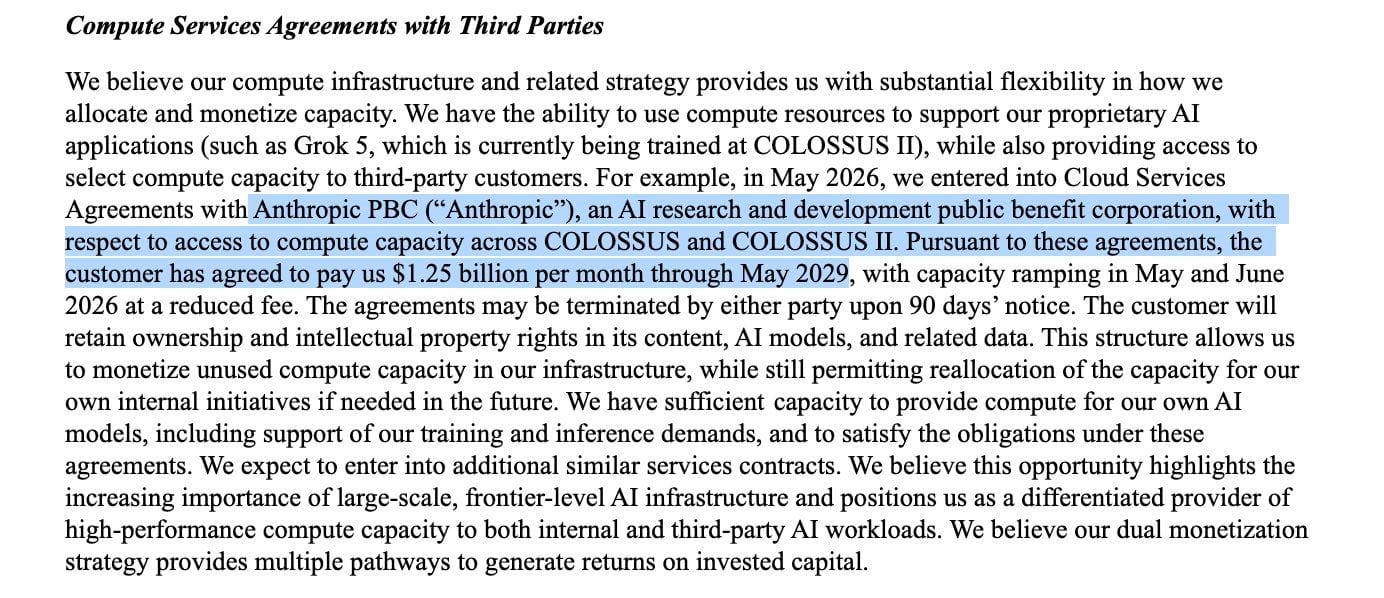
Anthropic, which competes with xAI's Grok through Claude, knows this and turns out to be paying $1.25 billion per month to use Colossus, xAI's AI compute center that was built from the ground up in just four months. That was a striking detail in the prospectus.
Anyone buying SPCX stock at a valuation of roughly $1.75 trillion is investing in the expectation that internet, AI, and spaceflight under one roof represent the future. SpaceX itself claims a total addressable market of $28.5 trillion, with 93% attributed to AI. That explains why the seemingly outrageous valuation isn't as far-fetched as it looks, at least according to SpaceX.
Already trading on Hyperliquid
If you don't want to wait for the stock to list on the exchange, you can already get in. The perps version of SpaceX has been trading on Hyperliquid for over a week as the SPCX-USDC pair, at a price of 206 USDC at the time of writing. There's reason to believe Hyperliquid trading has good predictive value. Cerebras went live on Hyperliquid before listing on the exchange on May 1. One hour before the Nasdaq open, the on-chain contract was trading around $340. The stock then opened at $350, while the official IPO price had been set at $185.
Bitcoin surprise
Buried among the accounting appendices, bitcoiners found a pleasant surprise. While it was known that SpaceX held BTC on its balance sheet, it turned out to be hodling more than expected: 18,712 bitcoin. Purchased at an average price of roughly $35k per coin. That would also place SpaceX in the top 10 of publicly listed companies with the largest BTC treasuries.
Whether this is bullish for BTC is unclear. On one hand, it's nice that a company of this stature believes in BTC. On the other hand, mega-IPOs like this tend to suck attention and capital flows away from the crypto market. AI and rockets: that's tough to compete with when it comes to investment narratives.
SpaceX isn't the only one planning an IPO. OpenAI is preparing to confidentially file a prospectus this week. It's targeting an IPO in September, at a valuation that could also exceed one trillion dollars. Anthropic is also reportedly eyeing a public listing.
🍟 Snacks
To wrap up, some quick snacks:
- Truth Social pulls bitcoin ETF applications. Trump's media company unexpectedly pulled the plug on its SEC filings for its bitcoin fund and combined bitcoin/ether fund this week. It turns out to be a strategic pivot. A new application will be filed soon, but under a different regulatory framework that offers more flexibility for things like futures, derivatives, and broader investment strategies. In doing so, Truth Social is trying to sidestep the cutthroat competition in the spot ETF market.
- The CFTC sues Minnesota over its aversion to prediction markets. On August 1, the state will become the first in America to explicitly ban platforms involving sports, election, and weather betting, with heavy penalties for violators. According to the regulator, Minnesota is overstepping its authority, since prediction markets fall under federal oversight. The conflict touches on a broader power struggle between states and Washington over what prediction markets actually are: illegal gambling or legitimate financial markets. The CFTC has now sued six states.
- US bitcoin funds lost $1.26 billion in capital last week. The outflow over ten trading days rose above $2 billion, following a period in which ETFs had been attracting substantial inflows for weeks. The reversal coincides with rising bond yields, persistent inflation, and fading expectations for rate cuts in the US. The bigger picture remains strong, though: since the funds launched, nearly $58 billion has flowed in on a net basis, and on-chain data shows no panic among long-term holders.
- Zerohash has received an electronic money institution (EMI) license from DNB. The company is thereby positioning itself explicitly as a regulated stablecoin player in Europe. Behind the scenes, Zerohash provides crypto infrastructure to banks, brokers, and fintechs. The American company emerged from the institutional trading platform Seed CX and operates in Europe from Amsterdam. The combination of a MiCA and an EMI license is important, because certain stablecoin services in Europe are classified not only as crypto services but also fall under the domain of electronic money and payment services.
- Dutch major banks unexpectedly back European stablecoin after all. ABN Amro, Rabobank, and ING are joining Qivalis, an Amsterdam-based consortium of now 37 European banks that aims to launch a euro stablecoin under DNB supervision later this year. It's intended to counter the dominance of dollar stablecoins from the likes of Tether (USDT) and Circle (USDC). The move is notable because these banks kept crypto at arm's length for years, citing fraud and speculation. They now see stablecoins as a potential building block for payments, crypto trading, and tokenization.
- Departing leaders and governance frustrations: ether faces deep bear-market sentiment. Investors are searching for explanations for the coin's poor performance. The price of ETH has dropped nearly 10% over the past 30 days. That stood in stark contrast to competing coins like Solana (-0.6%) and Hyperliquid (+51%). The arrows are pointed at the Ethereum Foundation. In recent weeks, several key figures have departed. Ethereum figurehead Vitalik Buterin felt compelled to respond himself: according to him, the foundation needs to become smaller, leaner, and less dominant.
Thank you for reading!
To stay informed about the latest market developments and insights, follow our team members on X:
- Bart Mol (@Bart_Mol)
- Peter Slagter (@pesla)
- Bert Slagter (@bslagter)
- Mike Lelieveld (@mlelieveld)
We appreciate your continued support and look forward to bringing you more comprehensive analysis in our next edition.
Until then!