
Halfway There, and They Still Don't Get It
Bitcoin halving: we're halfway through the cycle toward 2028, yet myths about its origins keep circulating. Why the protocol marches on — and why misconceptions, like the CIA theory, refuse to die.

 Contribution by
 Peter
It's Monday, April 20, 2026, and we're already past the halfway mark of this bitcoin cycle. The previous halving, back in April 2024, still feels relatively fresh. Yet the network has been quietly humming along toward its next milestone. If the pace stays roughly the same, the fifth halving will arrive around April 10, 2028. At that point, the miner reward drops again, from 3.125 to 1.5625 BTC per block. The daily supply of newly minted bitcoins will fall from roughly 450 to 225.
Next ₿itcoin Halving Progress
— Documenting ₿itcoin 📄 (@DocumentingBTC) April 14, 2026
▓▓▓▓▓▓▓▓▓▓░░░░░░░░░░ 50%
Loading…Please HODL
Current Block: 945,031
Halving Block: 1,050,000
Blocks Remaining: 104,969
Days Remaining: ~729
This mechanism sometimes evokes a strange sense of wonder. Because the system keeps marching forward with the precision of a metronome, while the narratives surrounding it... fly off in every direction.
It's safe to say that bitcoin is no longer some obscure internet curiosity. Yet tall tales about its origins still make the rounds. The latest came from Jiang Xueqin, a Chinese-Canadian commentator who is often presented online as a professor but is actually a teacher at a high school in Beijing. On a widely listened podcast, he claimed that bitcoin is essentially a CIA operation. He wanted to know where the databases are, where the servers are located, physically. To him, that seemed like a logical question. To anyone with even a basic understanding of how bitcoin works, it was above all a revealing moment.
Professor Jiang Xueqin claims Bitcoin was created by the CIA.
— Altcoin Daily (@AltcoinDaily) April 15, 2026
"When you do game theory analysis & you look at all posibilities - you end up with the deep state. You end up with the CIA." pic.twitter.com/Zht3eLo7SM
Xueqin presents himself as someone who has clearly thought things through. He sprinkles in geopolitical trends and game-theory concepts to appear credible. Many people can easily imagine a world of states, banks, agencies, headquarters, interest groups, and secret programs. But a network without an owner, without a central server, without a CEO, without a marketing department, and without a country of origin? That's where people's brains start to short-circuit.
The question "where are bitcoin's servers" reveals a childlike lack of understanding on Xueqin's part. It also immediately raises doubts about the other domains from which he draws his wisdom; that expertise turns out to be paper-thin.
For the record: bitcoin runs on countless computers all over the world. In different countries, operated by different people, at different companies, and for different reasons. Nobody needs to trust each other to collectively maintain a single shared history of transactions. That is the core innovation — that's where the breakthrough lies.
The software has been running in the open for seventeen years. The code is open source. Anyone can inspect it. Anyone can run a node. Anyone can verify what the rules are. That's precisely why it's so bizarre that in 2026, people still act as though bitcoin's servers are humming away deep in a Langley basement, behind a metal door with a red light above it.
Of course, bitcoin's origin story remains fascinating. The fact that its creator's identity is unknown certainly adds to the mystique. But as a 'game theorist,' Xueqin should surely be able to arrive at multiple scenarios — and then assign the CIA as creator and operator the lowest probability of all.
If we take a step back, the timing of these kinds of stories isn't even that surprising. For large groups of people, suspicion has become the default mode of thinking. You only need to look at the Epstein files and the behavior of world leaders to understand why. There must be a culprit. A power. A hidden hand. People handle mystery poorly, especially when that mystery has generated trillions in market value and is taken seriously by governments, exchange-traded funds, and asset managers. In that context, "nobody owns this" is an unsatisfying answer.
And so bitcoin does two things at once. It becomes increasingly normal and increasingly strange. More normal, because established names are participating, regulations are embedding it into society, and the market looks ever more professional. Stranger, because bitcoin's core still runs counter to how most people understand power and money. A neutral, digitally scarce asset without an issuer still feels like science fiction to many. And where people can't make sense of something, fairy tales are born.
More Alpha
Are you a Plus member? Then we continue with the following topics:
- Bitcoin developers want to permanently freeze funds
- Financial sector watches 𝕏 transform into a formidable competitor
- Yet another DeFi hack wipes out hundreds of millions
Below that, you'll find the news snacks — a handy overview of the news that actually mattered last week.
1️⃣ Bitcoin developers want to permanently freeze funds
 Contribution by
 Erik
No, don't worry — your sats are fine. But a grenade has been lobbed into the digital henhouse. A formally submitted Bitcoin Improvement Proposal has been filed that would essentially force the entire ecosystem to migrate to quantum-safe cryptography, with frozen coins as the penalty for non-compliance. The radical element of BIP-361: anyone still sitting on a vulnerable address five years after potential activation would have to watch as their funds are frozen by the network itself.
BIP 361: "Post Quantum Migration and Legacy Signature Sunset" has been published.
— Murch (@murchandamus) April 14, 2026
You can read it here: https://t.co/JIuMbitQQj pic.twitter.com/iH63XIWi6k
The proposal comes from six developers, including the well-known Jameson Lopp. Within the first week after publication, it already stirred up a storm. How do the authors justify their proposal to eventually freeze BTC if the owner takes no action? They start with a quote from Satoshi...
"Lost coins only make everyone else's coins worth slightly more. Think of it as a donation to everyone." – Satoshi Nakamoto
...and put their own spin on it:
"Quantum recovered coins only make everyone else's coins worth less. Think of it as a theft from everyone."
By "quantum recovered coins," they mean coins stolen by criminals using a quantum computer.
If you're somewhat familiar with this topic, you'd immediately think of the bitcoins that circulated during the Satoshi era as a prime target for such an attack. For those early bitcoin addresses, the associated public key is plainly visible on-chain — like a combination lock that anyone can keep trying combinations on.
Most newer address types hide that public key from view. But that doesn't mean those newer address types are safe from BIP-361. Because all address types are vulnerable at the moment of spending. As soon as the public key becomes visible in the mempool, a quantum computer can sink its teeth into it. Sure, ten minutes or so isn't much time, but Lopp & co. aren't interested in half measures.
The proposal: three phases of migration
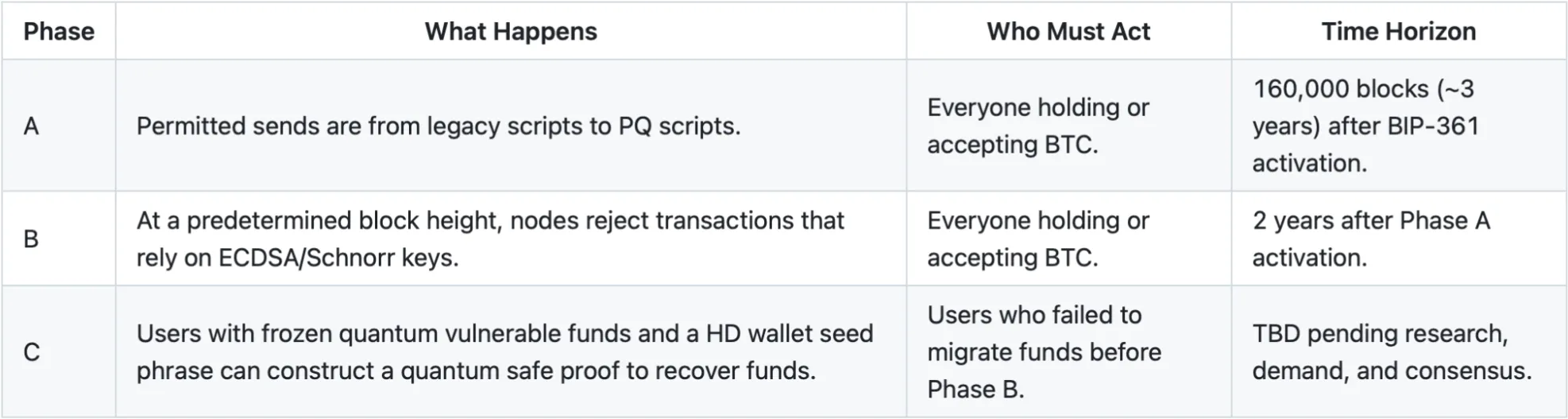
BIP-361 is structured as a phased soft fork. Each phase has a hard deadline, giving users a strong incentive to migrate to new, quantum-safe address types.
Phase A starts after 160,000 blocks, or roughly three years after activation: you can only send BTC to quantum-safe addresses. Old address types can no longer receive new coins. This pushes the entire ecosystem toward the new standard.
Phase B starts two years after Phase A and affects BTC held in old addresses: those sats can no longer be spent at all. The current type of signatures will simply no longer be accepted by the network. Coins that weren't migrated in time are frozen on the network forever.
What counts as 'old address types'? All addresses where the public key is traceable on-chain and the address types where the public key is revealed when making a transaction. And that's essentially… all commonly used addresses; only recently was a quantum-safe address type proposed in BIP-360.
Freeze them, that's the proposal. If you're too late migrating as an owner, Phase C offers one last escape hatch. Using your seed phrase, you can prove that an address belongs to you and still move your coins. This proof is delivered using zero-knowledge cryptography, so your seed phrase itself is never made public.
Unfortunately, this last escape route doesn't work for bitcoins that were last moved before 2013 — including Satoshi's. The mechanism for deriving private keys from a seed phrase simply didn't exist back then.
Thoughts on BIP-361:
— Jameson Lopp (@lopp) April 15, 2026
* I know folks don't like it. I don't like it myself. I wrote it because I like the alternative even less.
* It isn't a spec, nor is it proposed for activation. It's a rough idea for a contingency plan that needs more R&D.
* I hope it never needs to be…
Quantum risks are being taken seriously
This is already the second BIP in a few months tackling the anticipated threat of quantum computers. Since Nic Carter gave the discussion a major push a few months ago, the threat has been taken far more seriously in bitcoin circles.
The same Nic Carter foresees a battle over the freeze debate that's emerging, expecting that major stakeholders like Strategy and ETF providers will be in favor of such a soft fork.
Carter proposes a third path, free from such a drastic measure. He hopes the builder of the first sufficiently powerful quantum computer would be appointed by a U.S. court as custodian of all bitcoins from the Satoshi era, placing them in a trust whose ultimate destination would be America's own strategic bitcoin reserve. That would obviously only work if the company in question were a reputable firm like Google.
2️⃣ Financial sector watches 𝕏 transform into a formidable competitor
Contribution by Peter
For years, 𝕏 was simply the place where investors got each other worked up. That's where rumors started, hype was born, FOMO kicked in, and sooner or later panic struck again. But between consuming posts and acting on them, there was always a hurdle: you had to leave the app, go to your broker, your bank, another platform entirely, just to hit a buy or sell button. That barrier is now being chipped away, slowly but surely, by 𝕏.
𝕏 has always been the best source of financial news for traders and investors. Billions of dollars are allocated every day based on what people read on Timeline.
— Nikita Bier (@nikitabier) April 14, 2026
Today we're launching our new Cashtags feature in the US and Canada on iPhone, bringing real-time financial data to… pic.twitter.com/c8s7X9gHTO
Last week, 𝕏 launched so-called Smart Cashtags in the US and Canada. Search for a ticker like $BTC or $AAPL, and you immediately get price data and relevant posts in your timeline. And in Canada, it already goes a step further. Through a pilot with Wealthsimple, users can tap through from a cashtag to a screen where they can buy the asset in question. Wealthsimple is one of Canada's largest fintechs, with 3 million clients and 100 billion Canadian dollars under management.
Hello Smart Cashtags.
— Wealthsimple (@Wealthsimple) April 14, 2026
Starting today, any ticker tapped on @X routes Canadian investors straight to Wealthsimple to trade. One tap from conversation to order entry. That's it. pic.twitter.com/zxwRh8zJaP
So 𝕏 isn't a new broker. Elon Musk's company is essentially layering on top of the existing web of financial players. Smart move, because it means the regulatory burden and execution fall on partners. 𝕏 sticks to what it does best: converting attention into action. In the crypto world, that's a powerful position. Everyone knows that financial markets are partly made on 𝕏.
On top of this relatively simple feature, an entirely new business line recently entered beta: 𝕏 Money. Visa is the first payments partner. In announcements, 𝕏 talks about a digital wallet, peer-to-peer payments, and bank account integrations. Screenshots and reports have been circulating about 6 percent interest on balances, FDIC coverage via Cross River Bank, and a metal debit card with cashback.
Slowly but surely, Musk's vision of 𝕏 as the everything app is taking shape. And the financial sector is watching with growing tension. By some estimates, 𝕏 has around 550 million monthly users. If a distribution giant of that scale brings together prices, sentiment, payments, accounts, and eventually perhaps trading itself, the result is a channel larger than many a bank, broker, or exchange.
Whoever controls the step from information to execution can earn from orders, partner deals, payment flows, and balances. Musk has been talking for years about an American version of WeChat. For the first time, it's starting to look less like bluster and more like an actual product.
The 𝕏 Money card. Gorgeous.
— Mario Nawfal (@MarioNawfal) March 30, 2026
No card number. Just your @XHandle on steel.
Cashback. Interest. Zero FX nonsense.
A bank card with an 𝕏 attitude. Solid.@X https://t.co/3CtLEe9H2c pic.twitter.com/PjYcvUWNuO
With that comes growing resistance, including from U.S. politics. Senator Elizabeth Warren warned this week that 𝕏 Money could pose risks to consumers, financial stability, and even national security. Earlier, Senator Blumenthal had already requested documents from Visa about its partnership with 𝕏. And those concerns aren't entirely unfounded. With a platform that reduces the distance between influence and transaction to nearly zero, Musk doesn't just have a new business model on his hands — he has a new battleground.
3️⃣ Yet another DeFi hack wipes out hundreds of millions
Contribution by Peter
It's only April, and 2026 must already feel like a war of attrition deep in the DeFi world. The list of the year's biggest hacks doesn't feature one or two incidents — it's a whole parade. The common thread is clear: it's not just code that's vulnerable, but also the people, the infrastructure, and the links between them.
Two weeks ago, we already wrote about Drift Protocol, the major derivatives exchange on Solana that was drained of roughly $285 million on April 1. According to reconstructions, social engineering was at the heart of the attack. Through compromised team members, pre-signed transactions could be executed at will. A North Korean team is suspected to be behind it.
To compensate for the damage, a $150 million rescue package is ready, largely funded by Tether. Part of this deal is that Drift switches to USDT, moving away from USDC, the stablecoin of Tether competitor Circle. Circle, in turn, faces lawsuits for allegedly failing to freeze stolen Drift funds.
The following week, a different type of theft emerged. Users who installed the Ledger Live app on their iPhone were drained immediately after entering their recovery phrase. It turned out to be a fake app, named LeddgerLĭve. More than fifty victims collectively lost around $9.5 million. The most heartbreaking case was that of musician G. Love, who lost 5.92 bitcoin — what he called his retirement savings, built up through ten years of DCA.
🚨 A fake Ledger Live app in the Apple Store led to $9.5M stolen from over 50 victims in under one week, according to recent work by crypto detective ZachXBT.
— International Cyber Digest (@IntCyberDigest) April 14, 2026
The app even has fake 5-star reviews describing it as "incredibly smooth and reliable." pic.twitter.com/9EwMK0zFEI
And this weekend, KelpDAO claimed the dubious prize for the biggest DeFi hack of 2026 so far. KelpDAO is a protocol in the restaking space: users lock up ether and receive a tradeable receipt token in return, in this case rsETH. To move that token across different networks, KelpDAO used LayerZero, a protocol that helps relay messages from one network to another.
That's where things went wrong. Attackers stole 116,500 rsETH, worth roughly $292 million, via KelpDAO's LayerZero bridge. According to LayerZero, it was a highly sophisticated attack. They suspect a state actor is behind it, pointing to North Korea.
The attack exploited so-called RPC nodes — servers that relay blockchain data to other systems. KelpDAO had set up the controls on these servers very narrowly, with just a single gatekeeper. A single point of failure that, once compromised, could mark malicious messages as valid.
This way, the attacker made KelpDAO's bridge believe that real ETH had been deposited elsewhere, when it hadn't. Based on that forged message, the system released new rsETH — a large amount of 'unbacked' tokens. The attacker could then immediately sell them or use them as collateral on other DeFi platforms, such as Aave, where they could borrow real ETH against them. In this way, fictitious tokens were converted into real value and siphoned off.
The impact of the hack was felt far beyond KelpDAO's walls. Aave had to freeze rsETH markets, dozens of protocols paused their cross-chain operations as a precaution, and according to CoinDesk, more than $13 billion in total value drained from the DeFi ecosystem within two days. It is not yet known whether and how the losses will be passed on to users of affected DeFi protocols.
 Sam Reynolds
In theory, DeFi is all about composability: building blocks that fit neatly together. In practice, it also means that a single weak link can make the entire ecosystem wobble.
Drift showed that developers can be the weakest link. The fake Ledger app showed that users themselves are under fire. And KelpDAO demonstrates once again how risky 'DeFi' infrastructure is when the principle of decentralization isn't fully applied.
🍟 Snacks
To wrap up, some quick snacks:
- Goldman Sachs is also launching its own bitcoin ETF. Well-known ETF watchers are in 'shock' as they've seen virtually all major traditional financial giants enter the bitcoin space in a short time. Goldman's ETF aims to generate monthly cash flow for shareholders, using underlying options strategies. Similar products have already attracted hundreds of billions in equity markets. Bitcoin is being packaged into something traditional investors recognize.
- ECB backs plan to centralize oversight of large crypto firms. Supervision would shift from national regulators to ESMA, a European authority based in Paris. Brussels wants to prevent firms from shopping around in countries like Malta, Ireland, and Luxembourg for softer rules. Several EU member states have raised objections, partly due to the potential impact on their local financial sectors. Negotiations on the proposal are set to begin in the coming months.
- Kraken gears up for an IPO and acquires a key position in the derivatives market. The IPO plans coincide with a capital injection from Deutsche Börse. The exchange is investing $200 million for a one-and-a-half percent stake in Kraken's parent company Payward. Kraken is using such capital for strategic acquisitions, among other things. The exchange announced the purchase of Bitnomial — for $550 million, Kraken acquires CFTC-regulated derivatives infrastructure.
- Strategy wants to pay STRC dividends twice a month going forward. The goal is to stabilize trading in the stock and boost demand. The crypto world has long discussed continuous, near-instant cash flows. Strategy is now cautiously bringing that idea to the stock market. The faster money moves, the sooner it can be redeployed — that's the thinking. STRC is a preferred share of Strategy. The proceeds from selling the stock go toward replenishing Strategy's own bitcoin treasury.
- U.S. bitcoin funds see over $1 billion in inflows. Last week, the ETFs were in demand among investors. Total assets under management rose from $94 billion to $101 billion. On the other side of these buyers are industrial bitcoin miners; they sold more than 32,000 BTC in the first quarter — more than in all of 2025. An estimated 20% of miners are currently operating at a loss.
Thank you for reading!
To stay informed about the latest market developments and insights, follow our team members on X:
- Bart Mol (@Bart_Mol)
- Peter Slagter (@pesla)
- Bert Slagter (@bslagter)
- Mike Lelieveld (@mlelieveld)
We appreciate your continued support and look forward to bringing you more comprehensive analysis in our next edition.
Until then!