
From Napster to Nakamoto
What do the compact disc, Napster and bitcoin have in common? Together they tell the story of a digital world where copying became free — and scarcity had to be reinvented from scratch.

 Contribution by
 Peter
In the German town of Langenhagen, just north of Hanover, a quiet revolution took place on 17 August 1982. It was there that compact discs first rolled off the production line on a large scale. You know the ones — those shiny twelve-centimetre discs, with a hole in the middle the size of a small coin, and a rainbow that appeared when you held them up to the light.
Philips and Sony had spent years developing the technology. For music lovers, the leap forward was mainly a practical one. Compared to cassettes and records, CDs were sturdy. Needles and grooves were a thing of the past. Rewinding tapes or flipping records? With the arrival of the CD, you skipped to a new track at the push of a button.

The biggest innovation, however, was hidden behind that ease of use. With the introduction of the CD, music made the leap from the analogue to the digital age. Music had become information. Sound waves took the shape of zeroes and ones, only to reach your ears again later as music, via electrical pulses and vibrating membranes.
At first, that information was still locked away inside a piece of aluminium-coated plastic. Anyone who bought a CD in the eighties owned a single copy. If your neighbour wanted the same album, you could lend him your CD, or he'd have to head to the shop himself. In that respect, the music industry still worked exactly as it had in the era of vinyl and cassettes.
That changed once computers arrived on the scene. Millions of households suddenly had CD-ROM drives. These could not only play music, but also read it out and save it as a file. The storage needed for this kept getting cheaper, and new compression techniques made music files smaller. Handy, because they could be shared over the then-emerging internet.
Ever-better programs sprang up to do just that. You might still remember Napster, or Kazaa and LimeWire. They laid bare, painfully, what happens when digital information escapes its physical packaging. Whoever gave a friend a CD in the old days no longer had that CD. Whoever sent a friend an mp3 still had the track themselves afterwards. And two copies could become four. Four became four thousand. Then four million. The cost of an extra copy was practically zero.
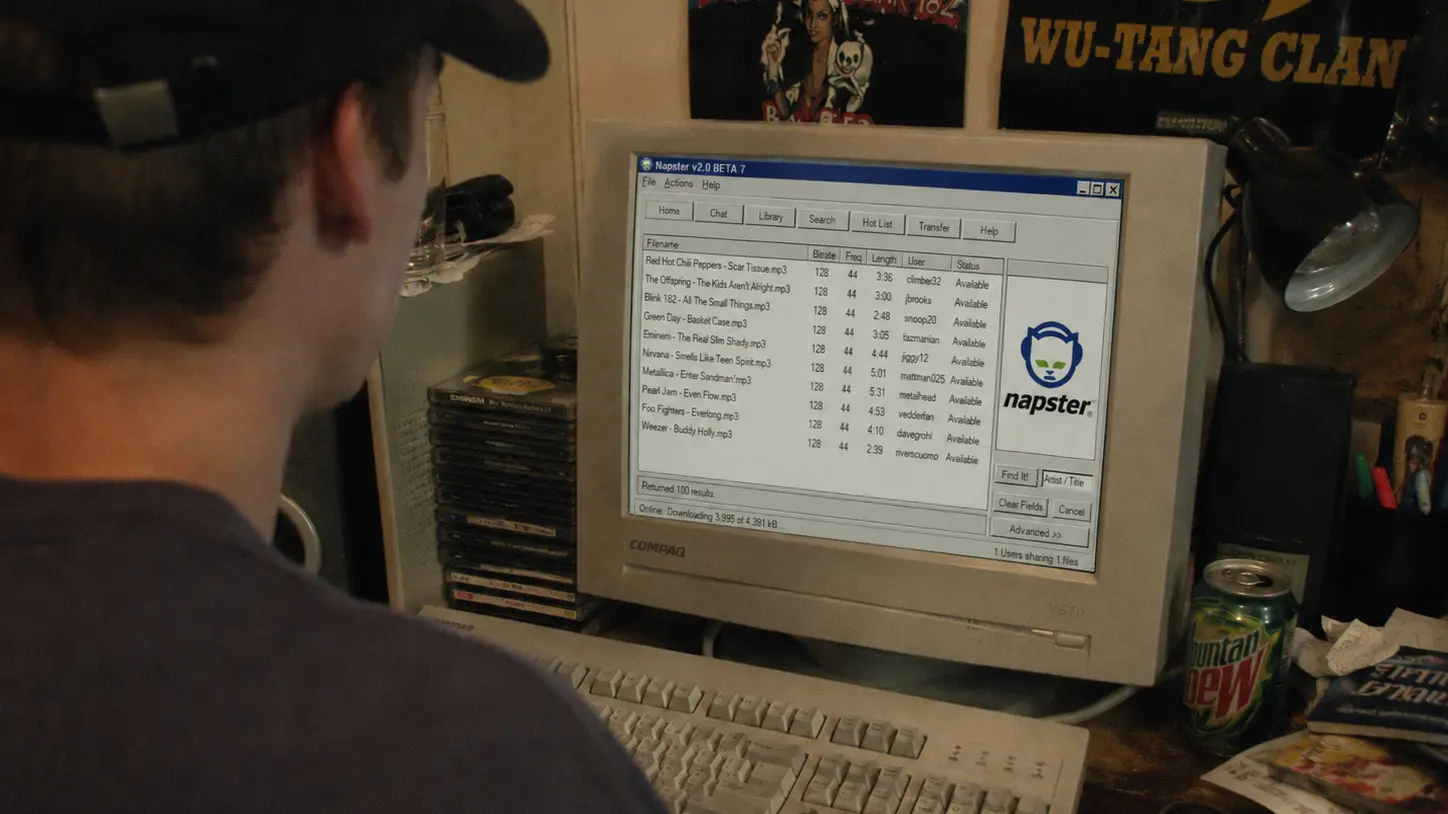
The music industry panicked and then spent years trying to convince bits and bytes that they ought to behave like plastic discs. That proved tricky. A digital file simply has no innate reason to be scarce. Quite the opposite. Copying is exactly what it's built for.
Music was eventually poured into a new business model. Spotify and its ilk no longer sell copies, but access to the entire archive.
With money, things get more complicated. Suppose I send you a digital tenner and my computer does the same thing it does with an mp3. Afterwards, you have ten euros — and so do I. That's fantastic for the two of us, but a fairly dismal innovation for the euro. Digital money therefore requires a bookkeeper.
The idea of a central party holding that role didn't sit well with Satoshi Nakamoto. You'd have to trust that they won't tamper with the money, deny you access to it, or otherwise get in the way of using it. In the period both before and after his whitepaper, examples of exactly that were plentiful. His answer? A monetary system in which that fragile trust is removed as a component altogether. Bitcoin.
In the world of bitcoin, too, there's plenty to copy. The software is open source and the complete transaction history sits on thousands of computers. Yet the network has one hard limit: ownership — the valid claim on the sats circulating within it — cannot be duplicated. This absolute digital scarcity is an emergent property; a unique, uncopyable phenomenon that arises purely from the interaction between the individual parts of the system.
Nearly the entire digital revolution of the past decades has revolved around destroying scarcity. A newspaper no longer needs to roll off a printing press to reach millions of people. For a photo, you no longer need a roll of film and a darkroom. A book doesn't have to be bound, nor a song pressed onto a disc. The moment something consists entirely of information, an extra copy costs virtually nothing. That's one of the wonders of the internet.
Bitcoin, within that very world, puts a fence back up. The well-known cap of 21 million is the poster child of this, but on its own it isn't all that special. Anyone can create a digital coin at home and limit its issuance to 21 million units. The difficulty lies in organising a network that enforces that agreement, while nobody is in charge and participants have a financial incentive to cheat.
Meanwhile, the CD has all but vanished from everyday life. In 2008, a clear, sharp downturn in CD sales became visible worldwide. Coincidence or not: in the very year the technology that gave rise to digital abundance began to fade, the technology of digital scarcity flickered into existence.
More Alpha
Are you a Plus member? Then we'll carry on with the following topics:
- Crypto firms want access to the latest AI models
- Bitcoin fork BIP-110 stalls after two blocks
- Vitalik redraws the ethereum roadmap once again
Below that follow the news snacks, a handy overview of the news that really mattered this past week.
1️⃣ Crypto firms want access to the latest AI models
 Contribution by
 Erik
More than seventy companies in the crypto world are asking AI labs for early access to the most powerful new AI models. The trigger couldn't be more timely: two of the signatories, BTCPay and Foundation, were hacked this month.
Today, Bitcoin Policy Institute and a broad coalition from across the digital-asset ecosystem are publishing an open letter calling on the world’s leading AI labs to provide qualified open-source defenders with trusted access to frontier AI models.
— Bitcoin Policy Institute (@bitcoinpolicy) August 10, 2026
The past several weeks have… pic.twitter.com/4C1tjvGiCe
Whoever maintains the software securing a billion-dollar treasure ought to have the same tools as the pirates circling the coast. That's the crux of an open letter, Defenders need the frontier, addressed to the major AI labs. It's an initiative by the Bitcoin Policy Institute (BPI), with big names like Coinbase and ARK Invest among the signatories.
The issue is perhaps most urgent for the smaller organisations. The letter cites the Bitcoin Core developers as an example — the decentralised group that maintains the network's software. They have no access to the programs that AI labs run for trusted security partners. Through Project Glasswing, Anthropic gives hundreds of vetted organisations access to its Mythos model. The big players get in, but “many digital asset defenders”, according to the BPI, have to make do with safety filters that leave the models toothless.
A team like that then has to go up against hackers who play by the rules far less scrupulously. They bypass safety filters, for instance through stolen access to corporate systems.
The models and the computing power
The signatories are asking not only for access to the strongest models, ahead of any public release, but also for a sufficient compute budget. Thorough AI audits quickly run to thousands of dollars a day in computing power — a sum the nonprofits funding Bitcoin Core developers can't easily cough up.
Just how urgent the appeal is became clear over the past two weeks. The Coldcard hack, which we wrote about earlier, exploited a vulnerability that had been lurking in the firmware since 2021, and which hackers may have tracked down using AI. More than five thousand addresses were affected.
That hack was also the catalyst for founding the Bitcoin Red Team: a group of sixteen volunteers who point AI models at bitcoin codebases. In a sprint of just over a day, the team says it filed 4,962 findings across 390 projects, including 85 critical ones. The cost? Forty thousand dollars in computing power, donated by the nonprofit OpenSats.
Bitcoin Red Team update: we've grown to 16 globally distributed people working 24/7
— calle 🟥 (@callebtc) August 5, 2026
We're running a large-scale ecosystem security audit across bitcoin code bases.
27.5 hours in, we've filed 4,962 findings across 390 projects. 85 critical and 635 high severity issues.
We're at… pic.twitter.com/iRCylprbY1
One of those findings led to the patch at BTCPay Server, which plugged a critical hole that attackers were already exploiting to drain the Lightning nodes of web shops. Signatory and hardware wallet manufacturer Foundation lost its own node in that attack, including the bitcoin stuck on it.
2️⃣ Bitcoin fork BIP-110 stalls after two blocks
Contribution by Erik
The controversial attempt to rein in ‘spam’ on bitcoin culminated on Saturday evening in a fork of the bitcoin blockchain, which fizzled out almost immediately. The camp wanting to keep non-financial data off the network lost. As expected, mind you — most had seen it coming from a mile off.
On Saturday evening, a small group of bitcoiners split off from the bitcoin network. The adventure lasted a grand total of two blocks. The split began at block height 961,632, when nodes enforcing BIP-110 started rejecting traditional blocks that lacked the required signal.
BIP-110 is a Bitcoin Improvement Proposal that aims to restrict the storage of arbitrary data in bitcoin transactions for roughly a year. It's the product of a years-long feud within the community, which flared up again after the launch of the Ordinals protocol in 2023. That protocol made it easy to store images, text and other arbitrary data in the form of inscriptions inside bitcoin transactions.
BIP-110, then, seeks to curb the inclusion of non-financial data on bitcoin. Spam supposedly clogs up the network and drives up fees. Opponents of BIP-110 see it as a dangerous precedent: once you start filtering by content, you chip away at bitcoin's censorship resistance.
Just 2.5 percent support, fierce criticism
There was barely any support for implementing the new rules. Only 2.5 percent of the miners' computing power was willing to mine under them. An anonymous group of miners managed to mine two blocks, and that was that. The longest chain, the one following the traditional rules, was by then already dozens of blocks ahead and impossible to catch up with.
There's plenty of negativity around the proposal. Prominent bitcoiner Dylan LeClair, dripping with cynicism:
Belated congrats to the BIP110ers, who have eliminated all spam from their chain, along with all other transactions, hash rate, and every economically relevant user.
— Dylan LeClair (@DylanLeClair) August 14, 2026
As a reminder, both this outcome and the subsequent response from its proponents were entirely predictable 👇 https://t.co/m9ZMTerbtn
This scorn stems mainly from the way BIP-110 broke with the usual rules of the game for implementing such a proposal. The BIP-110 camp pushed on, even long after it was clear the support wasn't there. In doing so, it knowingly accepted a fork. Earlier, successful soft forks such as SegWit and Taproot required that 95 and 90 percent of miners respectively (measured by total computing power) signal support before activation. That high threshold is a safety mechanism that all but rules out a lasting split at activation.
BIP-110 not only used an unusually low threshold of 55 percent, but also built in a mandatory phase in advance that would kick in regardless.
A storm in a teacup
All the commotion aside, the contrast between this episode and the ‘block size wars’ of ten years ago is enormous. Back then, a comparable disagreement of principle over the direction bitcoin should take was still an existential matter. It resulted in a hard fork (bitcoin cash still exists), and it wasn't clear beforehand whether the traditional variant of bitcoin would win.
An issue comparable to the one that once became a divisive fratricidal war is now nothing more than a storm in a teacup. It'll rumble on a while longer, mind you. Although driving force Luke Dashjr has been stripped of his role as BIP editor, it's already been announced that after this defeat the camp wants to launch a hard fork — their own bitcoin variant, in other words.
They're of course entirely free to do so, and it stirs up nostalgic feelings for the good old days. What will the new fork be called? Bitcoin Clean? Bitcoin Pure?
3️⃣ Vitalik redraws the ethereum roadmap once again
Contribution by Peter
In 2023, Vitalik Buterin put an ethereum roadmap down on paper. A big map full of arrows, boxes and technical jargon meant to show where the network was heading. This week, he laid that old map alongside the Ethereum Foundation's current plans — the slimmed-down foundation that focuses on the network's continued development.
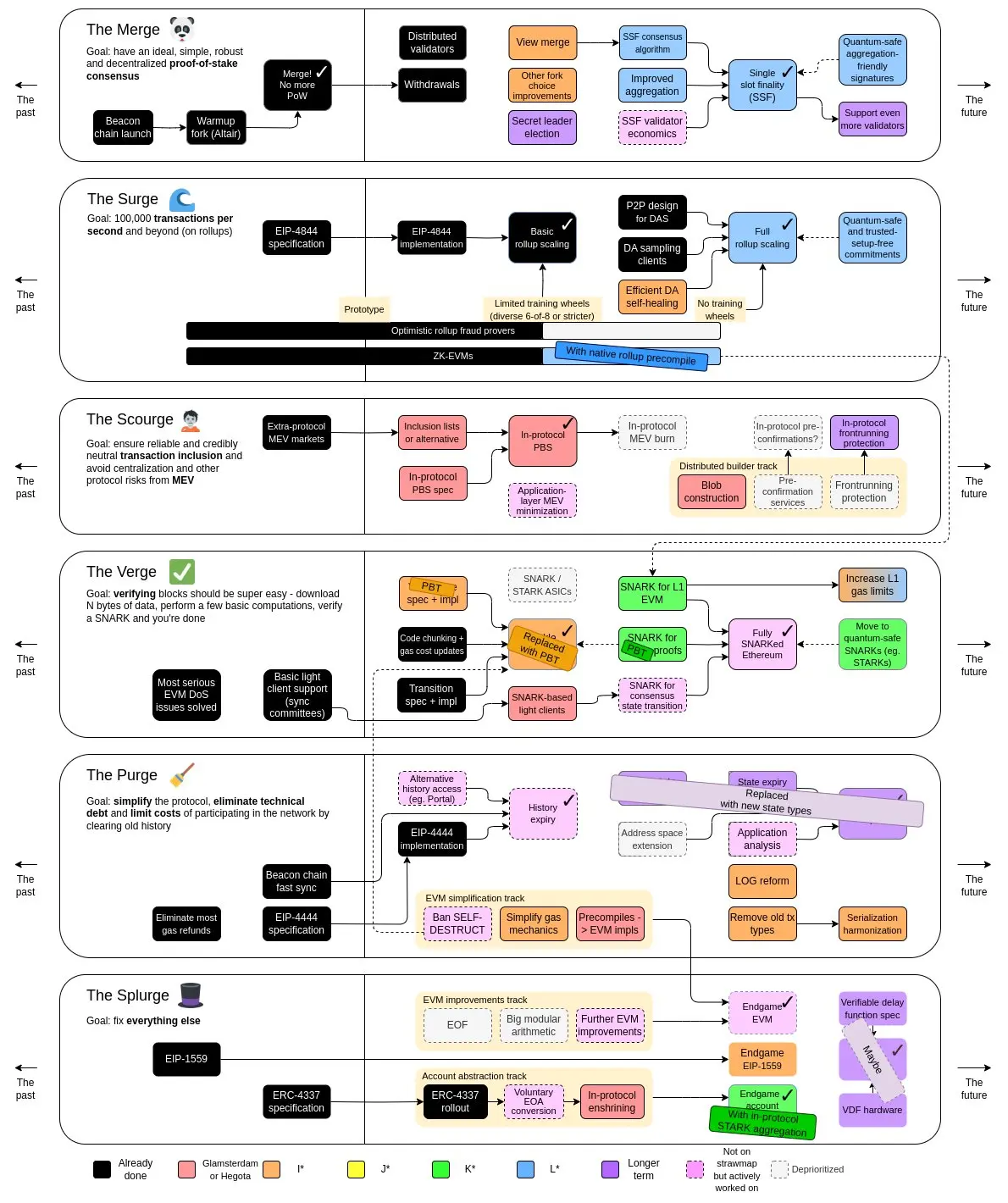
Some ideas have simply vanished. Others have been pushed back or replaced by something researchers now consider better. And a number of topics that were barely on the radar three years ago now rank among the top priorities, including quantum computers and privacy.
That protection against quantum computers has climbed higher up the list can hardly come as a surprise. Over the past year, the same warning has surfaced from multiple corners: the same warning — the development of powerful quantum computers is accelerating and could pose concrete problems within just a few years. As far as Vitalik is concerned, an upgrade should arrive swiftly to put the associated risks to rest once and for all. That's no small feat: the necessary cryptography is heavier, so the network has to adapt to stay both secure and fast.
Privacy is likewise getting a far more prominent spot. Earlier this year, privacy briefly became a popular theme among investors, with price gains for privacy coins like zcash and monero. According to the foundation, the renewed focus on privacy is unrelated to that. Privacy ought to be the default both online and onchain, and ethereum is championing the second of those domains. In doing so, ethereum is also positioning itself for the growing group of financial institutions coming onchain; for them, sweeping transparency is an insurmountable barrier.
I updated my 2023 roadmap diagram to overlay where the items that were there sit in the current Strawmap ( https://t.co/9deLIQWG24 ).
— vitalik.eth (@VitalikButerin) August 10, 2026
In general, a lot of overlap, but:
* Some things got reshuffled in order (eg. quantum safety up-prioritized)
* Some things deprioritized (eg.… pic.twitter.com/XLdIt4kAgT
A sacred cow has also been placed on the new map. The EVM, the machine on which ethereum applications run, has been the technical heart of the network ever since its launch. Vitalik wonders whether that position ought to remain in place forever, and calls for an open mind about the design of this part of the network. He implies that it has to change, because the road to quantum safety already exposes users and developers to new — and, in his view, better — infrastructure anyway.
Finally, and how could it be otherwise, AI is named as a prerequisite for success. To become sufficiently scalable, computers need to be able to check each other's work without redoing it. That verification has to be provable in numbers and formally recorded. “That's only achievable with modern AI tools,” Vitalik writes. “That's a direction we're quite happy to tie ethereum's technical fate to.”
The roadmap gets a new buzzword slapped on it: Lean. Its meaning, in the context of software, is ambiguous. Sometimes it means plain, or simple. Other times it means agile and decisive. Here, the emphasis seems to fall on the latter, because the new route map above all adds ambition.
Once again, ethereum shows it dares to throw old plans overboard. For investors, that's both appealing and uncomfortable at the same time. This trait boosts the odds that the network stays relevant as the world changes. But it also means nobody knows exactly what ethereum will look like ten years from now.
🍟 Snacks
To wrap up, a few quick snacks:
- Boltz shuts down: popular bitcoin swaps “disabled until further notice”. The small company says the pressure from AI-assisted attack attempts is becoming too much. Some of those attempts succeeded and hit Boltz's own coffers. Customer funds have always remained out of harm's way. Over the past weeks, the company saw a rapid rise in the number of hacking attempts. “We can't responsibly keep our services running at this moment,” Boltz explains. Boltz's founders have laid down their work and handed it over to a group of ‘bitcoin veterans’. It's unclear whether there will be a relaunch.
- Outages, exploits and software bugs: altcoins had a rough week. At solana, an outage at a single infrastructure provider wiped out 30 percent of all staked SOL, just below the threshold at which transactions are no longer finalised. At Harmony, a hacker minted new coins amounting to 26 percent of the existing supply, after which the price plunged. On top of that, an XRP bridge was drained, and Ravencoin turned out to be accepting invalid blocks due to a bug. In nearly every case, AI is cited as an accelerant for finding software flaws.
- Bitcoin miners, too, are trying to cash in on AI's hunger for capital. The former Bitfarms, now Keel, is quitting mining in the US and sold over 1,000 BTC to fund a transition into an AI data centre. Riot reportedly struck a twenty-year lease with Anthropic worth $9.1 billion. And Mara is putting up 18,750 BTC as collateral for a multi-million-dollar loan to develop ‘new business models’. The flight makes sense: AI companies are offering hefty sums for data-centre contracts, while bitcoin mining as an activity is loss-making for a growing number of miners.
- Strategy sells bitcoin to restore confidence in its financial machine. The company sold 1,690 BTC this past week and issued new MSTR shares. With the proceeds, it added $650 million to its dollar reserve and bought back $109 million worth of Stretch shares. Strategy can now cover its dividend obligations for almost 3 years. On television, chief executive Phong Le promised to start buying again later this year. First, restoring the STRC price takes priority. There's still work to be done there: the share is still trading 5.5% below its target price of $100.
- Tether has, for the first time, undergone a full annual audit. The US arm of KPMG issued an unqualified opinion on the 2025 financial statements of Tether's El Salvador entity, the issuer of USDT. That is a milestone, since a proper audit has been the big demand of Tether for years. Once again, there's something uncomfortable clinging to it: the company publishes neither the financial statements nor the opinion itself. The audit was also carried out according to a standard less strict than what the Genius Act prescribes. Put another way, Tether is seeking legitimacy — but still on its own terms.
- The Clarity Act gets a shot in the Senate in September. On Tuesday 15 September, it should become clear whether the bill actually comes to the floor. The market rates the odds of that very low. On Friday, Galaxy revised its estimate down to just 10%, with unresolved disputes as the main reason. There's also very little time left before preparations for the midterm congressional elections begin. The executive branch — the sitting administration, regulators and major market players — seem to be positioning themselves for a stalled bill. They're meeting this week at the White House, presumably to discuss what can be arranged outside the legislative process.
Thank you for reading!
To stay informed about the latest market developments and insights, follow our team members on X:
- Bart Mol (@Bart_Mol)
- Peter Slagter (@pesla)
- Bert Slagter (@bslagter)
- Mike Lelieveld (@mlelieveld)
We appreciate your continued support and look forward to bringing you more comprehensive analysis in our next edition.
Until then!