
Does Bitcoin Become More Compelling in an Economy Disrupted by AI?
AI is making the future of companies and governments more uncertain. According to analyst Jordi Visser, it's precisely that uncertainty that makes bitcoin more attractive.

 Contribution by
 Erik
Imagine you launched a little company back in 2020 that analyzes legal contracts. It had taken you a year to build the software, and that gave you a comfortable feeling. You had a moat, a built-up competitive edge. Your product couldn't easily be copied by a new player entering the market. Customers were happy and paid handsome prices.
Then, at the end of 2022, ChatGPT, the first Large Language Model (LLM), hit the market. At first a curiosity, but the models improved rapidly. And from late 2024 onward, your company saw a noticeable drop in its customer base. AI had largely evaporated your competitive edge, leaving you barely any time to adapt.
The new piece by analyst Jordi Visser is titled The Silent IPO Is Over: Bitcoin, AI, and the Collision of Time. In it, Visser rubs our noses in the fact that every company, and therefore every investor, is currently wrestling with the question of how their business model will still work in the future. And: to what extent they can still say anything about that future with any certainty.
The growing uncertainty of long-term financial assumptions
Crypto had of course already started tossing the traditional financial calendar in the trash, with activity on weekends and holidays. Visser points out that things like quarterly reports and annual statements will soon feel hopelessly old-fashioned too. With AI, a company can launch a product in the time it used to take just to organize a brainstorming session. The old economy isn't built for these short cycles of creation and destruction.
For governments, too, the future is becoming murkier. How will their tax revenues change now that the traditional economy, which runs on human limitations, stares like a deer in the headlights at the oncoming AI economy?
“Governments are caught in a duration trap. They refinance long-term fiscal obligations, while AI shortens the lifespan of the assumptions underneath them: the tax base, the labor market, corporate profits, and the durability of competitive advantage.”
And then the core point Visser is building toward:
“Scarce, globally transferable collateral rises in value when long-term financial assumptions become less comfortable. Bitcoin becomes a claim that the future monetary regime will be harder to manage, precisely because developments are moving so fast.”
According to Visser, then, bitcoin is attractive precisely because it stands outside the traditional financial system. That's always been a reason to believe in BTC, of course, but the AI disruption gives this argument new weight.
Visser comes forward with this fundamental bullishness right now, just as he believes what he calls the Silent IPO (and what we called the great rotation) has come to an end. In other words: over the past few years, a large part of the old guard has sold their BTC, or part of it, to a new guard of institutional clients: the bitcoin ETF buyers. The Silent IPO is over after a year or two, and that leaves room for price gains.
Some caveats to Visser's story
It's a thought-provoking piece, and it naturally leaves a bullish aftertaste, which is always nice. One caveat I'd add is that Visser idealizes bitcoin a touch too much as invulnerable to the AI threat. Uncertainties have arisen within the bitcoin community as well. If AI dramatically ramps up the capacity of quantum computing, will there still be enough time to make the protocol quantum-safe? The bitcoin community operates more slowly than companies and even governments; exactly the kind of vulnerability in the new AI economy that Visser points to.
Another point of criticism is that Visser rightly throws many certainties overboard, yet still seems convinced that AI agents will use dollar stablecoins for transactions, and that BTC will remain global digital collateral. That's plausible, but far from certain. It's not inconceivable that AI agents will build their own online monetary ecosystem. Perhaps far-fetched, but once you try to peer past the singularity, all bets are off. That's precisely the core point of the piece.
And yet, there's something to his thesis. In a world where the probability distribution of the future has a sizable fat tail of extreme outcomes, a somewhat larger allocation to BTC is simply easy to defend.
Because turn it around: if we had perfect trust in the financial system, we wouldn't need bitcoin. The further that trust is eroded, the more attractive the alternative becomes.
More Alpha
Are you a Plus member? Then we'll continue with the following topics:
- Will Strategy buy up future dips?
- xxx
- xxx
Below that come the news snacks, a handy overview of the news that really mattered this past week.
1️⃣ Strategy will buy up future dips
 Contribution by
 Peter
Strategy raised roughly 2 billion dollars last week, but didn't buy any bitcoin with it. Part of it landed in the existing dollar reserve, another part in a new pot of freely deployable money. With that, Michael Saylor gives the impression that he wants to transform his company from a mechanical bitcoin buyer into an active asset manager.
Strategy increased USD Reserve to $5.10B, established additional USD Cash of $1.59B, and repurchased $136M of $STRC. As of 8/23/26: Strategy holds ~4% of Total BTC Supply and has ~0% Net Leverage. $MSTR https://t.co/WZ9GFtJBXh
— Michael Saylor (@saylor) August 24, 2026
The dollar reserve has existed since December 2025. Strategy uses this money to pay interest on debt and dividends on preferred shares. Initially, the company wanted to hold enough dollars to cover at least twelve months ahead. Early this year, it held over two years' worth of obligations.
But that changed in May. Strategy used roughly two-thirds of the reserve to pay off a loan. About 800 million dollars remained, good for only about six months. A thin cushion that sowed the very doubt the reserve was meant to dispel: could Strategy sit out a prolonged bear market without bruises – or worse?
Since then, Strategy has done what many investors hoped for. The reserve got a more tightly defined purpose, and may only be used for interest and dividends and must maintain at least twelve months of coverage. That has indeed been treated as a minimum, because the reserve now contains roughly 5 billion dollars, good for well over 3 years of obligations.
Alongside the dollar reserve, Saylor has set up a second pot, named 'USD Cash'. This cash reserve, now good for 1.5 billion dollars, is broadly deployable. The company can use it to buy bitcoin, pay off debt, and buy back its own shares. The money can also be transferred to the regular dollar reserve.
USD Cash is a separately designated pool for general Bitcoin Treasury Company purposes.
— Strategy (@Strategy) August 24, 2026
USD Reserve policy is unchanged; designated for dividends and interest.
USD Cash adds flexibility to respond quickly to market conditions, including dislocations in BTC or our securities. pic.twitter.com/nbncPY2sUJ
That freedom of movement is being seen as a shift in course. For years Saylor said he couldn't time the market. So after Strategy raised capital, a purchase often quickly followed. “I'm going to be buying the top forever” was one of his standard lines.
In a recent presentation to investors, Strategy speaks of dynamic capital allocation. Depending on market conditions, the company can raise capital, buy or sell bitcoin, and buy back its own securities. According to Strategy, active management can increase value per share.
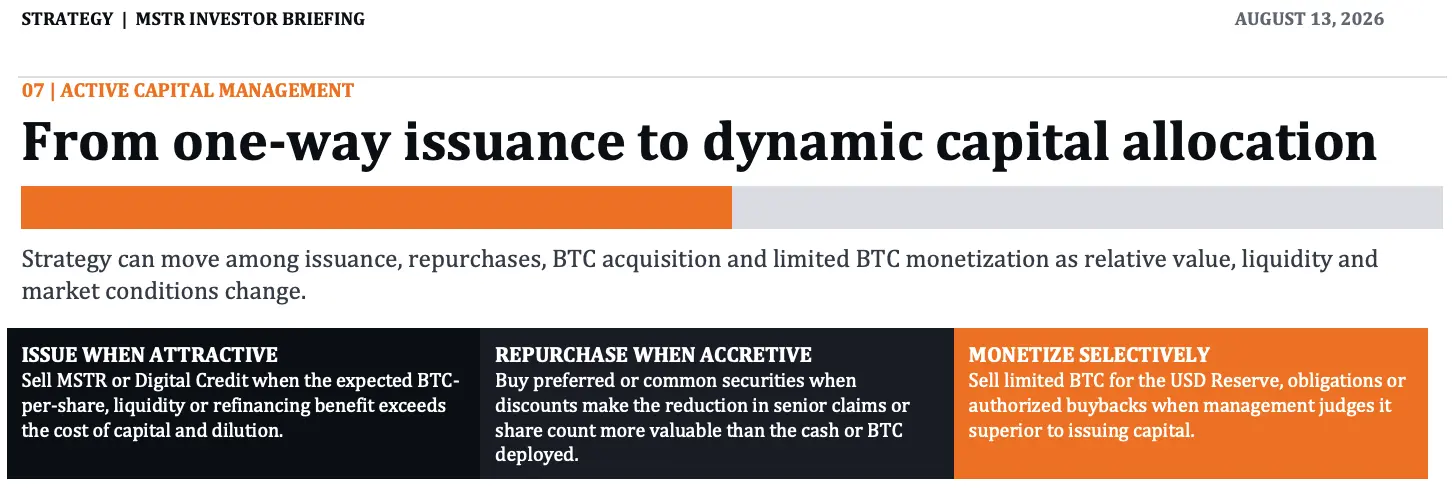
The new cash reserve makes that policy possible. If the bitcoin price suddenly drops by 15 percent, for example, Saylor doesn't first have to raise capital in order to pounce.
All in all, the concerns about Strategy, which clearly hung over the market a few months back, have largely disappeared. With over 6.5 billion dollars in cash, the company now has almost as many dollars as it has debt. You could say: the leverage has temporarily vanished from the company.
The next big correction is therefore going to be interesting. Will Saylor indeed be standing ready to buy the dip?
2️⃣ Attempt two: who gets to custody crypto?
Contribution by Peter
The US market watchdog, the SEC, is making a fresh attempt to draw up rules for the custody of crypto. The regulator wants to limit where professional asset managers may place their clients' holdings. The regulator's previous chairman, Gary Gensler, tried the same in 2023, but his proposal got practically the entire sector up in arms.
The rules are intended for investment advisers: parties that make investment decisions on behalf of clients and manage their assets. They can't just leave stocks and other financial holdings lying around anywhere. For that they must use a recognized custodian, in the United States a qualified custodian.
With traditional investments, that's a bank, a trust company, or a registered broker-dealer, for example. With crypto, it's less clear which parties meet those conditions. That can be a problem now that more and more advisers are giving bitcoin and other cryptocurrencies a place in their clients' portfolios.
Gensler therefore wanted to expand and tighten the existing custody requirement in 2023. His message to the sector:
“Make no mistake: Based upon how crypto platforms generally operate, investment advisers cannot rely on them as qualified custodians.”
That threatened to sideline a large part of the existing crypto sector. Crypto companies, traditional financial institutions, and a broad array of lobby groups objected. The proposal was never adopted and was formally withdrawn last year.
Under the current SEC chairman, Paul Atkins, the dossier is back. According to the official description, the new proposal aims to modernize the rules, provide clarity on who may act as custodian, and scrap outdated obligations.
The Securities and Exchange Commission has sent a new proposal to the White House concerning rules for investment advisers holding digital assets for their clients. https://t.co/wgRpJHNiFy
— Bloomberg (@business) August 26, 2026
The precise contents aren't yet known. The SEC first sent the plan to the White House for review. Only afterward will the proposal be made public and can market participants respond to it. Publication is tentatively scheduled for October.
The circumstances are a good deal more favorable than in 2023. Since then, more crypto companies have obtained a federal trust charter or sought affiliation with existing companies that already hold the right paperwork. As a result, a requirement to place crypto with a qualified custodian no longer needs to amount to a near-total exclusion of the sector.
The underlying principle isn't so strange, either. Whoever manages assets on behalf of others must be able to demonstrate that the holdings are safely custodied. The difference lies in the execution: Gensler used that idea to curtail access to crypto, whereas Atkins actually wants to give crypto an official place within the financial system.
3️⃣ The trenches spring back to life
Contribution by Peter
These days, many people look at the bitcoin price or ETF flows to gauge whether the crypto market is in demand. But part of the attention for crypto sits deeper in the market, in the digital trenches where speculators hunt for new tokens and quick profits. There, in the treacherous trenches, things have gotten pretty rowdy again over the past few weeks.
A striking figure made the rounds on social media last week. This type of Solana speculator supposedly holds a purchase for an average of just 42 seconds now. Earlier this year that was 58 seconds.
The average hold time for a token on Solana is down to 42 seconds.
— camol (@camolNFT) August 26, 2026
I wish I was kidding. pic.twitter.com/oP8oONG0x1
A closer look at the cited figure reveals that the dataset only contains positions closed within seven days. Long-term investors are therefore missing entirely. It's also not the average, but the median: the middle number in the series, which ignores the shape of the dataset.
But the figure does say something about the speed of the speculative part of the market. Bots account for an ever-larger share of the activity, and new apps make buying and selling ever simpler. Sometimes a tap on the screen is enough, as if people are playing Flappy Bird with token positions.
That, of course, has little to do with investing. The culture in the trenches is extractive; you come here to beat the other ground troops. The bear market pushed a good chunk of this crowd into other territories. Prediction markets, penny stocks, gambling games. After months of relative quiet, activity, capital, and attention are returning here too.
Solana seems to be losing its spot as the main battlefield this time. More and more activity is shifting to Robinhood Chain, where the familiar building blocks from earlier cycles are being erected at a rapid pace. Decentralized exchanges, trading protocols, launchpads, and variants on Pump.fun are appearing. The same ingredients, but on a new network and with a striking new weapon in the arsenal: tokenized stocks.
 Tyler Warner
On-chain stocks are being wrapped around everything. Stake a purchased token, and get fractions of shares deposited. Buy a lootbox, and receive a share. Send your money to a ponzi-like project, which then fills its reserve with Nvidia stock. A new wrapper for the gambling mechanisms that already proved their appeal in earlier cycles.
Arthur Hayes has found the trenches again, too. The former BitMEX top man now presents himself as director of FLOP, a project that wants to combine AI agents with crypto. Whether it amounts to anything is another matter. Hayes has a habit of loudly promoting projects; he then stands by the exit, which he single-handedly locks shut right after his own departure.
The return of this circus is, of course, no proof that a new bull market has begun. But it is an early signal. Because like it or not: that's when the gamblers and loudmouths come back too.
🍟 Snacks
To wrap up, a few quick snacks:
- Revolut brings the euro to ethereum with its own stablecoin, EURR. The neobank is starting with a phased trial among customers in Denmark, Poland, and Portugal. More countries are set to follow later this year. EURR is issued by Bridge, Stripe's stablecoin company. The stablecoin can be exchanged for regular money, used to buy cryptocurrencies, and sent to external wallets. For Revolut, EURR is the start of a broader offering: the company is working on stablecoins for other currencies.
- US campaign explains bitcoin to a broad audience once again. Under the motto “It's time to take bitcoin seriously,” six essays are being published by people like Lyn Alden, Alex Gladstein, and Adam Back, supported by six full-page and 24 smaller newspaper ads. The first ad ran in The Wall Street Journal. The campaign, put together by The Nakamoto Project, leans on two properties that make bitcoin unique: it can't be printed and it lets people exchange value directly.
- CFTC chairman ramps up the pressure on the Senate: the Clarity Act must happen. If Democrats keep blocking the law, the regulator will put rules for crypto markets on paper itself. Staff are therefore already looking into how derivatives exchanges and on-chain protocols can operate legally in the US. In doing so, the CFTC is looking pointedly at trading platforms that currently avoid America or operate in a gray area, such as Hyperliquid. The regulator's threat: if the Senate doesn't act, the CFTC will do it itself. One way or another, 'Clarity' is coming.
- Stablecoins are penetrating ever deeper into the financial system. The British government wants to make the Bank of England responsible for innovation in digital money as well. In South Korea, Visa is going to experiment with a bank and crypto exchange on stablecoins for international payments. At the same time, according to The Wall Street Journal, more than a dozen major banks, including Bank of America, Wells Fargo, and Santander, are working on a joint stablecoin. Banks are no longer fighting against them, but have become active developers themselves.
- Starting this season, USDC will feature on the front of Chelsea's shirts. Circle becomes main sponsor of the men's, women's, and youth teams. What the deal costs is not known. Chelsea was reportedly aiming earlier for 65 million pounds per year. The sponsorship brings back memories of the costly sports deals from the FTX era. The difference is that Circle now has a mature business model and considerably more stable revenues thanks to USDC.
- Kalshi risks getting tangled up in conflicting US rules. A judge ruled last week that Nevada may treat the prediction platform's sports contracts as gambling. Another court earlier ruled instead that the same product falls under federal financial oversight, meaning New Jersey may not intervene. So one product gets a different legal status in each state. The rulings aren't yet final, but they increase the chance that the US Supreme Court will ultimately have to decide under whose oversight Kalshi may operate.
Thank you for reading!
To stay informed about the latest market developments and insights, follow our team members on X:
- Bart Mol (@Bart_Mol)
- Peter Slagter (@pesla)
- Bert Slagter (@bslagter)
- Mike Lelieveld (@mlelieveld)
We appreciate your continued support and look forward to bringing you more comprehensive analysis in our next edition.
Until then!