
AI Stocks Crash as Bitcoin Shows Relative Strength
AI stocks cratered on Thursday, dragging the broader market and crypto down with them. Yet bitcoin held its ground surprisingly well. Healthy correction, or the start of something far uglier?

The market seemed to welcome the ‘blue tsunami’. In the midterm elections, the Democrats won majorities in both the House and the Senate. They flipped five Republican governorships, took control of legislatures in eight states, and captured several other powerful state offices such as attorney general and secretary of state. The S&P 500 jumped 1.5% right at Wednesday’s open, and the tech-heavy Nasdaq 100 was up 2.3% over the course of the US morning.
The explanation was partly technical and partly fundamental. Investors had reportedly bought hedges against major irregularities around the election, and those never materialised. Unwinding those hedges pushes prices higher. A Democratic majority could also bring more calm and stability.
The relief was short-lived. On Thursday a different narrative took hold: that the Democrats would try to hold back the rise of AI in all sorts of ways. A pause on developing new models, a ban on superintelligence, and sweeping restrictions on building data centres.
In the first hour of trading, the Nasdaq plunged 5.2%. Its daily loss of 6.4% is the biggest drop since the Covid crash of March 2020.
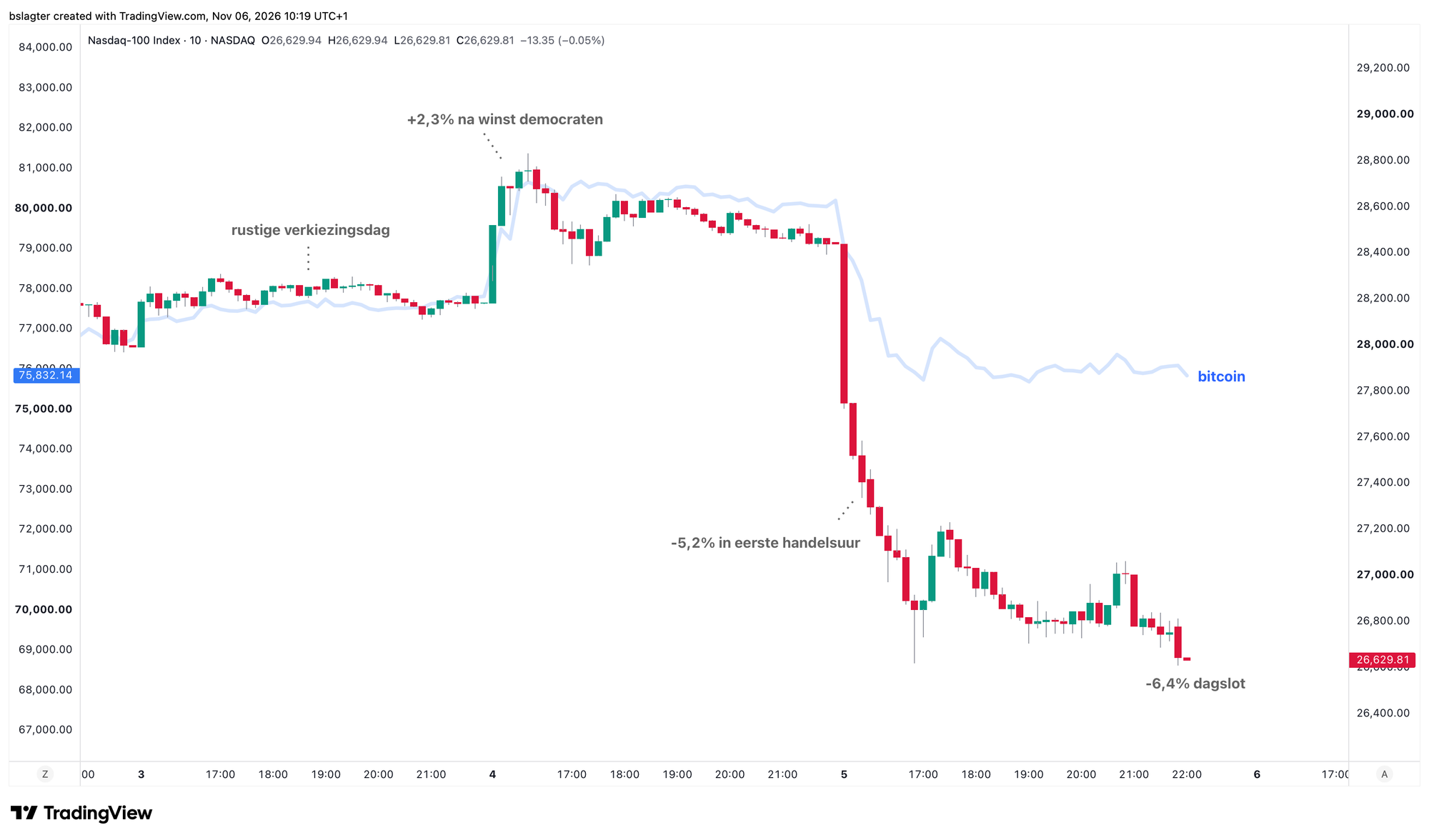
Bitcoin held up relatively well, closing the day down 5.5%. In the chart above, we’ve overlaid bitcoin’s price as a thin blue line on the Nasdaq, aligned on Wednesday’s rally. It confirms that this is primarily about AI worries, not broad macroeconomic or geopolitical fear.
Today marks the second time in history the Nasdaq fell more than 5% and Bitcoin fell less than the Nasdaq.
— Alex Krüger (@krugermacro) November 5, 2026
The other time was on March 16, 2020.
Mar 16, 2020: QQQ -12.0%, BTC -10.6%
Nov 5, 2026: QQQ -6.4%, BTC -5.3%
The big question is whether this is a healthy correction, or the start of a deep bear market driven by the collapse of many AI-related stocks.
If you follow AI development closely, you see one impressive breakthrough after another. Practically every field stands to benefit. It’s not hard to imagine households, businesses and governments being willing to pay handsomely for it.
Even so, you’d expect stock prices to travel a bumpy road. There are plenty of reasons why adoption and diffusion take a long time. Building data centres and manufacturing hardware takes a great deal of time and money. Changing structures, workflows and culture within organisations isn’t easy. Laws and regulations aren’t ready for agents. The costs come before the benefits.
Some companies will go under, such as neoclouds that borrowed heavily and see their construction projects stall. Others will turn out to play a smaller role than expected, such as certain infrastructure companies.
In the decade between ChatGPT’s launch in November 2022 and the first signs of mature AI usage sometime in the early 2030s, some air will regularly need to be let out of the market. This could be one of those corrections.
It could take the form of a brief dip, like in April 2025 when Trump introduced tariffs, or in April 2026 when Trump started the war in Iran. A cyclical bear market, like in 2022, is also possible. But that would also require macroeconomic weakness to emerge.
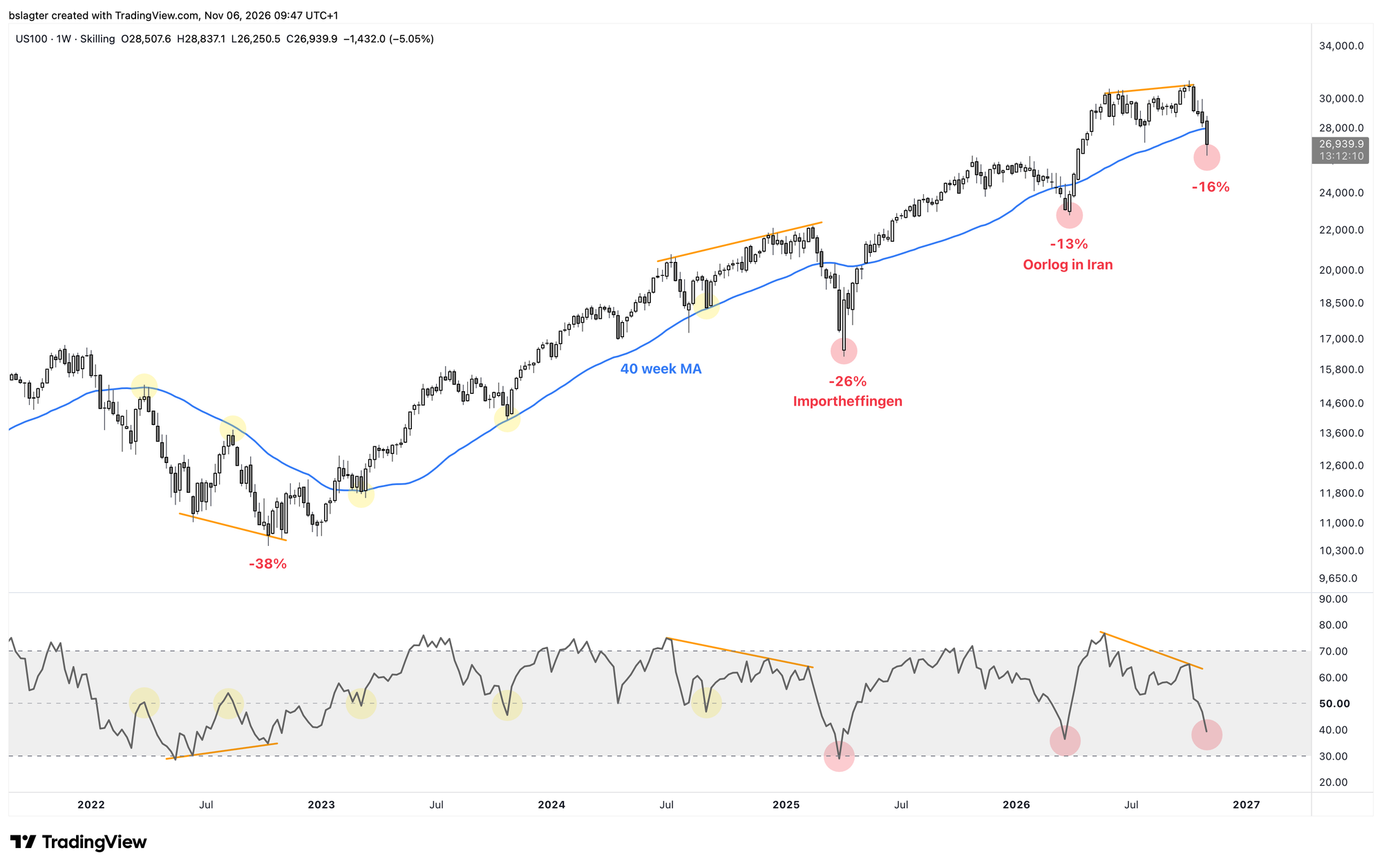
But what are the odds that this isn’t just a correction, but the start of a crisis like 2000 or 2008? A deep, multi-year bear market and a severe economic recession?
Let’s first look at the technology itself. There’s no reason to assume the string of breakthroughs ends here. Behind the scenes, the AI labs have powerful models, and once a certain capability level is reached, they keep making those models more efficient.
The Democrats won’t (want to) stop this development either. The geopolitical and economic stakes are simply too high. China is pressing ahead, and labs on other continents are racing to catch up too.
There will undoubtedly be more emphasis on safety, alignment, guardrails, monitoring and accountability. But that’s nothing new. In fact, over the past decade the labs themselves have repeatedly called for slowing the pace.
Demand for compute will keep growing in the years ahead. Especially if data centre construction is curbed, demand will far outstrip supply. That’s no disaster — scarcity sparks creativity: smaller, more efficient models and more on-device inference, for example. But it seems unlikely to us that we’ll be looking at empty ghost data centres anytime soon.
That sounds reassuring. So how could you still end up with a deep bear market scenario?
For instance, through a spiral of pessimism about the investments and commitments along the chain linking AI labs, hyperscalers/neoclouds and infrastructure companies. That could play out against a backdrop of economic weakness that has been masked lately by the AI trade lifting all boats.
In the long run, that’s no disaster. Development continues. People and resources from bankruptcies will find their way to the survivors. The US government might even nationalise Anthropic and/or OpenAI. That would be an easy sell, on the grounds that not only the burdens (risks and externalities) but also the rewards (revenue) would then belong to the people.
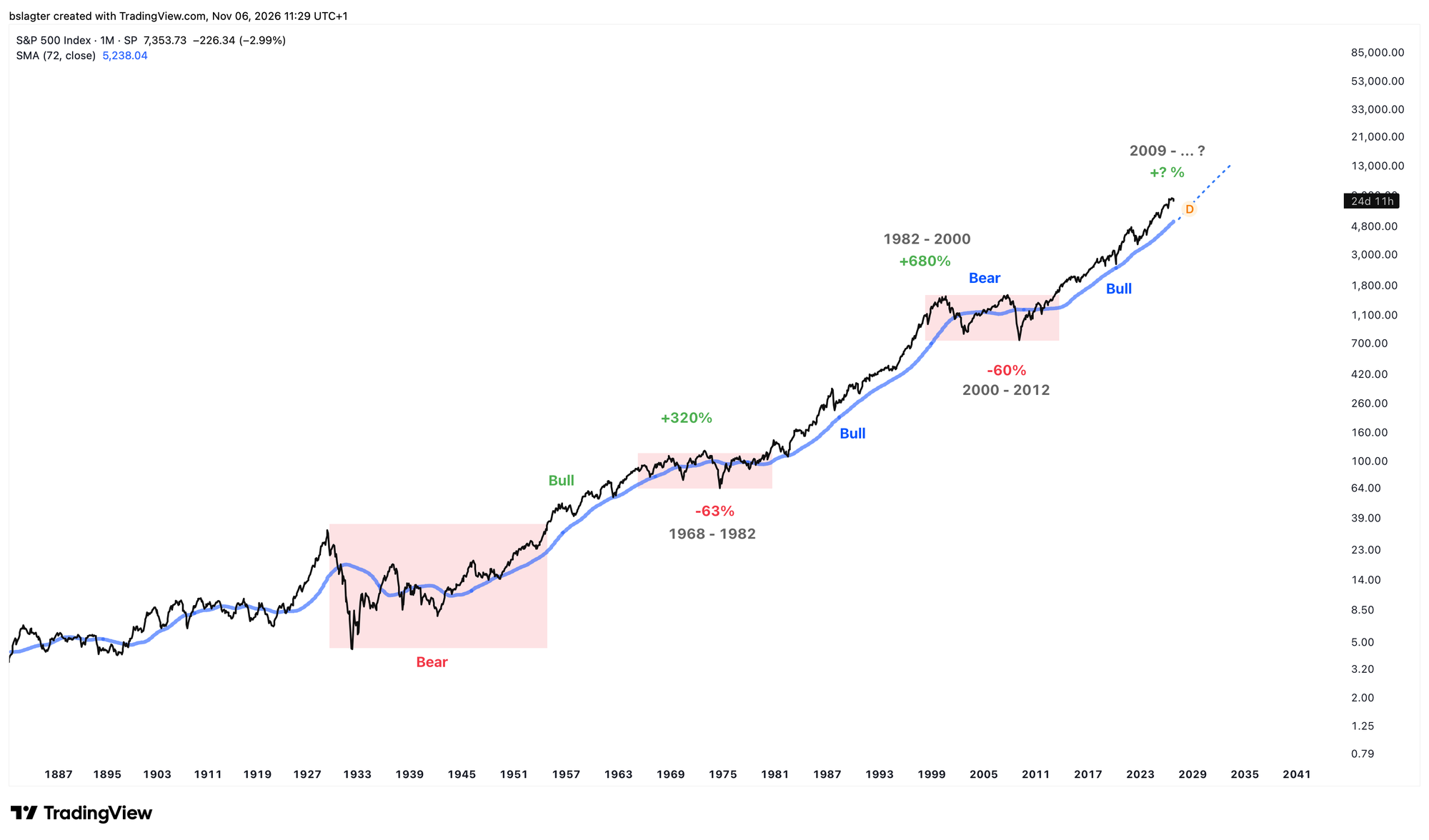
The chart below shows the secular bull and bear markets of the S&P 500 over the past 140 years. As you can see, the current correction is still a long way from a secular bear market.
In the coming weeks we’ll find out which flavour we’re dealing with: a correction of the kind we see once or twice a year, a cyclical bear market like 2022, or the start of a deep secular bear market. To be continued!
We continue with the following topics for our Alpha Plus members:
- How is bitcoin holding up?
- Diversification or bitcoin only?
1️⃣ How is bitcoin holding up?
 Contribution by
Bert
The turbulence in tech stocks is also weighing on bitcoin and the broader crypto market. Some investors have put crypto in the same bucket of their portfolio as AI stocks, so a single decision dumps both.
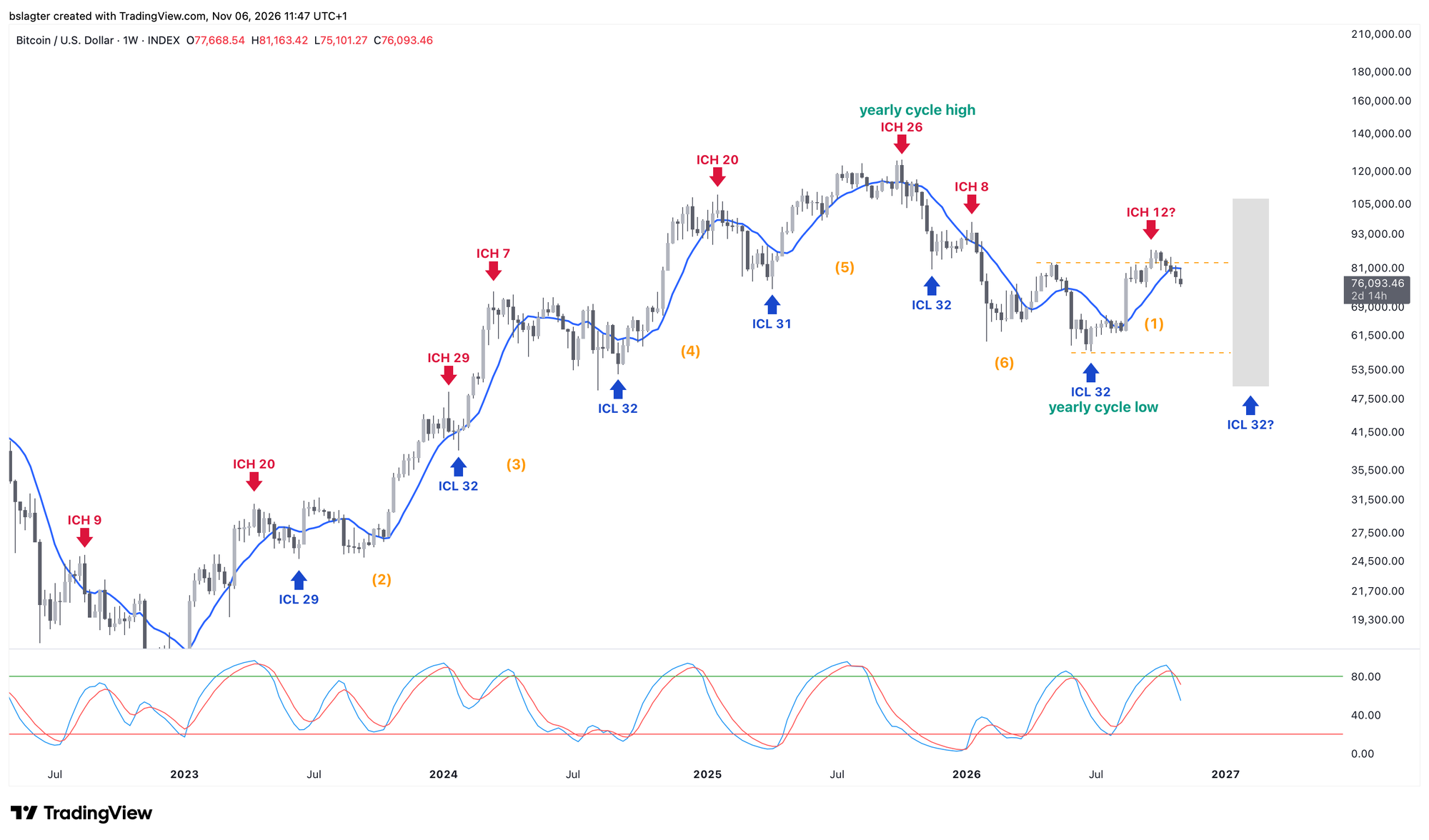
Bitcoin held up well, but couldn’t prevent the price from sliding back to $75,000, roughly 14% below the recent peak of $87,000. Many lines converge here: a horizontal level, the 50-week moving average, the 200-day moving average and the volume-weighted average price (VWAP) anchored from the bottom.
A potential bullish divergence on the RSI offers hope that this zone may provide enough support.
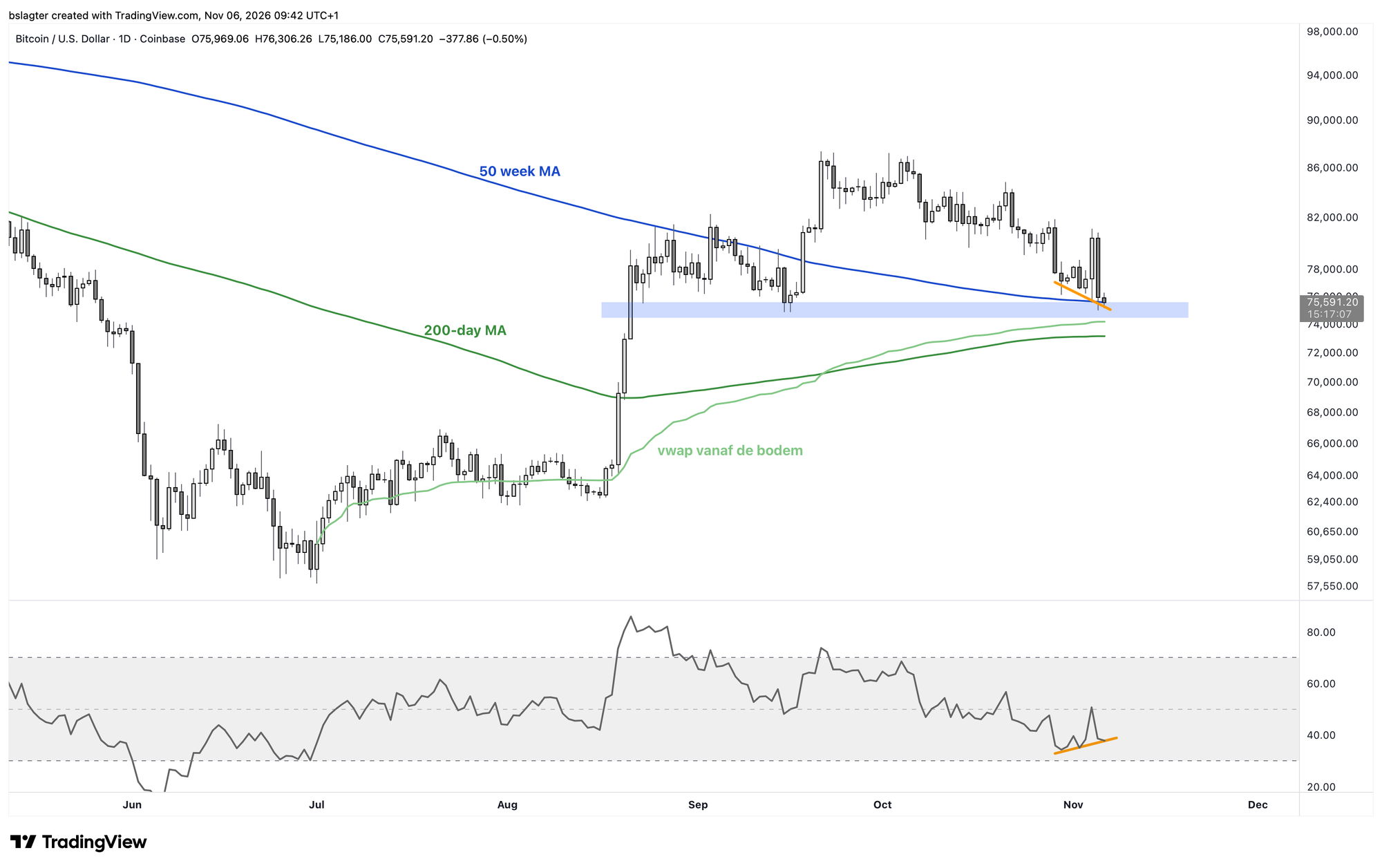
We should add right away that the chances of bitcoin holding firm are extremely slim if equity markets plunge further off a cliff. In that case, all those support lines go straight out the window.
The weekly chart also gives reason to doubt the support zone at $75,000. The weekly cycle appears to have topped and now seems headed for a weekly cycle low (ICL). The annoying part is that we don’t expect that low until January or February. That leaves months for ‘chopsolidation’ or further downside.
A weekly close above the 10-week moving average, currently at $81,000, would brighten the picture considerably. A rally to a higher weekly cycle high (ICH) could then bring this weekly cycle to a nice finish.
2️⃣ Diversification or bitcoin only?
 Contribution by
Sam
Over periods of weeks, and in some cases even months, it pays to have some altcoin exposure.
You can distinguish three categories. First, every bull market has its darlings that perform well for an extended period. This year there are a handful trading well above where they started the year, but it’s a select group. Think Near, ZEC and VVV.
The second category consists of tokens that ride a temporary narrative and then give back most of their gains after a few weeks, such as the coins on Robinhood’s blockchain.
The third category covers tokens that rallied hard, sometimes very hard, for just a few days on related news, only to give (most of) it back. Ondo and Hype are recent examples.
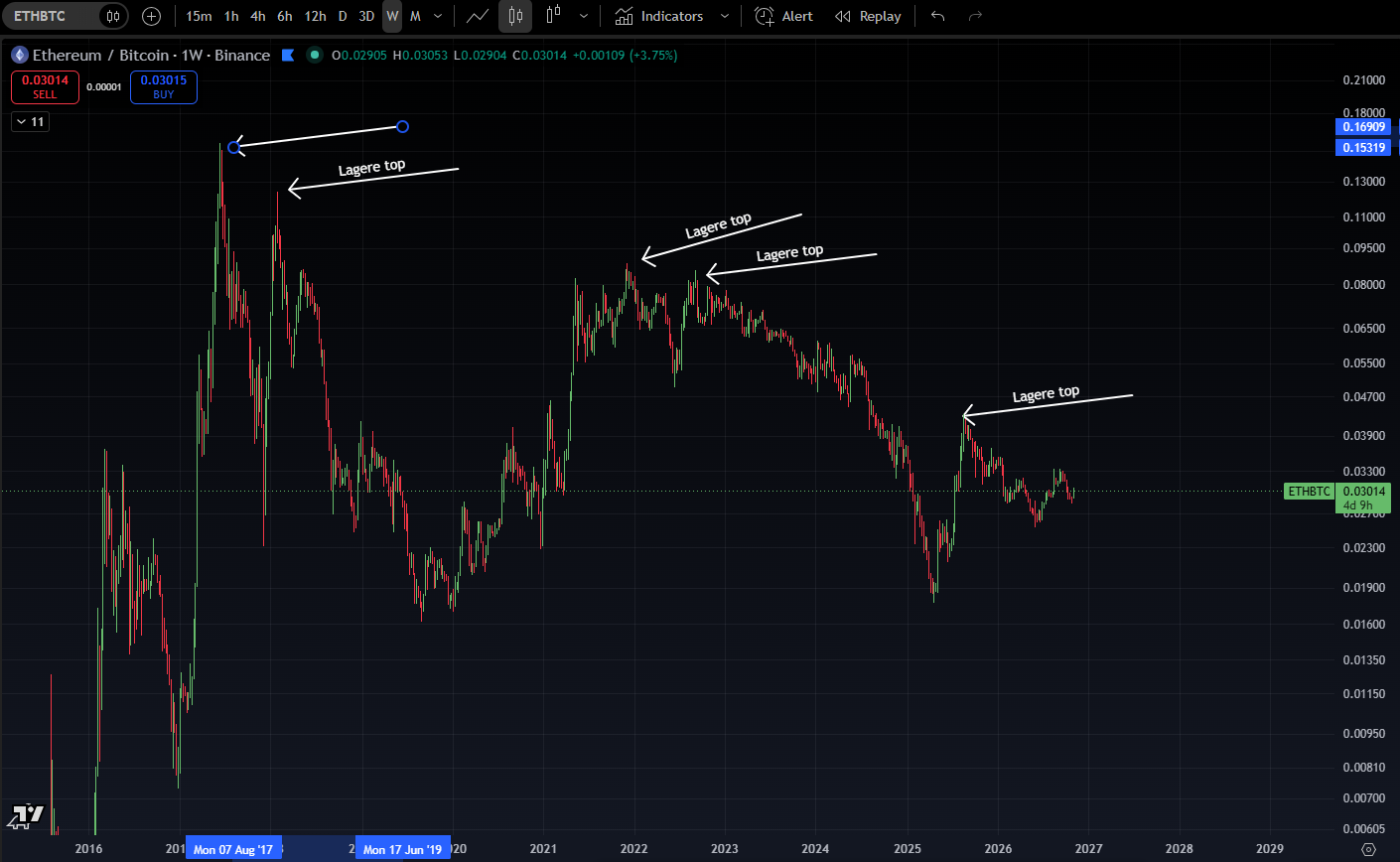
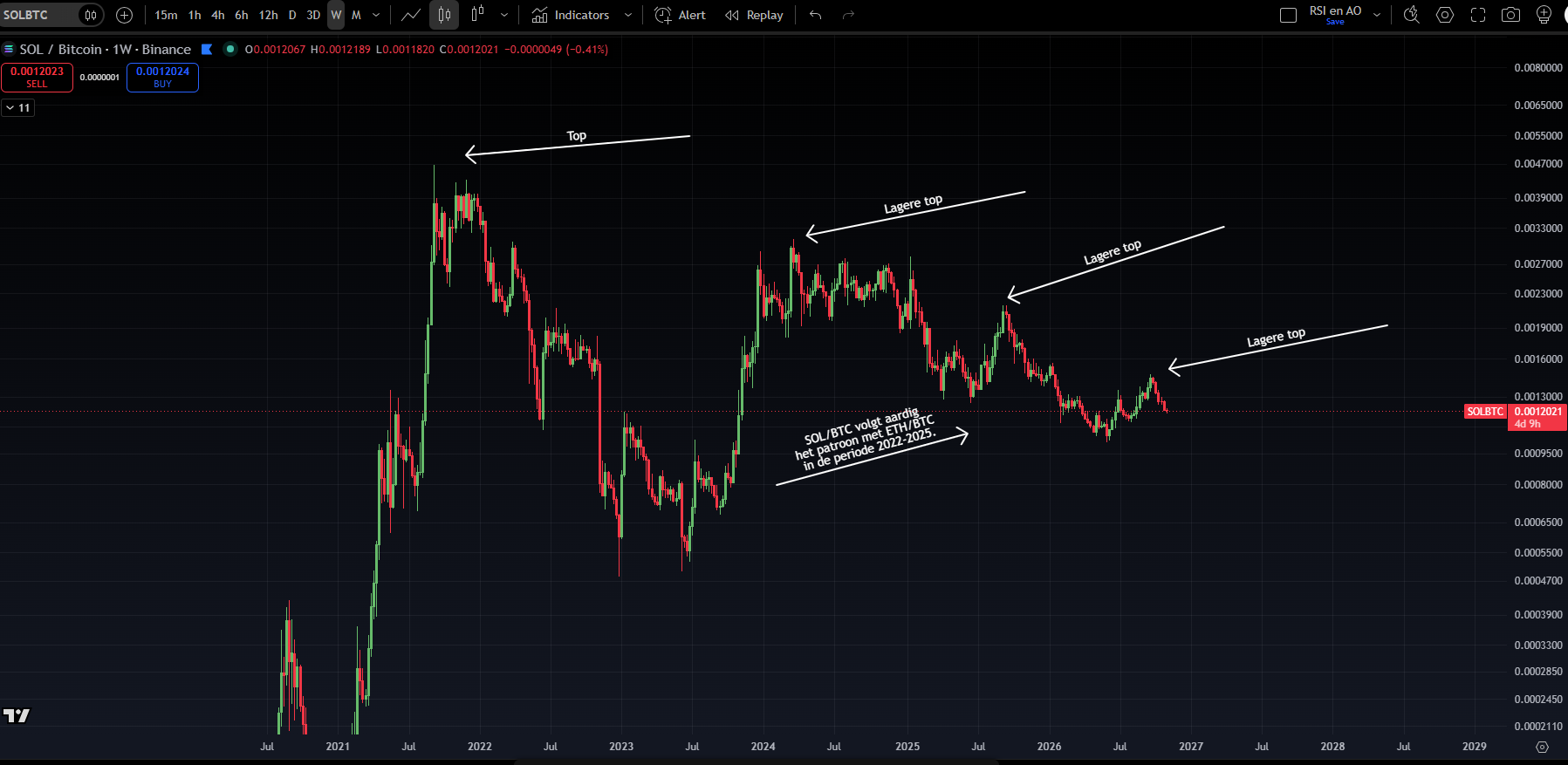
A handful of coins have managed to stand out across multiple cycles, such as SOL and ETH. When we look at them over a multi-year period against bitcoin, it becomes painfully clear that the longer-term trend is down. In other words, there are weeks and sometimes months when these two post stronger gains, but they then bleed lower in the period that follows.
You could argue that when bitcoin is moving strongly higher, exposure to these altcoins is a good choice. It’s only when bitcoin corrects sideways or downward that these altcoins show considerably more weakness.
For investors with a multi-year time horizon, it therefore doesn’t seem worthwhile to look beyond bitcoin within the crypto sector. Of course, black swans can create golden opportunities big enough to make it pay off, like SOL after the FTX implosion. Though at the time, it hardly felt like a golden opportunity.
Wrapping up
All previous editions of Alpha Markets are available in the archive. Questions, comments and suggestions are always welcome in the community.
Thank you for reading!
To stay informed about the latest market developments and insights, follow our team members on X:
- Bart Mol (@Bart_Mol)
- Peter Slagter (@pesla)
- Bert Slagter (@bslagter)
- Mike Lelieveld (@mlelieveld)
We appreciate your continued support and look forward to bringing you more comprehensive analysis in our next edition.
Until then!