
A Bear Market Rally for Bitcoin
Bitcoin surged past $73,000 this week—remarkably strong amid an escalating Middle East conflict. Yet the base case remains: this is a bear market rally until proven otherwise.
On Saturday morning, Israel and the US launched a series of heavy strikes on Iran. Ayatollah Ali Khamenei was killed, along with other top regime figures. In the days that followed, it escalated into a regional conflict, with significant consequences for much of the world.
The US government initially described the attack as a brief, targeted military action, aimed at weakening the regime enough for the Iranian people to liberate themselves and install new leadership. That doesn't appear to have worked—the timeline quickly shifted to 'three, four weeks'.
Shipping through the Strait of Hormuz has now largely ground to a halt, as has part of oil and gas production. Governments, companies, and markets are now processing the second-order effects. Geopolitical and economic interests are being weighed and deals struck. How this ends? Nobody knows yet.
"History is shaped by black swans: something improbable that happened anyway, or something probable that didn't," we wrote (coincidentally) last week. The attack on Iran isn't a black swan—at best a grey one. But the still unknown consequences could become one.
For now, financial markets are still pricing in the optimistic scenario: a short war without major disruptions or permanent damage. Peter made a video on Wednesday about the market's reaction (gold, oil, dollar, stocks, bitcoin) in the first days of the war. Highly recommended.
Bitcoin remains remarkably strong amid all the turmoil. It's interesting to look back at Russia's invasion of Ukraine on February 24, 2022. That was also a major geopolitical event with consequences for energy prices, and bitcoin was in a bear market then too.
The chart below compares the previous and current bear markets. We've aligned the capitulation of February 5, 2026 with the capitulation during Luna's collapse in May 2022, as they're similar in terms of market structure.
The first plausible time window for the bear market bottom is at the end of this weekly cycle, toward the end of Q2. We've marked that period with the blue area in the chart. In light green, you can see what a repeat of the previous bear market would look like.
The yellow highlight shows that bitcoin performed well in the first weeks after Russia's invasion of Ukraine, even briefly rising above the dominant moving average. It turned out to be a final test before the waterfalls from $48,000 to $15,500 in November 2022.
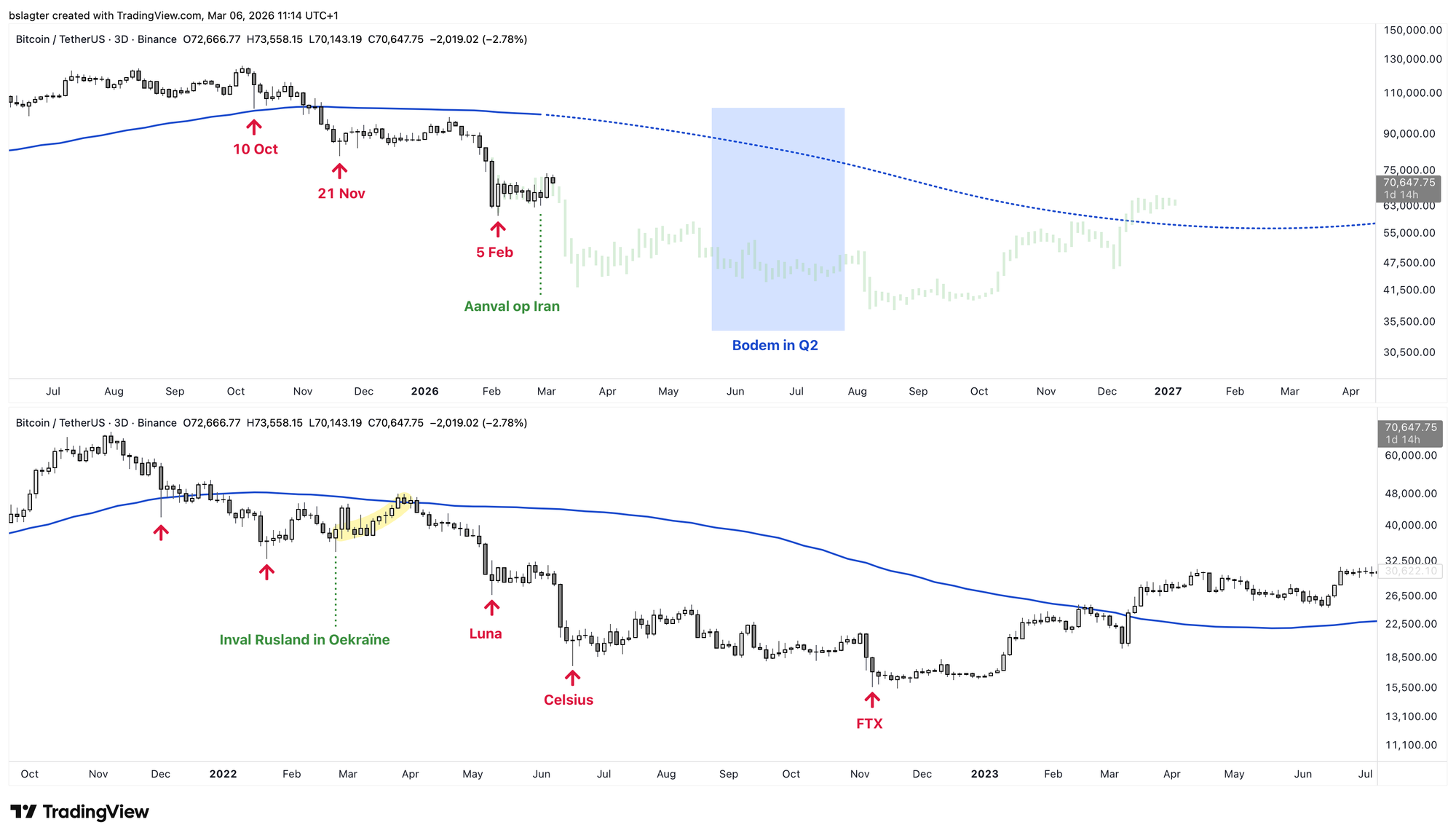
There's still hardly any support for a scenario in which bitcoin drops more than 75% in this bear market too. That would require new information coming to light. An as-yet-unknown shock. A global recession, a dramatic escalation of the Middle East conflict, a sudden bankruptcy at a major crypto player.
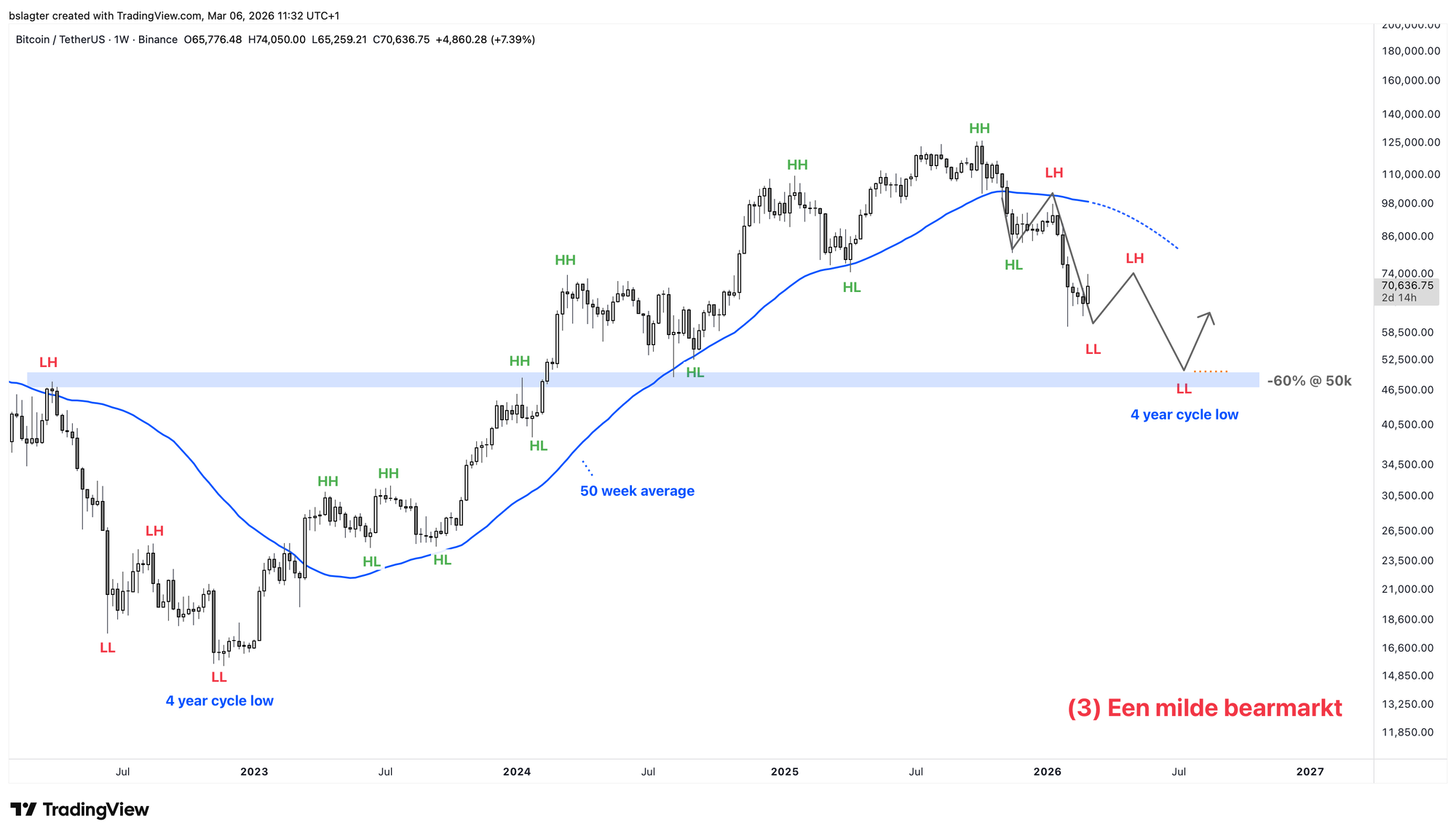
For now, our base case remains that we're in a mild bear market, with a price target between $48,000 and $60,000.
That means last week's rally is a bear market rally until proven otherwise. That proof would come with a weekly close above the 50-week moving average, or a higher high (HH) above $98,000. Neither of those has happened yet.

We continue with the following topics for our Alpha Plus members:
- Stocks ready for a new rally?
- February: fifth red month in a row
- Bitcoin won a battle, but certainly not the war
- Euro under pressure while dollar thrives as safe haven
- Gold cracked, the dollar surged, and bitcoin was surprisingly strong
1️⃣ Stocks ready for a new rally?
 Contribution by
 Bert
We already knew that it wasn't just bitcoin that peaked in October 2025 and has been declining since. You see this across virtually all high-risk investments. But MAGS, the ETF tracking the Magnificent Seven, also hit its highest price in October and is now down about 12%.
At the same time, the rest of the S&P 500 has been playing catch-up. As a result, the previous overvaluation of the Mag-7 relative to the equal-weight S&P 500 has disappeared. The AI hype has left the market. Investors remain positive but are also looking more critically at risks and potential disappointments. Sentiment has become more balanced.
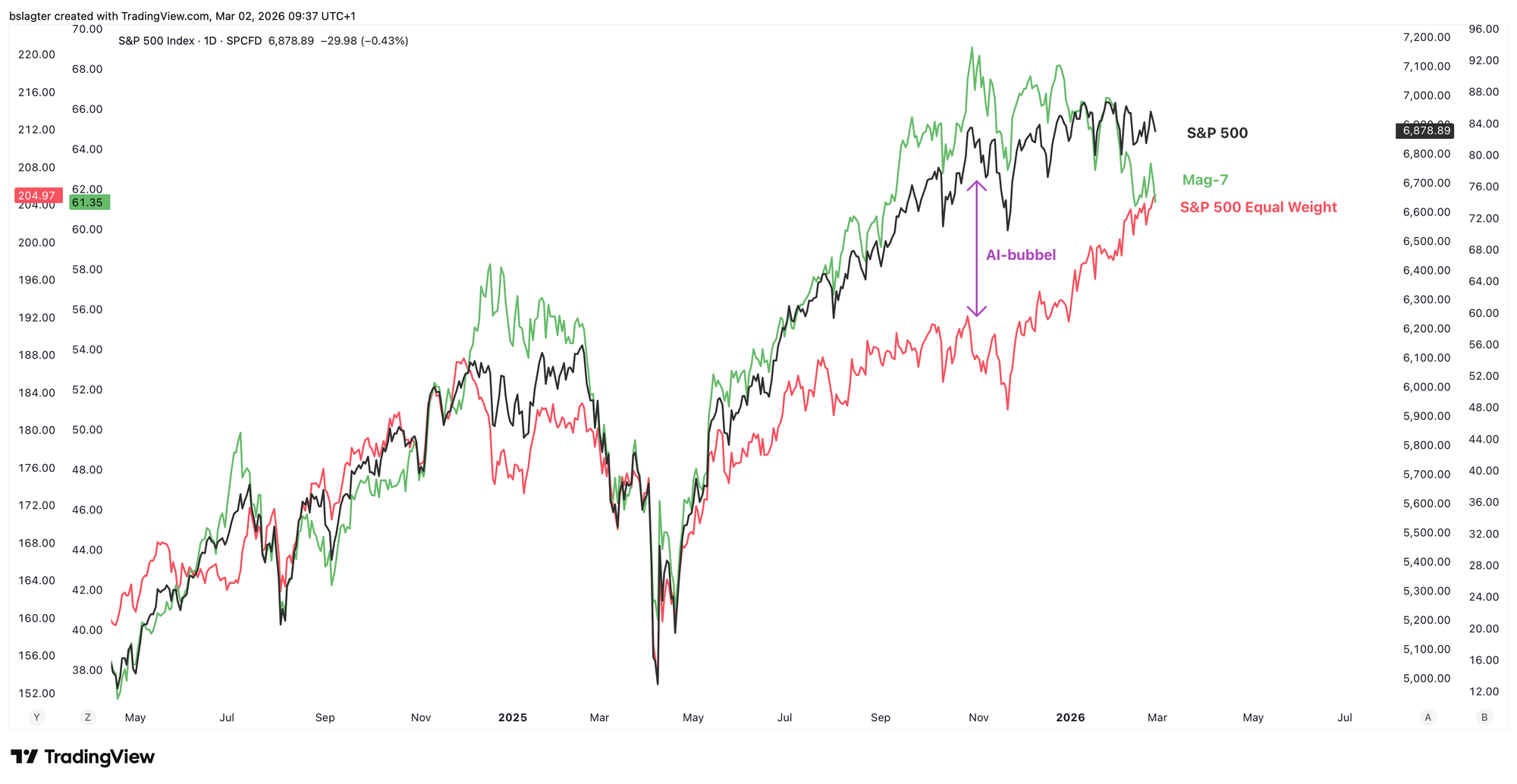
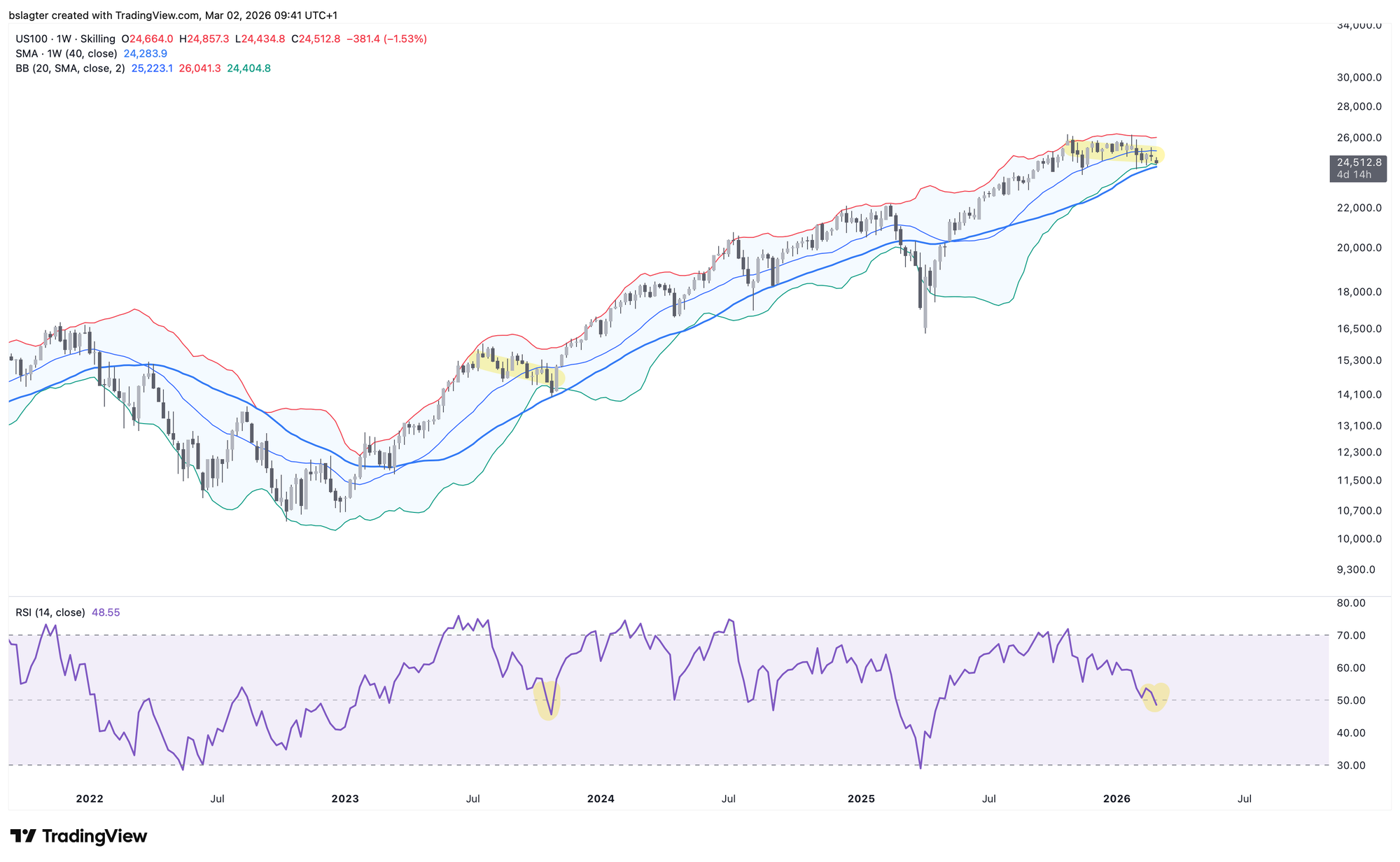
This forms a healthy foundation for a new rally in the stock market. Technically, the situation looks very similar to October 2023: price is touching the dominant moving average and the lower Bollinger Band, while RSI has fallen back to a neutral level.
If there truly is another 'leg up' in store, it should begin this month.
2️⃣ February: fifth red month in a row
Contribution by Bert
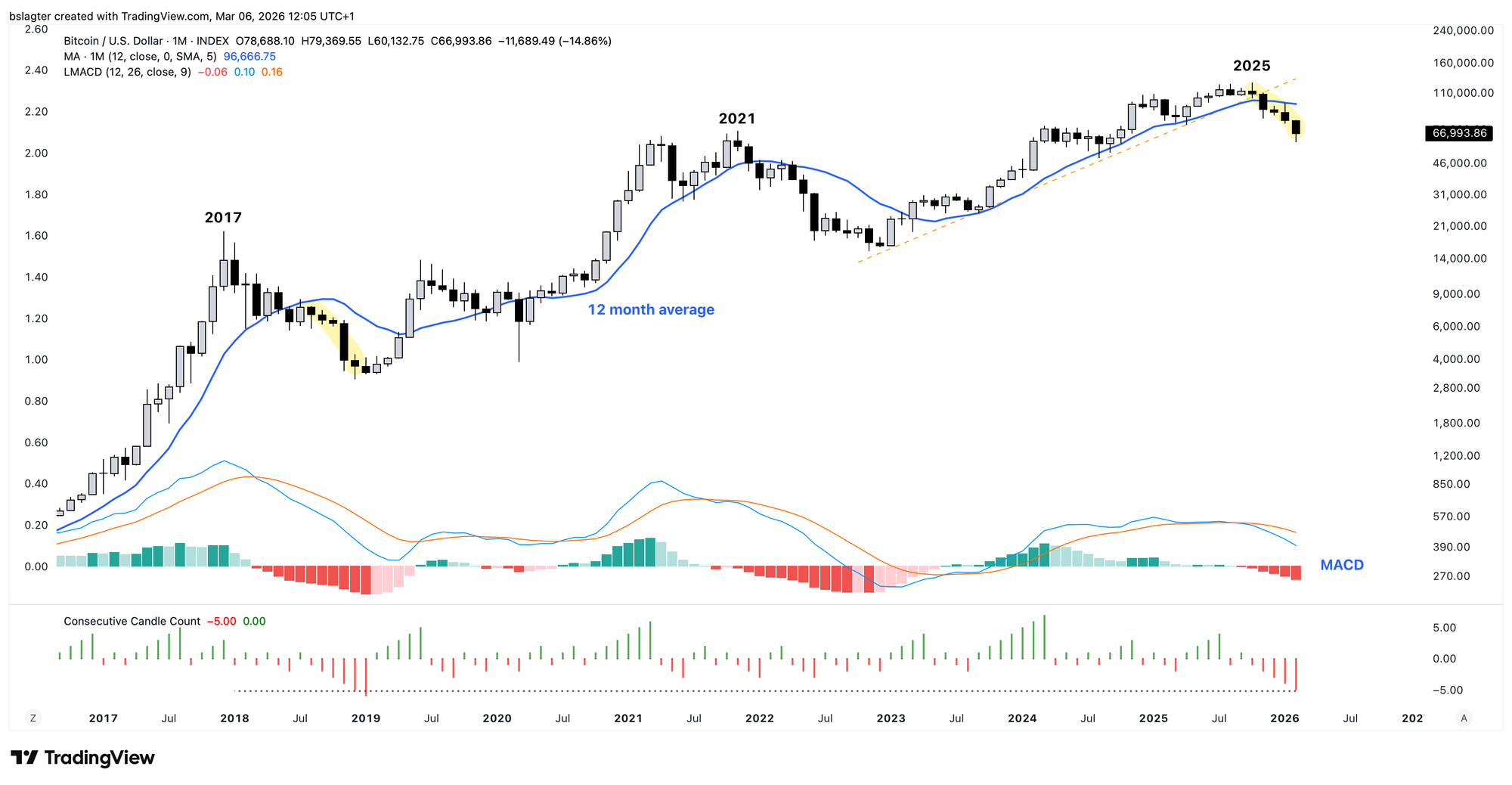
The start of a new month is a good time to look at the market with some distance. February started turbulently. In four days, bitcoin dropped from $79,000 to a low of $60,000 on February 6. After that, the price stabilized and moved sideways around $66,000 for the rest of the month.
With a 15% loss, February is the fifth consecutive red month. That's not unique, but it is rare. At the end of 2018, the market saw six consecutive red months, with the last one coinciding with the bear market bottom.
The monthly chart now leaves no doubt about the end of the rising regime from 2023 through 2025. Price fell like a rock through the trendline and dominant moving average, and the MACD momentum at the bottom is firmly in the red.
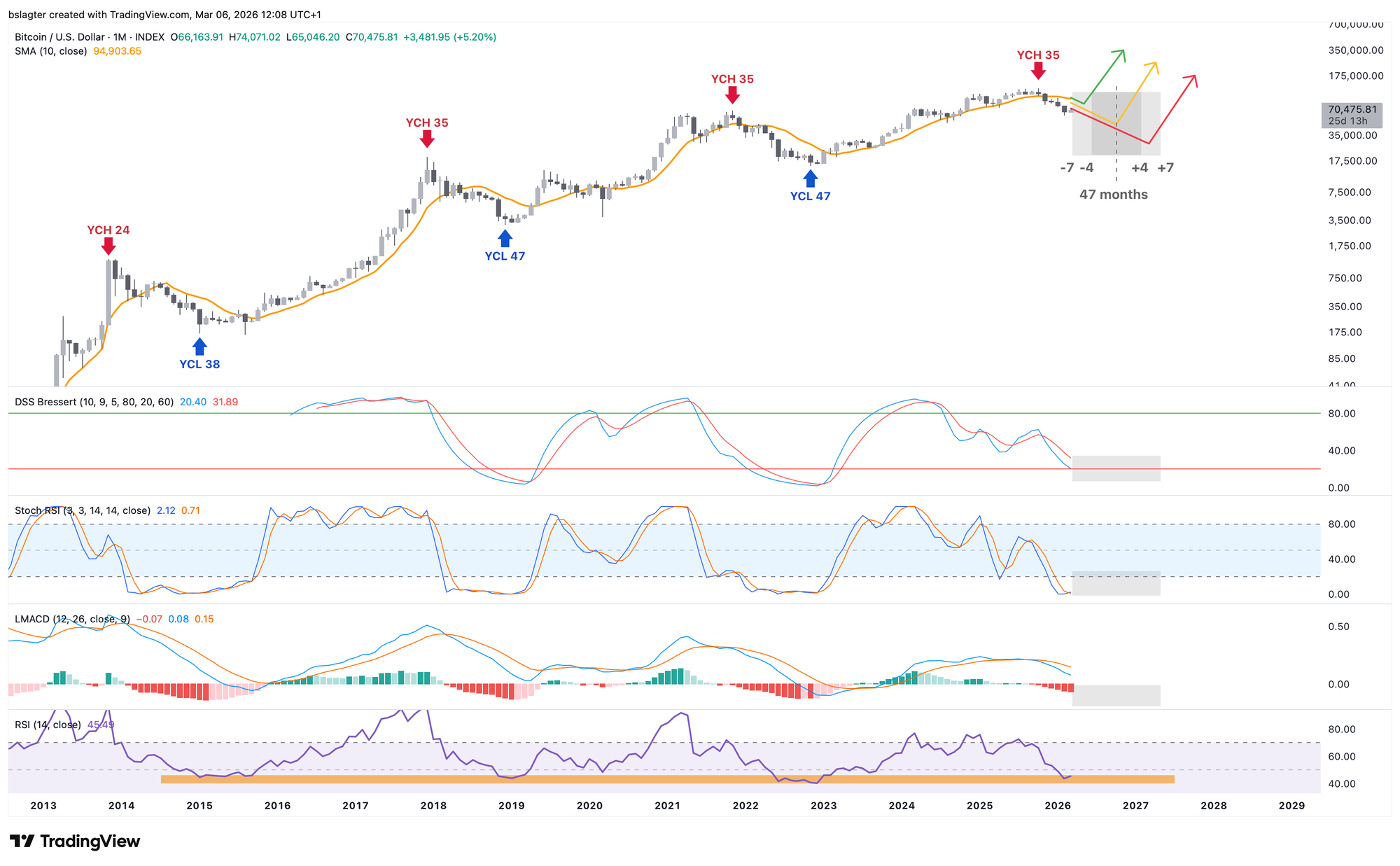
On the monthly chart, we've arrived in March at the first moment where a bear market bottom becomes realistic. The chart below shows the yearly cycle, with several oscillators and momentum indicators at the bottom.
You can see that if we let the natural wave pattern do its work, it will take a few more months before a new period of growth can emerge.
3️⃣ Bitcoin won a battle, but certainly not the war
 Contribution by
 Sam
Wednesday was (just like last Wednesday) a strong day for bitcoin, with a 6% rise from $68,000 to $73,000. Last weekend, as the situation in the Middle East escalated, we already saw signs of underlying strength. You'd expect a sharp move down, but bitcoin's price didn't really do much at all.
In the night from Sunday to Monday, Asian markets and US stock futures opened. Unrest, uncertainty, and panic led to red numbers, but bitcoin once again refused to join the selloff and even rose cheerfully along with the general recovery later on Monday.
So the underlying strength was there, and with Wednesday's strong upward move, the price has finally broken out of the trading range between roughly $60,000 and $71,500.
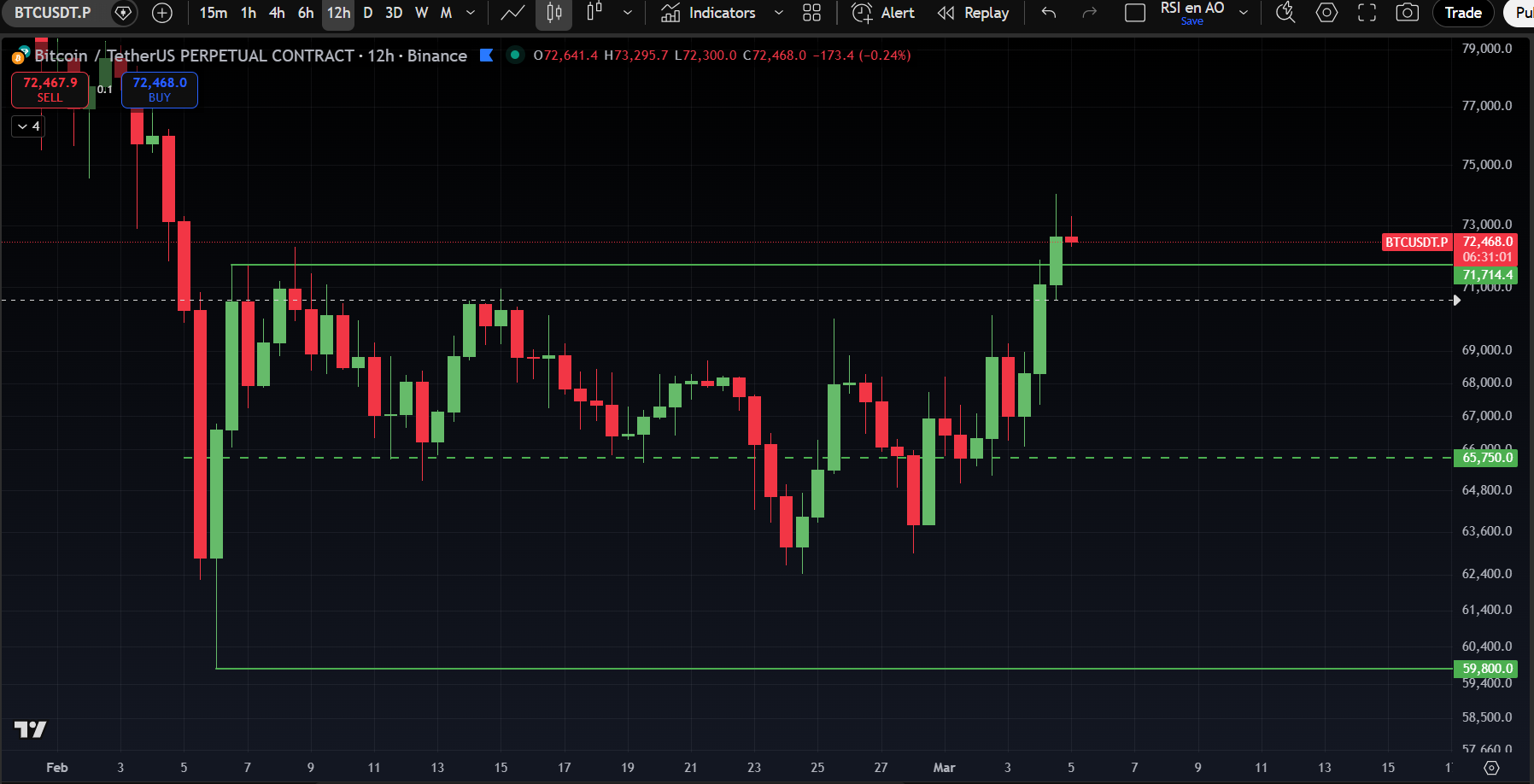
An important first step has been taken, and there's no signal yet that this rally is over. However, the assumption remains that this is an upward correction within a larger downtrend. The bulls have landed an initial punch, but the fight is far from over.
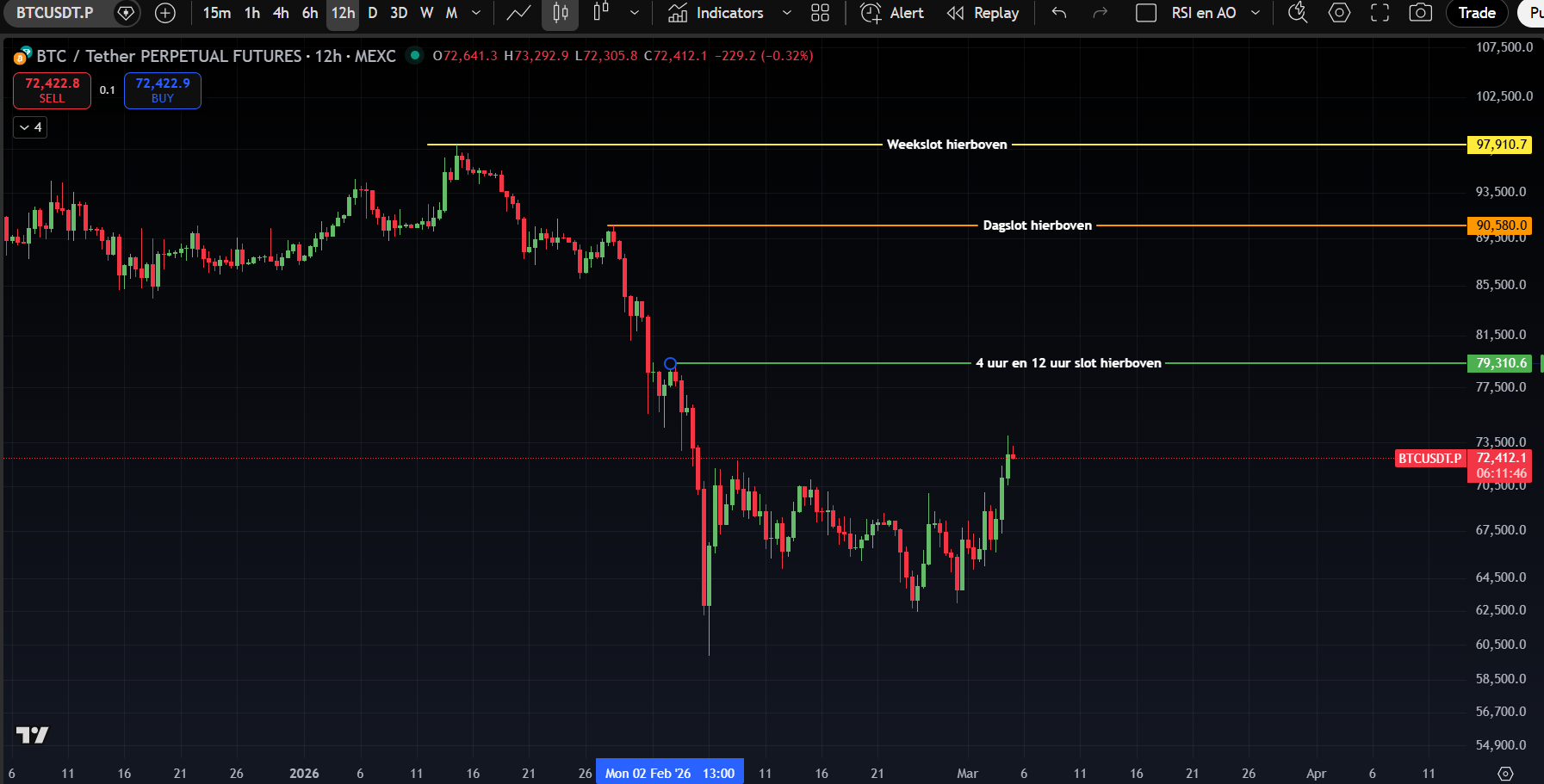
A useful analogy is comparing timeframes to boats. Lower timeframes are like a speedboat—quickly turning in all directions. Higher timeframes are more like an oil tanker. It takes time to turn around, but once it does, that's a strong signal.
The image below shows when market structure would flip from bearish to bullish across different timeframes.
On the 4-hour chart, a close above $79,300 is needed to take a first real step. It's likely this upward correction will stall before then. Statistically, the odds always favor the dominant trend continuing, with price eventually moving toward $60,000 or lower.
4️⃣ Euro under pressure while dollar thrives as safe haven
 Contribution by
 Thom
Not long ago, you could still get $1.20 for your euro, and it seemed only a matter of time before EUR/USD would jump to 1.25. At the time of writing, the pair is trading at 1.16, and the US dollar is demonstrating just how powerful it still is as the world's reserve currency.
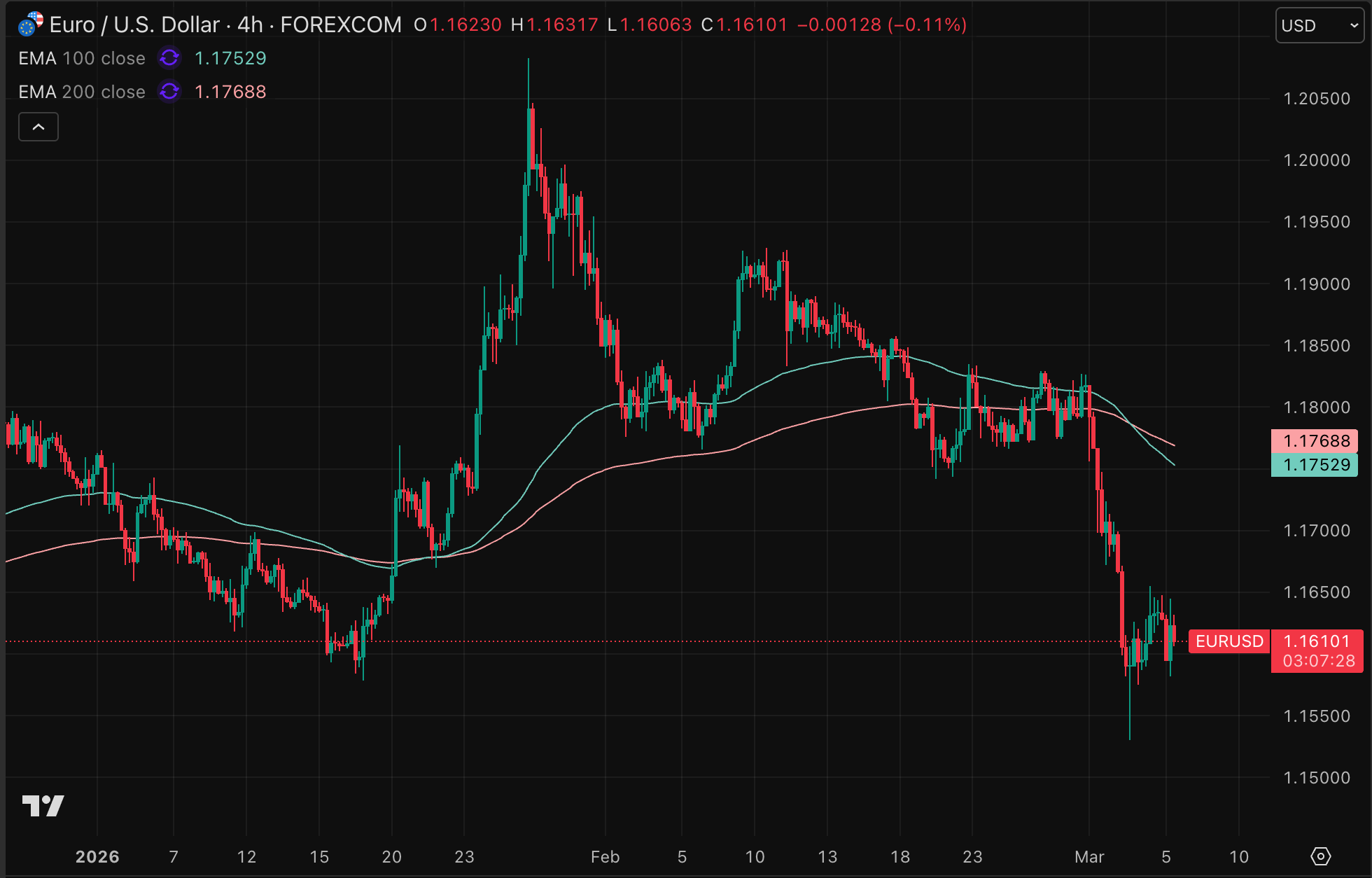
Several fundamental problems are currently at play for the euro. First, Europe is dependent on imports for virtually all forms of energy, making it a price taker. This means the continent is being hit not only by higher oil prices but also by sharply rising gas prices.
Since the weekend, natural gas prices have risen almost 100 percent. In that regard, it's not a bad thing that the weather is starting to improve. Furthermore, real economic growth in the United States is significantly higher than in Europe, and the same goes for interest rates.
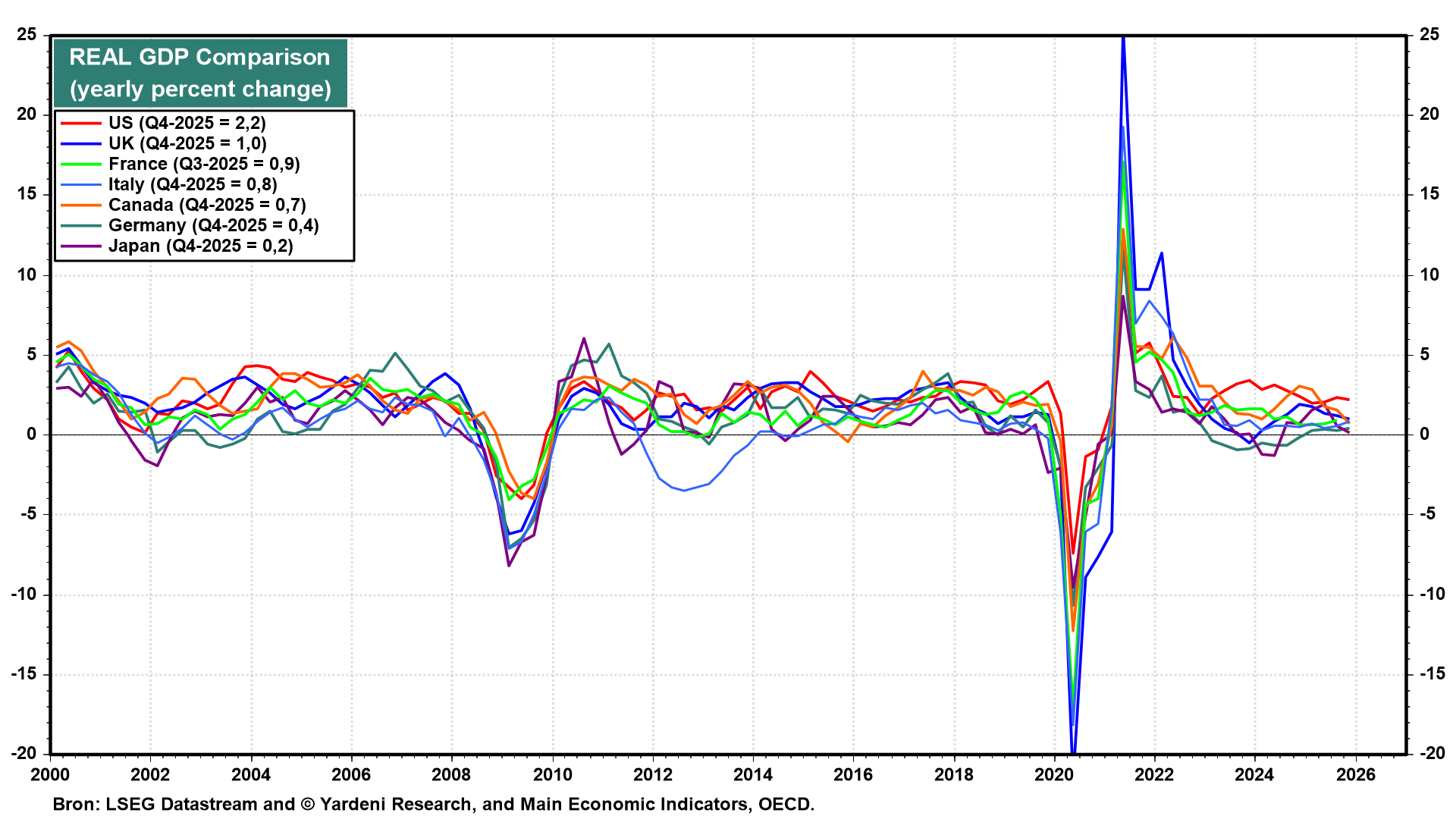
From a fundamental perspective, it's not surprising that the US dollar is currently regaining some ground against other world currencies. What's particularly interesting is the timing: right after sentiment around the reserve currency turned extremely negative—something you often see in financial markets.
At first glance, this might seem to have little to do with bitcoin, but the parallel is interesting. Just as many analysts were recently sketching doomsday scenarios for the US dollar, we're seeing similar narratives circulating about bitcoin right now.
Where bitcoin was presented in 2017, 2021, and 2025 as an improved version of gold that would eventually take over the world, that now seems unthinkable to those same people.
This mainly shows how sensitive financial markets are to price action and momentum. Not that long ago, we were supposedly witnessing the end of the US dollar. Now it's precisely the dollar that's holding up as a safe haven, while bonds, the Swiss franc, and gold are faltering.
Bitcoin is also showing signs of life. While it's still early days and plenty of additional confirmation is needed, this is exactly the kind of price action required to slowly restore confidence in the digital currency.
5️⃣ Gold cracked, the dollar surged, and bitcoin was surprisingly strong
Contribution by Thom
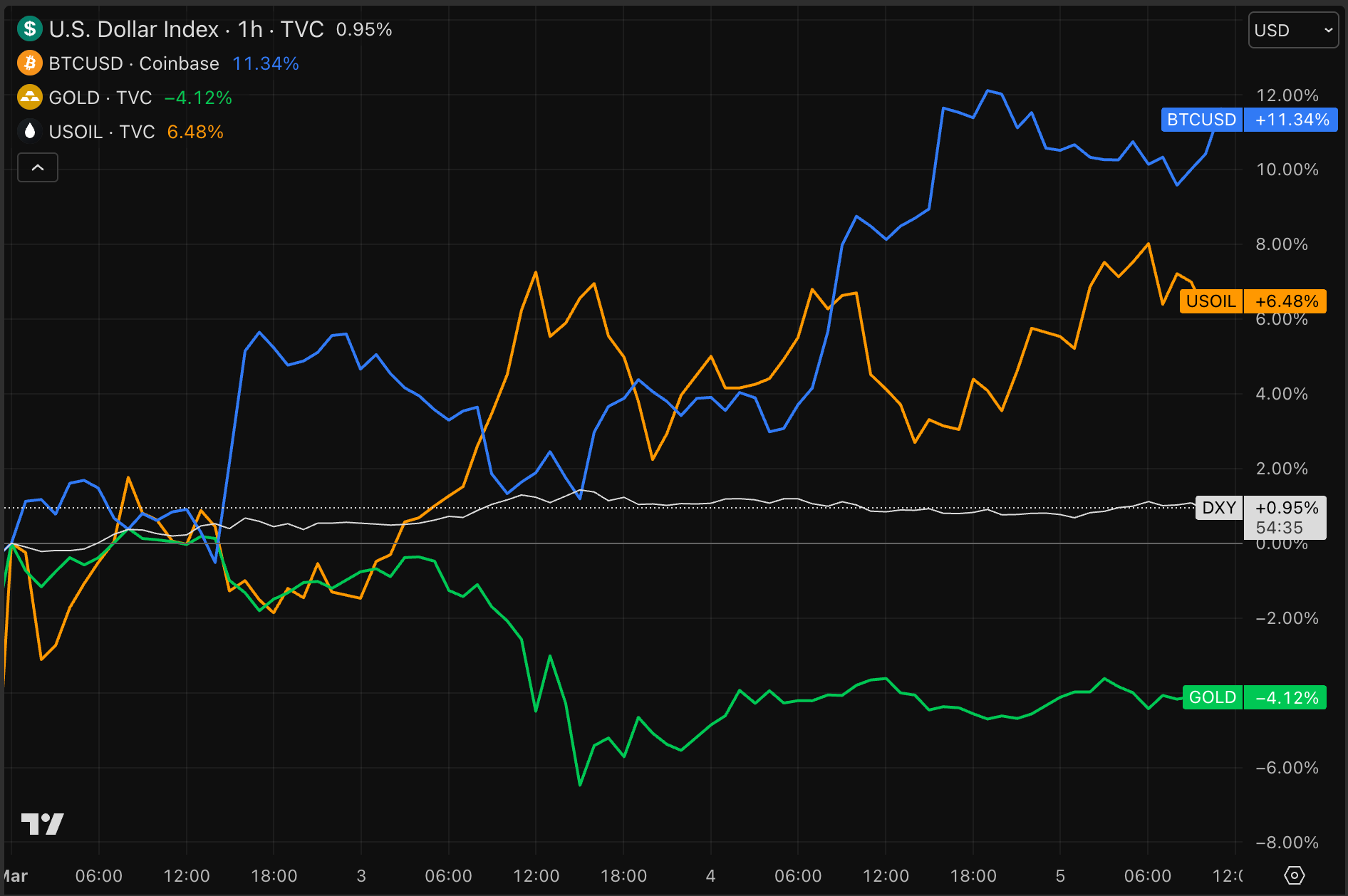
When the conflict with Iran seriously escalated last weekend, almost everyone expected another flight to gold. That move did come initially, but it proved short-lived. The US dollar quickly made clear that gold isn't the only safe haven in the world.
The combination of rapidly rising oil prices and surprisingly strong data from US industry reduces the likelihood of quick rate cuts by the Federal Reserve. A higher inflation risk and a robust economy mean the central bank has less reason—and less room—to lower rates.
Likely as a result, we saw the US dollar bounce, financial conditions tighten, and gold lose momentum. Higher rates make gold less attractive compared to the dollar, since the precious metal yields no interest. At moments like these, the US dollar proves it remains one of the world's most important safe havens.
Equally interesting was bitcoin's reaction. While gold was visibly struggling, we saw the bitcoin price explode. Although it's far too early to draw conclusions, these are the kinds of price movements that could eventually set a serious capital rotation in motion.
That we shouldn't celebrate too early is also evident from the performance of the software index (IGV) this week. While its current gain of +4.19 percent is less impressive than bitcoin's preliminary recovery, it's notable that IGV is clearly outperforming the broader S&P 500.
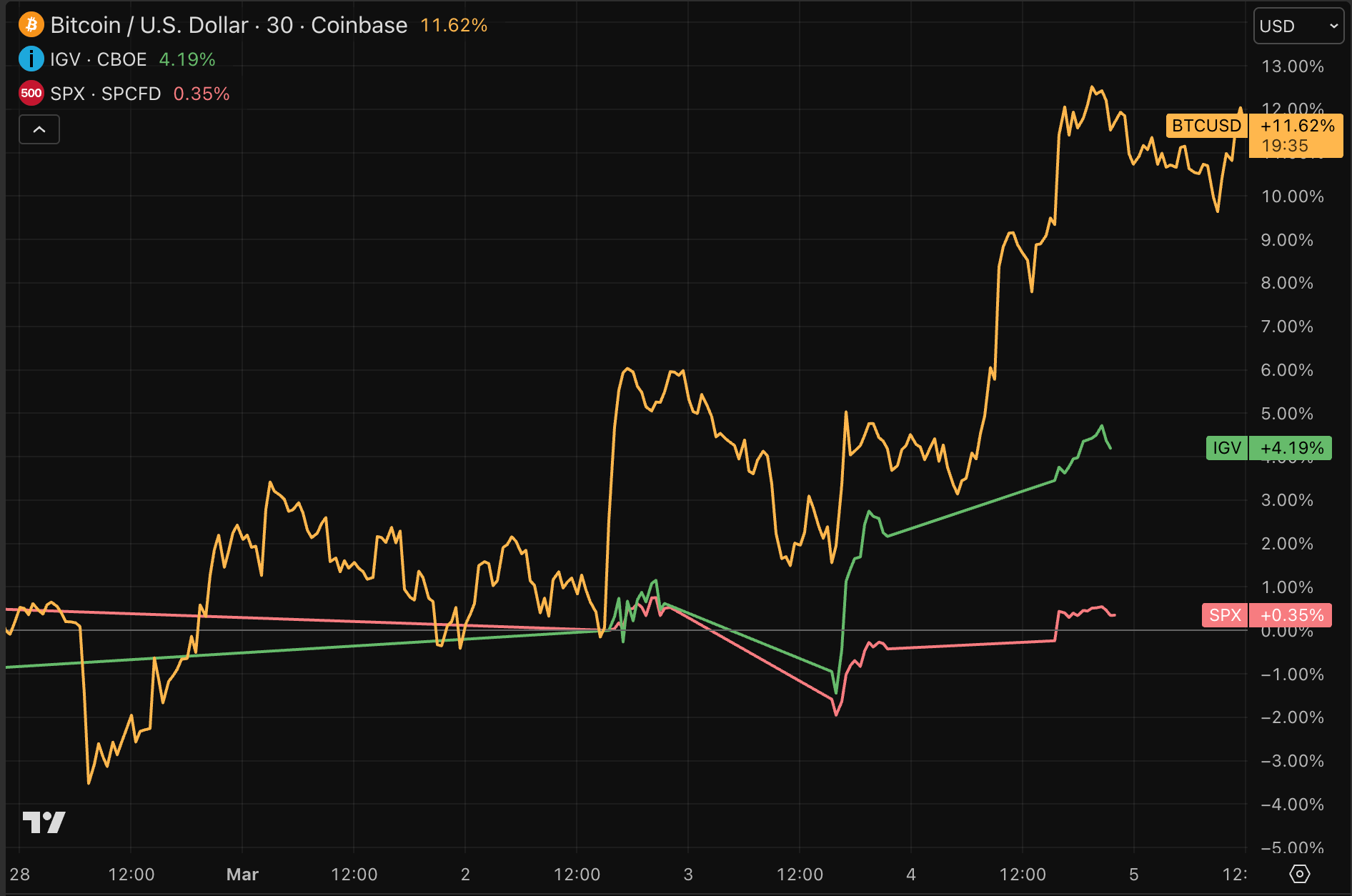
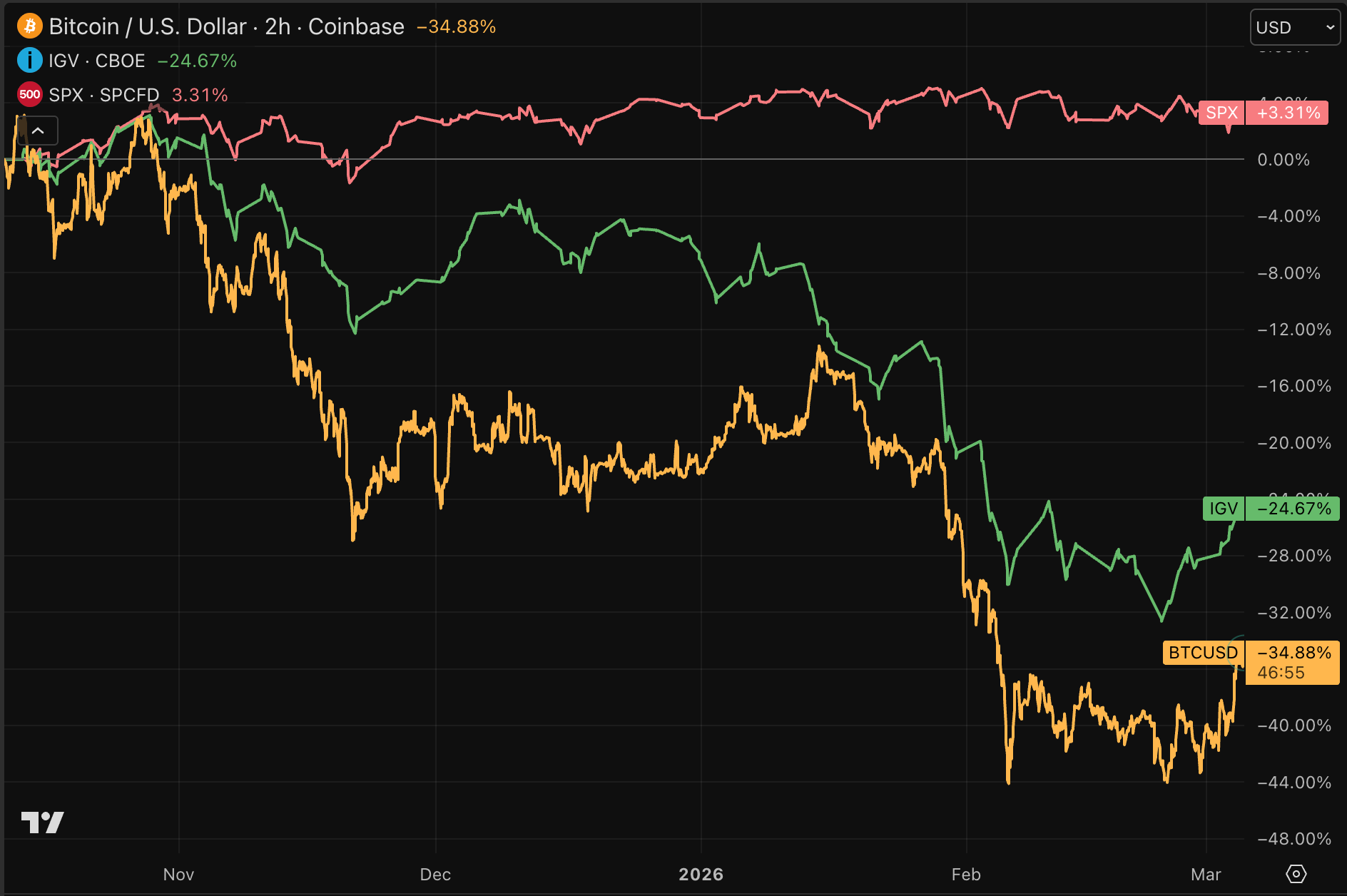
It's not just bitcoin performing after a weak period. Software is showing a similar reaction. It remains quite possible that we're looking at a classic bear market rally for both bitcoin and software stocks, which have both been going through a difficult period since October 2025.
After the steep price declines since Q4 2025, a recovery move was more than logical. Markets rarely move in a straight line down. Even in a downtrend, powerful counter-moves can emerge that sometimes last weeks or even months.
The coming weeks will reveal whether we're looking at a return of risk appetite, or whether this was a temporary bounce within a broader correction.
In closing
All previous editions of Alpha Markets can be found in the archive. Questions, comments, and suggestions are always welcome in the community.
Thank you for reading!
To stay informed about the latest market developments and insights, follow our team members on X:
- Bart Mol (@Bart_Mol)
- Peter Slagter (@pesla)
- Bert Slagter (@bslagter)
- Mike Lelieveld (@mlelieveld)
We appreciate your continued support and look forward to bringing you more comprehensive analysis in our next edition.
Until then!