
War, Oil, and a Surprisingly Strong Bitcoin
The Iran war pushes oil above $110 and rattles global markets. Yet bitcoin holds firm. What does that tell us about its role in times of geopolitical stress?
 Contribution by
 Peter
Last Wednesday I posted the chart below on Discord to illustrate the trajectory of the Iran war, which has gripped the Middle East and the world since February 28.
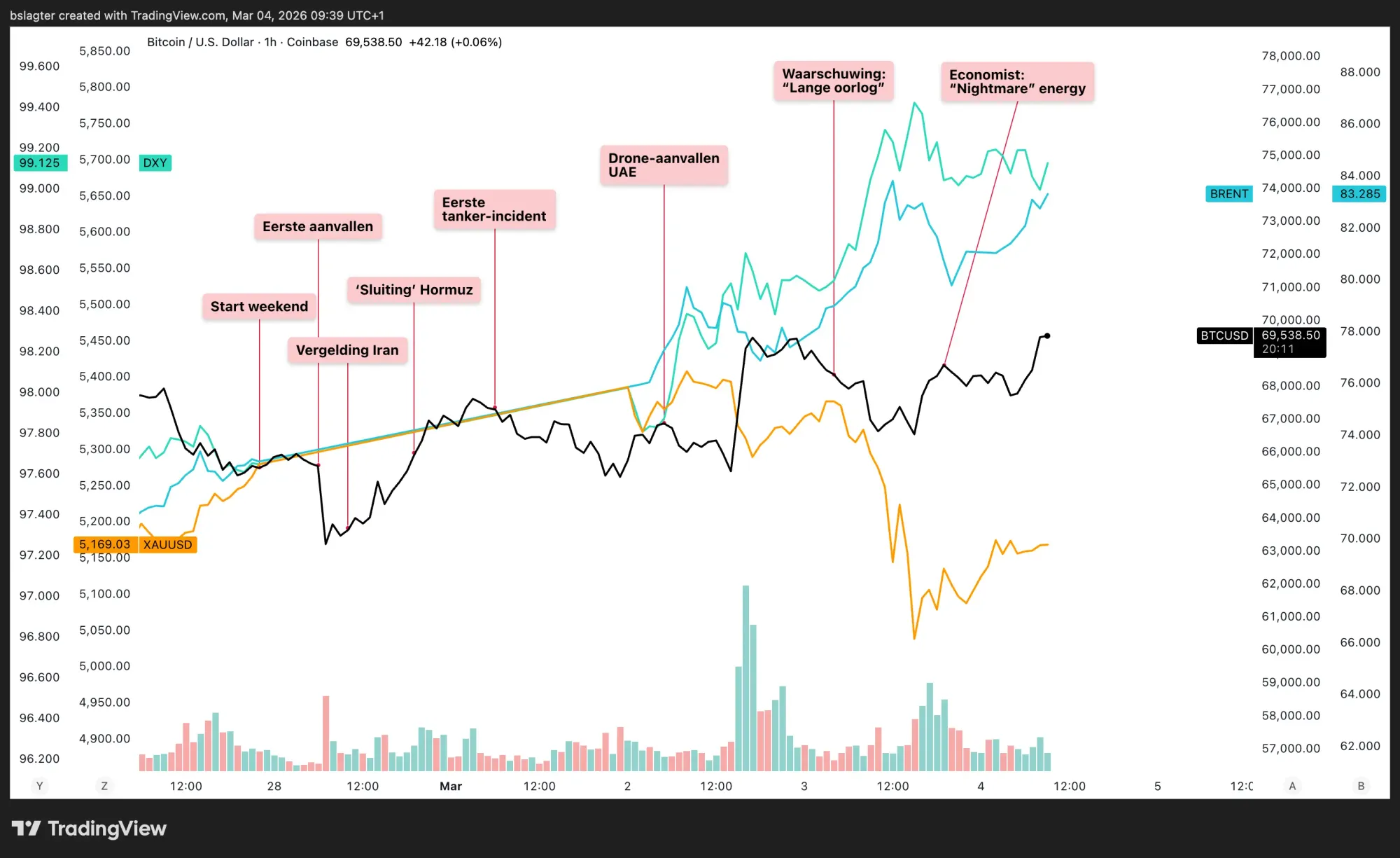
The chart shows three key indicators for the war's progression. The price of gold, as a safe haven. The price of a barrel of oil, where this conflict hits the global economy. And the value of the dollar, which reflects demand for liquidity and is used to settle transactions in the oil market.
As time passed, a clear divergence emerged: oil prices surged, leaving their mark across markets. Many stock exchanges hit the brakes due to sharp declines, and even the world's safest asset in times of geopolitical turmoil lost value, presumably due to dollar demand.
The higher oil price is not without consequences for the global economy. The IMF calculated that a 10% rise in oil prices depresses global GDP by about 0.15 percentage points, while inflation rises by around 0.4 percentage points a year later. The ECB sees the same effect: the same increase immediately pushes inflation up by about 0.4 percentage points, with an additional 0.2 percentage points spread over the following three years.
Where do things stand now, five days later? Not great.
A few hours ago, the oil market reopened after the weekend. The price of a barrel of oil jumped from $90 to above $110. Since the conflict began, oil prices have risen by more than 50%. Once again, circuit breakers had to kick in across Asian markets to keep stock exchanges afloat. And demand for dollars—for immediate liquidity—remains sky-high. The updated chart shows the oil spike.
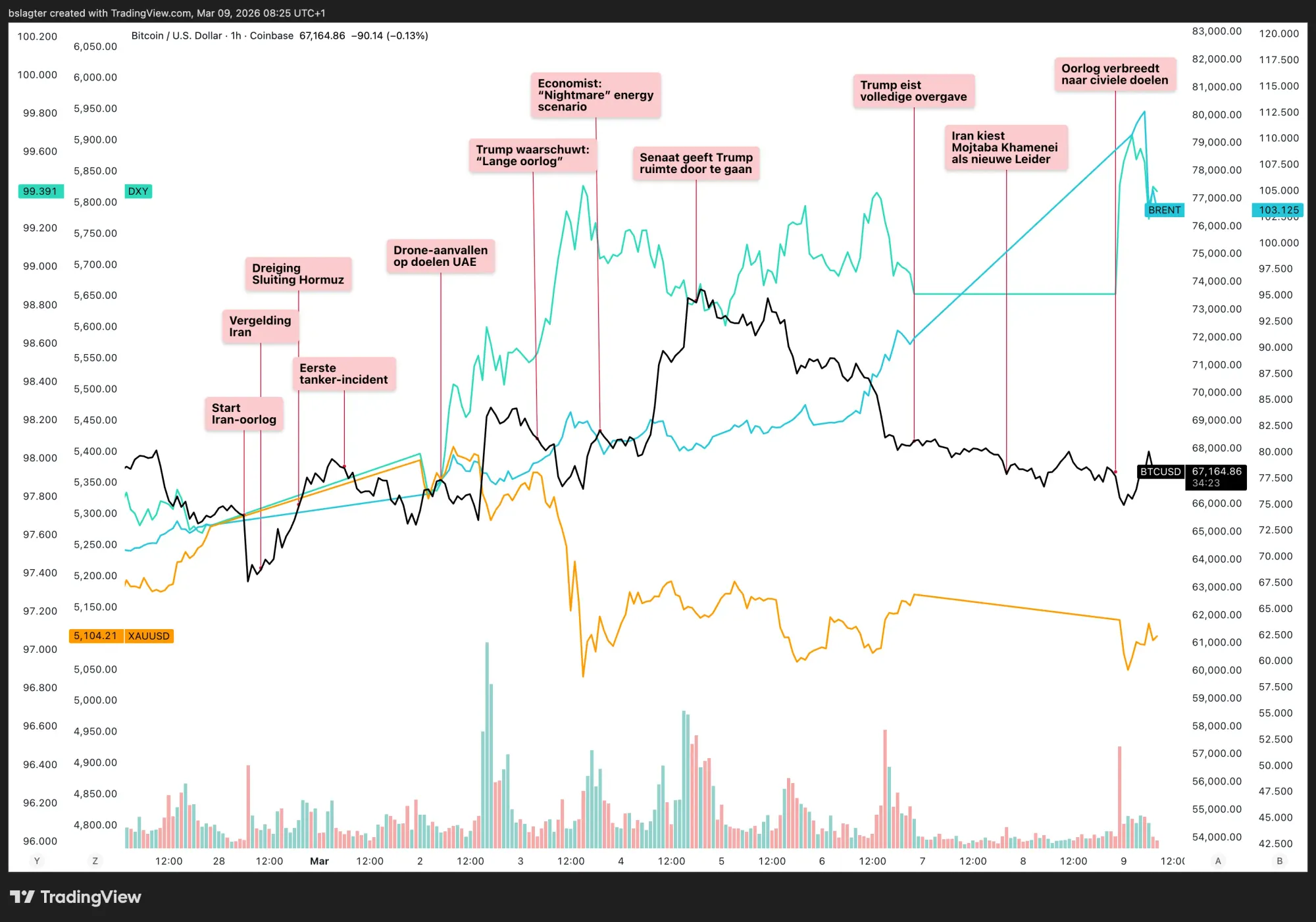
Over the past few days, the war has entered a new phase. The attackers demanded unconditional surrender but didn't get it. In fact, the regime that was supposed to fall has appointed a successor from the same bloodline. Mojtaba Khamenei now holds the reins and doesn't seem ready to give up the fight. Meanwhile, both sides have begun targeting civilian infrastructure.
As the war enters its second week, both parties are running up against the limits of their strategy. Military objectives have been achieved, but a political breakthrough remains elusive. The regime is holding on. So are America's allies in the Gulf. Without new plans, the conflict is shifting toward a war of attrition—one where not only military strength matters, but also the ability to absorb economic damage and attacks on critical infrastructure.
All in all, sentiment in financial markets is grim. Many analysts have turned pessimistic and tossed their optimistic forecasts in the trash. They've become doom prophets, or locked themselves into worst-case scenarios. "It's not fear porn, it's reality."
Here it comes. WTI +20%; Brent +18%.
— Alexander Stahel 🌻 (@BurggrabenH) March 8, 2026
Backwardation going wild. Panic mode...
This will become a long week chaps https://t.co/Ly91NiSDfg pic.twitter.com/JDIkM1P7wz
Against this backdrop, it's all the more striking that bitcoin during this period... is holding up remarkably well. The bitcoin price is currently 3 percent higher than when the war started. More on that... after the break!
More Alpha
Are you a Plus member? Then we continue with the following topics:
- Bitcoin holds strong—good news?
- Kraken gains access to Federal Reserve
- Paraguay wants to mine BTC with hydropower
1️⃣ Bitcoin holds strong—good news?
Contribution by Peter
There's no getting around it: bitcoin's price has held up remarkably well so far. And that's not a given during times of acute turmoil. We've grown accustomed to bitcoin being part of the liquidity flight at these moments—a sharp decline as traders rush to the dollar.
You can of course spin nice stories around this. For instance, that Iranians are buying bitcoin en masse to escape the consequences of war. Bitcoin as "the only remaining exit."
NEW: 🇮🇷 Bitcoin is leaving exchanges in mass in Iran because of the war
— Simply Bitcoin (@SimplyBitcoin) March 3, 2026
Bitcoin is the exit. pic.twitter.com/0AIRGVEuf1
But however appealing a strong humanitarian role for bitcoin sounds, there's no hard data to back it up.
A more logical explanation for bitcoin's relative strength seems to lie in its correlation with SaaS stocks. Just look at this chart, showing bitcoin performing similarly to IGV (Tech-Software Sector ETF) and SKYY (Cloud Computing ETF). Part of the market has long grouped bitcoin together with software stocks, and once again that pattern appears to be playing out.
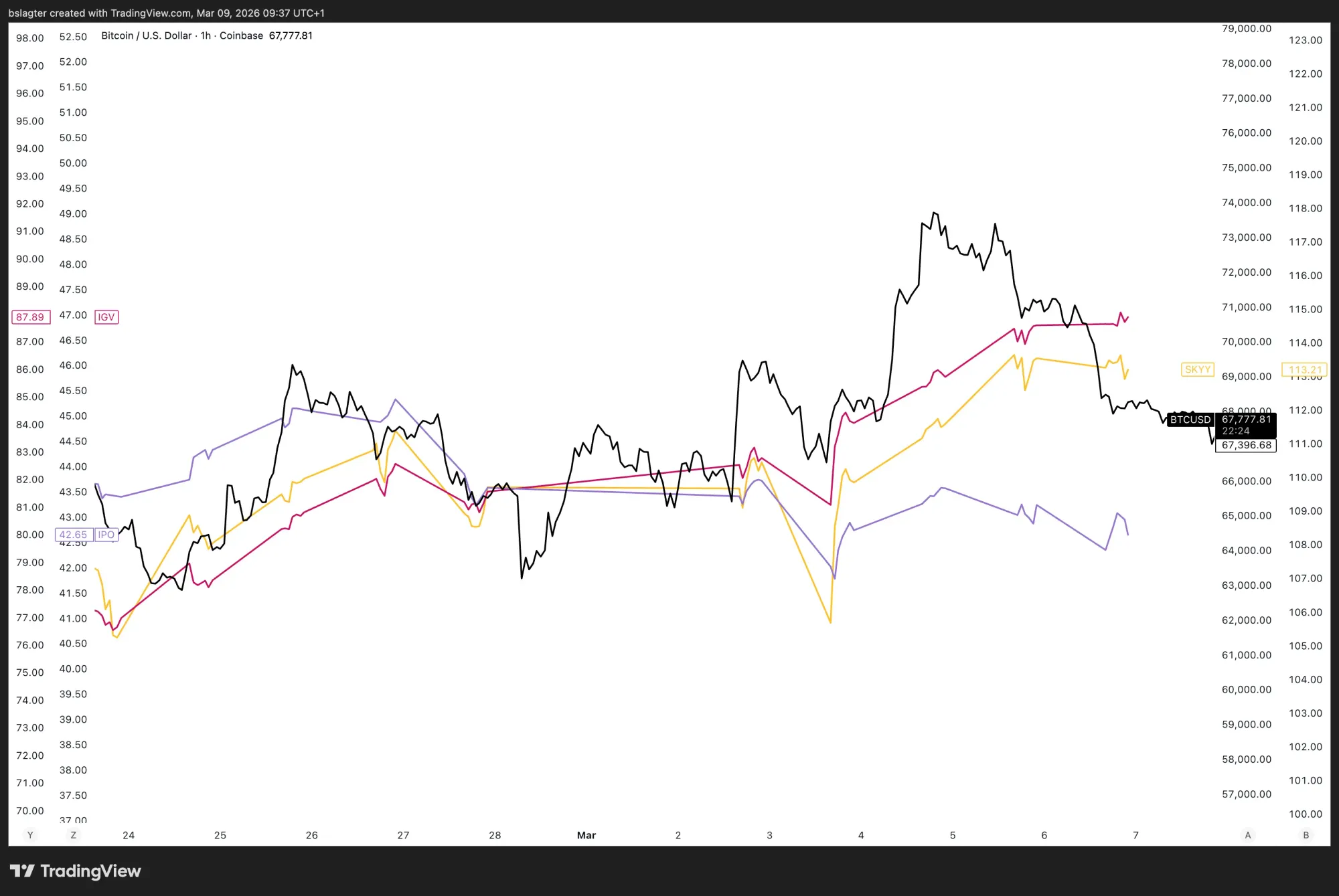
Analysts at RBC Capital examined how software stocks have behaved during periods of geopolitical tension and market volatility over the past ten and twenty-five years. Their conclusion: the sector has proven surprisingly resilient to these kinds of shocks.
According to RBC analyst Rishi Jaluria, the explanation lies in the nature of the product. Software forms the beating heart of modern businesses. Systems for accounting, customer management, or online collaboration are simply too critical to replace at the first sign of crisis. As long as there are no mass layoffs reducing the number of software licenses, geopolitical uncertainty has little impact on demand. ERP and CRM systems don't get switched off because of tensions in the Middle East.
There's more to it. Unlike heavy industry or the energy sector, software is barely affected by disruptions to raw materials or logistics. Oil prices and shipping routes simply don't play a direct role in a software company's operations. Their product is digital, their margins are high, and their revenue often comes from subscriptions. That makes them look relatively stable in turbulent times.
Of course, these companies would also be hit by an oil crisis if it persisted. Oil is energy, and energy is ultimately needed for all production, whether your product is delivered physically or digitally. But for software companies, there's a substantial buffer. For investors seeking shelter from the market storm, that can be a reassuring thought.
Bitcoin shares some of that character. The network runs independently of logistics chains, raw materials, or geopolitical bottlenecks. A blockade of the Strait of Hormuz affects oil transport, but not the bitcoin blocks flowing through the network. Bitcoin, too, appears as an asset less sensitive to traditional economic disruptions.
In any case, right now both large software companies and bitcoin fall into the "digital assets" category. They therefore move with the same capital flows. When investors want to take on risk and value technology higher, they rise together. This mainly tells us something about how investors currently categorize them: as digital, scalable assets relatively detached from the physical economy.
In times of geopolitical turmoil, that may temporarily be a reason why capital flows toward them.
2️⃣ Kraken gains access to Federal Reserve
Contribution by Peter
The news broke as a "watershed moment." A crucial turning point, a historic milestone, is what American exchange Kraken calls it. The exchange has obtained an account at the U.S. central bank—a privilege normally reserved only for banks.
Kraken gets Fed master account in crypto first
— matthew sigel, recovering CFA (@matthew_sigel) March 4, 2026
"a watershed milestone in the history of digital assets" 👍 pic.twitter.com/2ewG1XI8Yh
It's a limited master account. With this account, Kraken gains access to the Fed's infrastructure. The company can now send large dollar amounts directly via Fedwire, without a correspondent bank. That makes moving dollars in and out of crypto markets faster, simpler, and cheaper. Access to FedNow also seems likely—a system similar to instant payments in the EU.
Additionally, Kraken can settle transactions directly through the Fed. This eliminates dependence on partner banks—a vulnerability exposed in 2023 when Silvergate and Signature collapsed.
But Kraken's account also has clear limitations. Kraken receives no interest on reserves held at the Fed and has no access to emergency funding through the discount window. The company also cannot engage in traditional banking activities through this route, such as extending credit. This aligns nicely with the model of Kraken Financial, the Wyoming-based SPDI bank that operates with full reserves.
Access to Fed services is temporary. The arrangement runs for one year and appears intended as a pilot project. Assuming success, it's a meaningful victory for Kraken, and by extension for the entire U.S. crypto sector.
That's also evident from the banking lobby's reaction to the Fed's decision. They've responded very critically, calling it a policy mistake. The Bank Policy Institute says the Kansas City Fed acted too hastily. The American Bankers Association calls the decision premature, since rules around this type of access are still being developed.
🚨NEW: Bank trades are coming out against the @krakenfx master account approval.
— Eleanor Terrett (@EleanorTerrett) March 4, 2026
📌@bankpolicy says the Kansas City Fed front ran the Board's public comment period and "violated policy" on seeking public comment when it intends to make significant changes to the payments… https://t.co/1mpghUFB2F
Supporters see exactly the opposite. According to them, the Fed is cautiously breaking with a system where access to critical infrastructure was almost exclusively in the hands of banks. That makes the decision potentially more significant for the crypto sector than it appears at first glance.
For Caitlin Long, founder and CEO of Custodia Bank, the news must be bittersweet. She has been fighting unsuccessfully for similar access since 2020. Judging by Kraken founder Jesse Powell's words, she fought for Kraken too: "Thank you for tirelessly waging war on this issue all these years." And: "We're the bankers now. Saddle up."
Sorry about your monopoly. Thank you @SenLummis, @GovernorGordon, the great state of Wyoming and @CaitlinLong_. Well done, @arjunsethi and the @krakenfx team. The end is the beginning is the end. We're the bankers now. Saddle up. 🤠🇺🇸🚀 https://t.co/CZb12rkybZ
— Jesse Powell (@jespow) March 4, 2026
3️⃣ Paraguay wants to mine BTC with hydropower
 Contribution by
 Erik
What do you do as a government with BTC seized from criminals? Some governments put them in a national fund, others sell them. Paraguay's government faced a similar choice when it confiscated tens of thousands of bitcoin miners from illegal mining operations. Instead of selling them, the country now wants to deploy the miners legally—starting with a pilot phase of 1,500 machines.
Paraguay has a surplus of electricity, thanks to its enormous hydroelectric plants. By far the largest, Itaipu, produces about 14 gigawatts. That's nearly enough to power all of the Netherlands, and coincidentally also in the same ballpark as what all bitcoin miners worldwide consume combined. Paraguay, with just 7 million inhabitants, currently sells part of its surplus to neighboring Brazil.
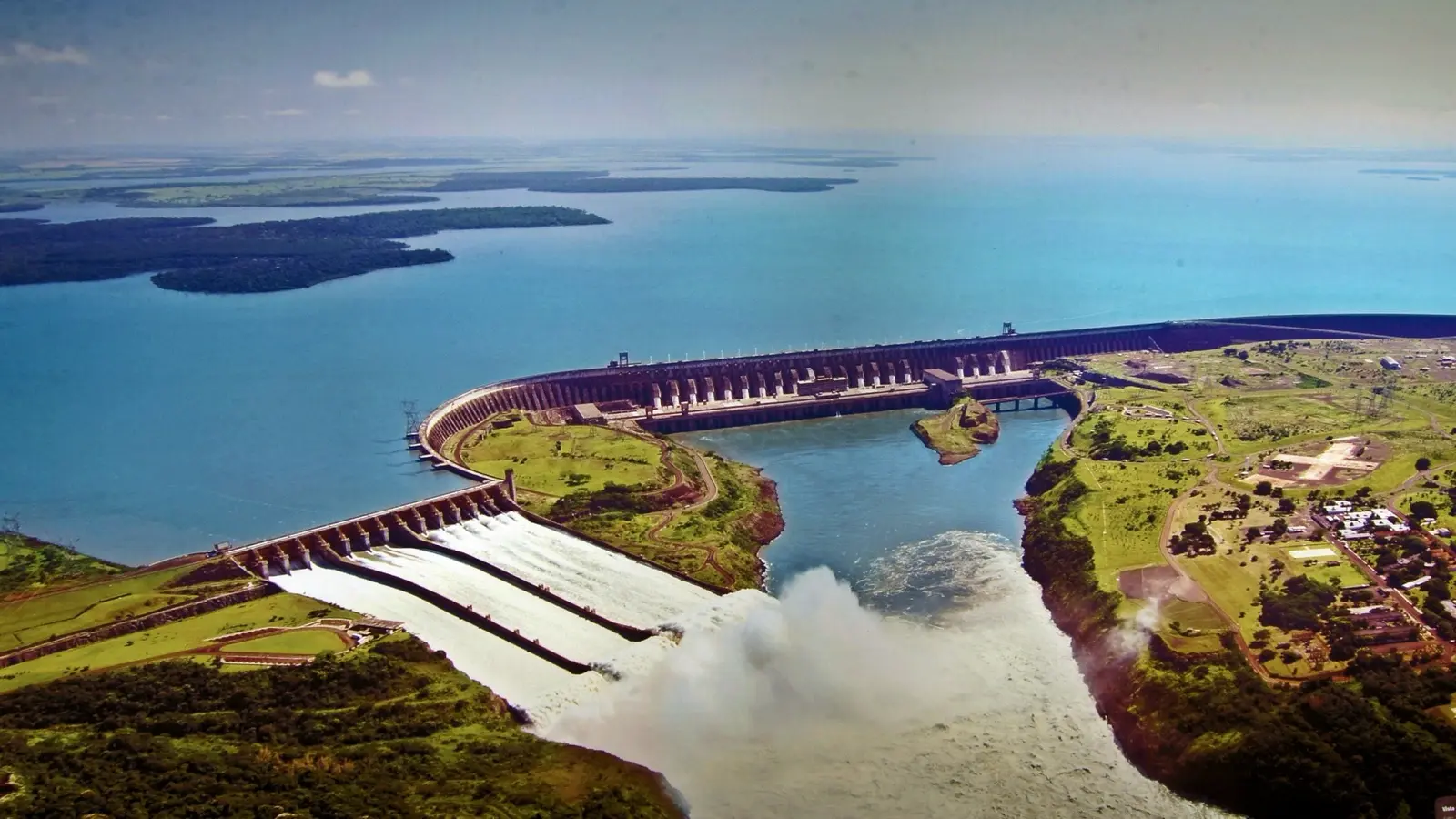
The electricity rates charged by Paraguay's government vary by sector. Private bitcoin miners paid relatively high rates. That tempted some to illegally tap into the power grid. After detecting and confiscating miners from these operations, the ministry now wants to profit from the cheap energy itself.
The seized miners "are literally stacked to the ceiling," says Morphware CEO Kenso Trabing in conversation with Bitcoin Magazine, referring to the government's warehouses. Morphware is helping the ministry set up the mining operation. Trabing: "They have no experience with bitcoin mining. We have an advisory role."
 Micah Zimmerman
If the pilot proves successful, Paraguay could purchase new miners instead of relying solely on what they seize. In its current form, the country's approach resembles how America views its bitcoin reserve. The U.S. stores seized BTC in a state treasury but isn't actively accumulating—as far as we know, at least.
The Bhutan parallel
Another small country with a hydropower surplus is Bhutan. It started mining in 2019 through a sovereign wealth fund. By 2025, that had yielded more than 13,000 BTC, worth nearly 40% of Bhutan's GDP. The country has deployed proceeds from part of its stack—including a salary increase for civil servants. Additionally, 10k BTC has been pledged to finance the construction of a new economic zone.
Bhutan has been very methodical about mining. Paraguay may be at the beginning of that journey. The oft-heard objection to bitcoin mining—that it consumes a lot of energy—rings rather hollow in this case. The capacity is abundant, and it's green energy.
🍟 Snacks
To wrap up, some quick bites:
- Morgan Stanley moves toward its own bitcoin ETF. The American bank has filed a prospectus with the SEC for a fund that invests directly in bitcoin. Coinbase Custody would serve as custodian and BNY Mellon as transfer agent. For Morgan Stanley, this could mean two things: participating in the fast-growing ETF market, and giving bitcoin a permanent place in its wealth management portfolios. That would have impact: the bank has about 16,000 advisors and nearly $10 trillion under management.
- Circle tests system for 'nanopayments' with USDC. The company wants to enable extremely small payments by bundling transactions before they're processed on-chain. Currently, a payment of one cent can still be wiped out by transaction fees, but by combining thousands of transactions, costs drop to a fraction of a cent per payment, according to Circle. The idea is mainly aimed at new applications, such as micropayments for AI services and automatic payments between AI agents.
- Bitcoin miners Core Scientific and MARA prepare to sell bitcoin reserves. Both companies state this in documents recently filed with regulators. Core Scientific expects to liquidate a large portion of its reserve in 2026 to fund new activities. MARA already started selling in 2025 and wants to continue doing so "opportunistically." Both companies describe a shift from bitcoin toward AI, where more stable revenues await. Together, bitcoin miners have sold more than 15,000 BTC since October 2025.
- Investment funds attract $619 million in new capital. According to CoinShares data, most of the inflow came from the U.S., accounting for $646 million. Funds in Europe, Asia, and Canada saw slight outflows. Bitcoin funds took the largest share with a gain of $521 million, followed by ether and solana funds. The week started strong with over $1.4 billion in inflows, but sentiment turned as oil prices rose and geopolitical conditions deteriorated. Despite this, capital flow into crypto remained positive.
- Kalshi sued after dispute over prediction market on Iranian leader. According to plaintiffs, the platform is refusing to pay out roughly $54 million to traders who bet on Khamenei stepping down before March 1. The plaintiffs claim Kalshi changed its interpretation of the rules after Khamenei was killed. Kalshi denies this and claims an exception for death was in place from the start. The case strikes at the heart of prediction markets: when is a market informative, and when does it become a legal and moral minefield?
- Kazakh central bank wants to invest up to $350 million in crypto sector. The investment comes from part of its gold and foreign currency reserves and could happen as early as this spring. According to the central bank, it's not just about direct exposure to cryptocurrencies, but also investments in companies active in the sector. With reserves of nearly $70 billion, it's a relatively small experiment—yet still significant: central banks are the most cautious players in the institutional wave toward crypto.
- Andreessen Horowitz targeting new crypto fund of around $2 billion. The venture arm a16z crypto wants to close its fifth fund by mid-2026. That's smaller than the previous $4.5 billion fund from 2022, but still one of the largest pools of capital in the sector. Notable: the fundraising starts while the market looks weaker. According to a16z, blockchain technology remains a long-term story, though the industry is increasingly shifting toward financial applications like stablecoins, tokenization, and staking.
Thank you for reading!
To stay informed about the latest market developments and insights, follow our team members on X:
- Bart Mol (@Bart_Mol)
- Peter Slagter (@pesla)
- Bert Slagter (@bslagter)
- Mike Lelieveld (@mlelieveld)
We appreciate your continued support and look forward to bringing you more comprehensive analysis in our next edition.
Until then!