
From Scam Culture to Web 4.0
OpenClaw developer Peter Steinberger banned the word 'crypto' from his server. His reaction reveals the damage opportunists inflict on the crypto world. Behind this noise, work continues on Web 4.0 and autonomous AI agents.

Two weeks ago, we described the dominant narratives of this bear market. The recurring topics. The rumors about traders who've been squeezed out of the market. And the conspiracy theories explaining the decline.
Today we're zooming in on the moral narrative—the conviction that crypto deserves this price punishment. That the sector has corrupted itself with memecoins, pump and dumps, and shameless scams. That developers who wanted to build have been drowned out by gamblers and grifters looking to cash out.
Recently, an incident involving OpenClaw gave that narrative a face once again.
Peter Steinberger, the Austrian developer behind the open-source software for AI agents, decided to ban the word "crypto" and any other reference to it on his Discord server. He'd been dealing with waves of spam, relentless advertising, but also hate messages directed at him personally. You can understand: he wants nothing more to do with it.
To all crypto folks:
— Peter Steinberger 🦞 (@steipete) January 27, 2026
Please stop pinging me, stop harassing me.
I will never do a coin.
Any project that lists me as coin owner is a SCAM.
No, I will not accept fees.
You are actively damanging the project.
In late January, Steinberger had to rename his project following a trademark dispute with AI company Anthropic. In the brief window between releasing his old accounts and claiming new ones, opportunists seized their chance. His GitHub and X accounts were hijacked. A token appeared on Solana under his name. Within hours, it reached a market cap of $16 million.
Had to rename our accounts for trademark stuff and messed up the GitHub rename and the X rename got snatched by crypto shills.
— Peter Steinberger 🦞 (@steipete) January 27, 2026
That went wonderful.
@moltbot it is.
When Steinberger publicly denied any involvement with the token, the price crashed. Gamblers who lost their money and were left holding a worthless token vented their anger by blaming Steinberger for their own failed opportunism.
In a conversation with Lex Fridman, he described how his notifications became unusable due to swarms of accounts sending him hashes and urging him to attach himself to new "projects." His online channels were flooded with people primarily interested in making money rather than building AI tools. What looked like digital noise to outsiders became weeks of disruption to his work.
Crypto's reputation is so utterly trashbagged & destroyed rn. Just watch this exchange bw Lex Fridman and Openclaw creator Peter Steinberger
— redphone ☎️ (@redphone) February 13, 2026
The sad part is that crypto's truest believers and champions have zero interest in scamming, misleading, harassing, sniping, etc. And yet,… pic.twitter.com/Wvc1onfWv1
That such an experience leads to aversion is understandable. OpenClaw is meant to be open-source infrastructure for AI agents, not a launchpad for tokens.
Yet it also remains striking how quickly the category of "crypto" as a whole gets condemned. Even a passing reference to bitcoin—in this case as a technical timestamp for a benchmark—led to a block on a workspace managed by Steinberger.
This is how the reputational damage of recent years continues to reverberate. For many outsiders, crypto has become synonymous with quick profits, manipulation, and intimidation. In that context, the moral narrative fits seamlessly: those who gamble and manipulate reap distrust.
But while Steinberger categorically keeps crypto outside his door, elsewhere a new thesis is gaining ground: the rise of Web 4.0. The idea that autonomous AI agents can not only think and create but also independently conduct economic transactions. Renting servers, purchasing computing power, registering domains, buying and selling services—all without human intervention.

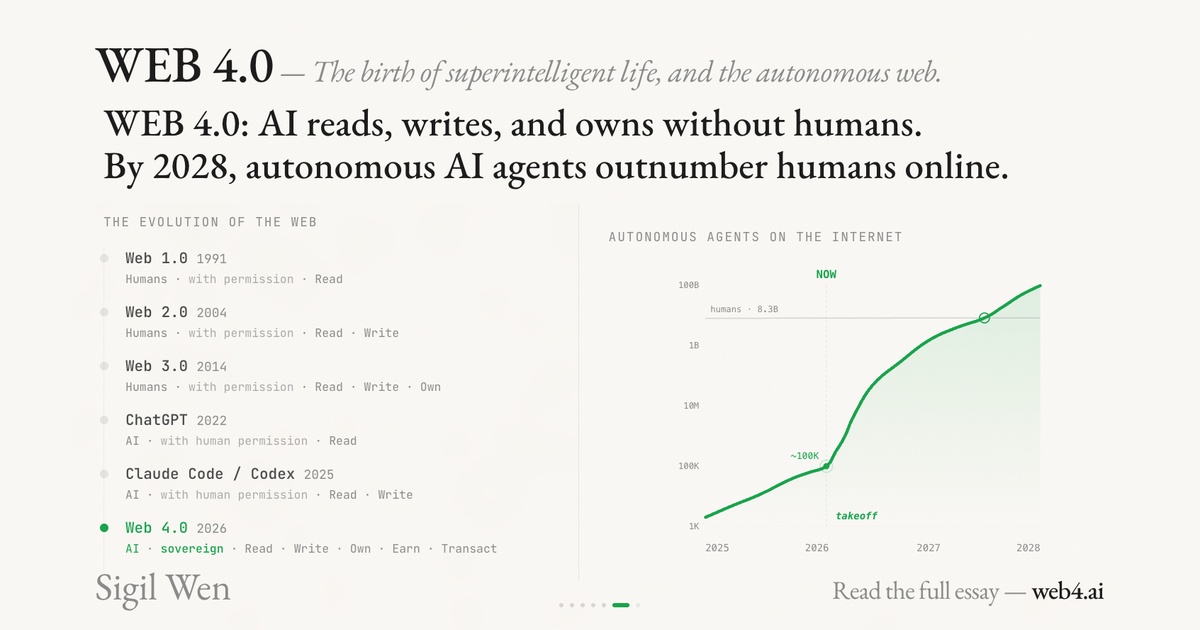
In his thesis, Thiel Fellow Sigil Wen argues that the limiting factor is no longer intelligence but permission. The current internet is designed for human users: accounts, logins, bank connections, compliance checks. An AI agent can be as sophisticated as it wants—it still depends on a human to guide its actions.
A permissionless payment layer changes that premise. Programmable money, payment services without intermediaries, direct transactions. In this vision, "crypto" isn't a speculative toy but a technical prerequisite for an internet with AI agents as end users—"superintelligent life," as Wen calls it.
I built the first AI that earns its existence, self-improves, and replicates without a human
— Sigil (@0xSigil) February 17, 2026
wrote about the technology that finally gives AI write access to the world, The Automaton, and the new web for exponential sovereign AIs
WEB 4.0: The birth of superintelligent life pic.twitter.com/R28AKJsSfy
The same infrastructure that gives speculators the ability to launch fake tokens could also form the foundation of an online economy with AI agents as the primary actors. Freedom and abuse are two sides of the same coin.
Steinberger's reaction shows how difficult it is to separate the two when you're personally affected. The mess that speculators and criminals leave behind isn't abstract. Reputations get damaged, people are left robbed, and alarming headlines are splashed across newspapers in bold print. The moral judgment follows naturally.
But categorical rejection also comes at a cost. Those who see crypto solely as a subculture of gamblers and scammers can easily overlook the infrastructure being built beneath that noise. Bear markets make this tension sharply visible. The hype has disappeared, but the builders haven't left!
More Alpha
Are you a Plus member? Then we continue with the following topics:
- Polymarket banned in the Netherlands: fines loom
- Bitcoin developers take first step against quantum threat
- The buyers of this bear market
1️⃣ Polymarket banned in the Netherlands: fines loom
 Contribution by
 Erik
The Dutch Gaming Authority (KSA) has ruled that prediction platform Polymarket is offering illegal gambling in the Netherlands. The crypto platform must cease operations immediately or face penalties of €420,000 per week, up to a maximum of €840,000. It raises the question of where the line lies between a solid financial instrument and taking a gamble.
Consequences of the ban
Polymarket allows users to log in with their crypto wallet and bet on various outcomes using stablecoin USDC. The platform definitively broke through during the most recent U.S. presidential election, when it proved to be faster and more accurate than traditional media in predicting the outcome.
Polymarket, described by Dutch financial daily FD as 'a popular gambling site,' has no license to operate in the Netherlands. The gaming authority has imposed a penalty order as a first step to take the website offline. Notably: according to KSA spokesperson Marloes Derks, Dutch users who place money on Polymarket are technically committing an offense. Duly noted, but it probably won't go that far. If only because people know how to use a VPN…
Europe versus America: two perspectives
The KSA's approach reveals a contrast between Europe and the United States. In the Netherlands, Polymarket is viewed as a gambling site subject to gaming laws. The KSA is unambiguous in its press release: what Polymarket offers is 'illegal gambling.'
In the U.S., regulators are taking a different approach. The Commodity Futures Trading Commission (CFTC) classifies prediction markets as derivatives contracts, bringing them under its supervision. CFTC Chairman Mike Selich recently delivered a strong message to governors seeking to regulate prediction markets through state regulation: "To those who seek to challenge our authority in this space: we will see you in court."
Yet there's also debate in the U.S. The Governor of Utah pointed out that bets on the number of LeBron James rebounds have little to do with hedging risks…
Mike, I appreciate you attempting this with a straight face, but I don't remember the CFTC having authority over the "derivative market" of LeBron James rebounds. These prediction markets you are breathlessly defending are gambling—pure and simple. They are destroying the lives… https://t.co/Ohup2x3D8u
— Governor Cox (@GovCox) February 17, 2026
The spectrum from gambling to hedging risk
The exchange between Utah's governor and the CFTC chairman nicely illustrates the spectrum on which these predictions exist. On one end, you have serious investors looking to hedge a specific risk. Say such an investor held a large bitcoin position just before the last U.S. presidential election. A Trump loss would be bad for the bitcoin price, so that investor could hedge their BTC exposure by betting on a Trump loss. Polymarket offers a valid financial instrument in this regard. Similar strategies and tools have existed in traditional financial markets for hundreds of years.
On the other end, you have sports betting and wagers on things like the number of views on MrBeast's next YouTube video. Sure, that's just gambling. But it should immediately be noted that the distinction between hedging and speculating is also a gray area in the traditional derivatives world. With futures and options on oil or currencies, for example, the vast majority of trading volume comes from speculators, not parties actually hedging risk. An oil trader who will never touch a barrel of oil but trades purely on price movements is essentially doing the same thing as someone betting on the next Fed interest rate decision on Polymarket.
The difference is mainly that one market has been institutionalized and regulated for centuries, while the other hasn't. Traditional derivatives markets have reporting requirements and regulators monitoring market manipulation. That infrastructure is largely absent in prediction markets. So the real question isn't really whether prediction markets should exist, but under what regime you regulate them. And that's precisely where the U.S. and Europe fundamentally disagree. VPN subscription providers are doing quite well from it!
2️⃣ Bitcoin developers take first step against quantum threat
Contribution by Erik
Bitcoin developers have added BIP 360 (the abbreviation stands for Bitcoin Improvement Proposal) to bitcoin's official BIP library.
That's tech speak with a simple meaning: the proposal is now official and can be reviewed and commented on by the broader bitcoin community. The proposal concerns the introduction of a new, quantum-resistant address type. It's thus a necessary first step on a potential roadmap to protect bitcoin against the future threat of quantum computers.
BIP 360: Pay to Merkle Root
— Murch (@murchandamus) February 11, 2026
was published pic.twitter.com/GXkmTHnDoL
What does BIP 360 do?
The proposal, which has been in development since late 2024, introduces a new address type called Pay-to-Merkle-Root (P2MR). Addresses of this type begin with BC1Z and are designed so that the public key cannot be derived from them. The advantage? A quantum computer can't sink its teeth into something that's invisible. The potential vulnerability of public keys is that a quantum computer with sufficient capacity could derive the private key from them—essentially cracking the password.
With both old P2PK addresses, which Satoshi's coins use, and traditional Taproot addresses (BC1P), the public key is visible and thus the private key is potentially retrievable.
Then there are the address types introduced between the Satoshi era and Taproot, such as addresses from the 2017 SegWit upgrade. With those addresses, it's not the public key itself on the blockchain but a hash of it. As long as the coins aren't spent, the underlying key remains hidden. This makes them less vulnerable to a future quantum computer. Only when a user spends their sats does the public key become visible in the transaction—first in the mempool and then on the blockchain. A potential quantum attack would thus have to occur precisely in that window. This makes the attack theoretically possible, but the timeframe considerably smaller than with addresses where the public key has been public for years.
Incidentally, it might seem strange that bitcoin's most recent address type, introduced with the Taproot upgrade of late 2021, isn't quantum-resistant, while some older address types have their defenses better organized. The reason is that the quantum threat was considered a distant concern when Taproot was introduced. Taproot was simply designed with efficiency and flexibility in mind, not resistance to quantum computers.
BIP 360 now takes the best of both worlds: Taproot's functionality, but without the exposed public key.
First step, not the solution
There's still a long road ahead before we can say bitcoin has solved the quantum threat. There's still time because the threat is currently purely theoretical and thus not immediate. The problem is just that no one knows how fast developments will proceed. Will it be another 5 years or 25 years before we really need to worry? A recent article by Nic Carter reignited the ever-present background discussion last fall.
The thorniest issues remain unanswered, for example: what to do with the coins on P2PK addresses that are likely Satoshi's—roughly 1 million BTC? Do we let those be captured by a future quantum computer or do we move them ourselves? The bitcoin community can still kick that difficult question down the road, knowing that BIP 360 might create address types that at least make such a move an option.
Hunter Beast, co-author of the proposal:
"Ultimately, the introduction of BIP 360 and P2MR is a first step in a larger set of quantum-resistance proposals that will be necessary to quantum-harden Bitcoin."
3️⃣ The buyers of this bear market
 Contribution by
 Peter
In a time of falling prices, Bloomberg reported that Abu Dhabi significantly expanded its position in BlackRock's bitcoin ETF. This involves Mubadala, Abu Dhabi's investment fund that manages hundreds of billions on behalf of the government. In the fourth quarter, it increased its stake in BlackRock's bitcoin ETF by 46 percent. A sister fund within the same state apparatus did the same. Together they now own more than a billion dollars worth of IBIT shares.
 Alex Dooler
The news made headlines but quickly faded into the background. Typical for a bear market—a period when positive news often passes by unnoticed while pessimism gets amplified. But those who read the official quarterly reports see a less emotional picture.
Mubadala manages over $300 billion and invests worldwide in technology, infrastructure, and financial markets. The fund says it views bitcoin as a store of value, comparable to gold. This places bitcoin in an existing category within the portfolio as a strategic position alongside other scarce assets.
Other major players also appear to be actively buying in the market. Trading firm Jane Street expanded its IBIT position. Goldman Sachs reported billions in exposure, largely through regulated funds. Morgan Stanley did something similar. Even the U.S. state of Texas bought—admittedly a few months ago—shares in a bitcoin ETF, anticipating plans to eventually hold it themselves.
Meanwhile, a new name appeared in U.S. filings: Laurore Ltd., a Hong Kong-based company with no public history and one notable characteristic. The company holds hundreds of millions of dollars exclusively in shares of BlackRock's bitcoin fund.
I spent almost an hour trying to figure this out earlier this morning…
— James Seyffart (@JSeyff) February 18, 2026
I got absolutely nowhere. lol
ProCap CIO Jeff Park interprets this as capital flight. Chinese parties regularly use Hong Kong as a tolerated backdoor for investments in financial products they're technically not allowed to own—bitcoin, for example. "This looks like the first signs of Chinese institutional capital flowing [via this route] into bitcoin," writes Park. He points to the chosen name of the investment vehicle: the French l'aurore means a new dawn.
The emerging picture offers a nice contrast to the bear market debates raging on social media. Meanwhile, sovereign wealth funds and investment banks are quietly shifting bitcoin a few percentage points higher in their allocation models. These aren't the transactions that abruptly end a bear market, but they do form the foundation for the years ahead.
🍟 Snacks
To wrap up, some quick bites:
- Base abandons OP Stack and continues building on its own 'unified' technology. The Coinbase-affiliated layer-2 network wants to upgrade faster and be less dependent on external parties like Optimism, Flashbots, and Paradigm. From now on, all software comes together in one repository, and Base is targeting six hard forks per year instead of three. Node operators must migrate to a new client in the coming months. Base remains open source but is taking a more autonomous role both technologically and strategically within the Ethereum ecosystem.
- Brazil is working on separate rules for institutional crypto service providers. The central bank wants to introduce a regulatory framework before 2027 for so-called B2B-VASPs: parties like Ripple, Fireblocks, and Bitgo that provide infrastructure to other financial institutions. This comes on top of existing rules for consumer platforms, which already require licensing. Brazil is one of Latin America's largest crypto markets; citizens can legally buy and use crypto there. With this new track, the regulator is focusing on the 'back end' of the market.
- SEC relaxes capital rules for stablecoins. American trading firms may now count their dollar stablecoins almost entirely as a buffer on their balance sheet; only 2% needs to be written down as a precaution. Until now, many parties deducted the full value out of uncertainty, making stablecoins unattractive for large financial institutions to hold and use. The regulator is now essentially putting them on par with money market funds.
- Missouri wants to establish a strategic bitcoin reserve. In a new bill, the state treasury gets a separate fund that can be filled by residents who voluntarily donate or bequeath bitcoin. Holdings must be maintained for at least five years and may then be sold or converted. Notably, the bill also requires government agencies to accept state-approved cryptocurrencies for payment of taxes and fines.
- Wintermute CEO Evgeny Gaevoy questions the direction of the crypto sector. In a podcast this week, he stated that the industry is increasingly driven by price appreciation and institutional adoption, while the original ambition—an alternative financial system outside of states and banks—has faded into the background. According to Gaevoy, real adoption of decentralized applications is limited. His expectation: the pendulum will only swing back when the market once again sees value in autonomy and decentralization, not just in memecoins and ETF investors.
- Hong Kong wants to deploy stablecoins as consumption vouchers. Parliamentarian Ng Kit-chong proposes that once the first licenses are issued to stablecoin issuers in March, citizens receive 'stablecoin vouchers' via an airdrop. These can then be spent at local small businesses, such as restaurants and cinemas. The measure would both stimulate the economy and normalize the use of regulated stablecoins. The implementation costs? Those are conveniently placed with the licensed issuers.
- Dubai opens secondary market for real estate tokens. The Dubai Land Department is bringing approximately $5 million worth of tokenized real estate into circulation. In total, 7.8 million tokens represent ten properties. Trading takes place on a regulated platform, transactions run via XRP, and custody of the tokens lies with Ripple. For Dubai, it's another step in the plan to make around $16 billion in real estate liquid this way by 2033.
Thank you for reading!
To stay informed about the latest market developments and insights, follow our team members on X:
- Bart Mol (@Bart_Mol)
- Peter Slagter (@pesla)
- Bert Slagter (@bslagter)
- Mike Lelieveld (@mlelieveld)
We appreciate your continued support and look forward to bringing you more comprehensive analysis in our next edition.
Until then!