
Fiat Time
Why January 1st is mostly an agreement. On fiat time, the British tax year, and why old systems are stubborn. A historical perspective on time, money, and the new framework bitcoin has established.
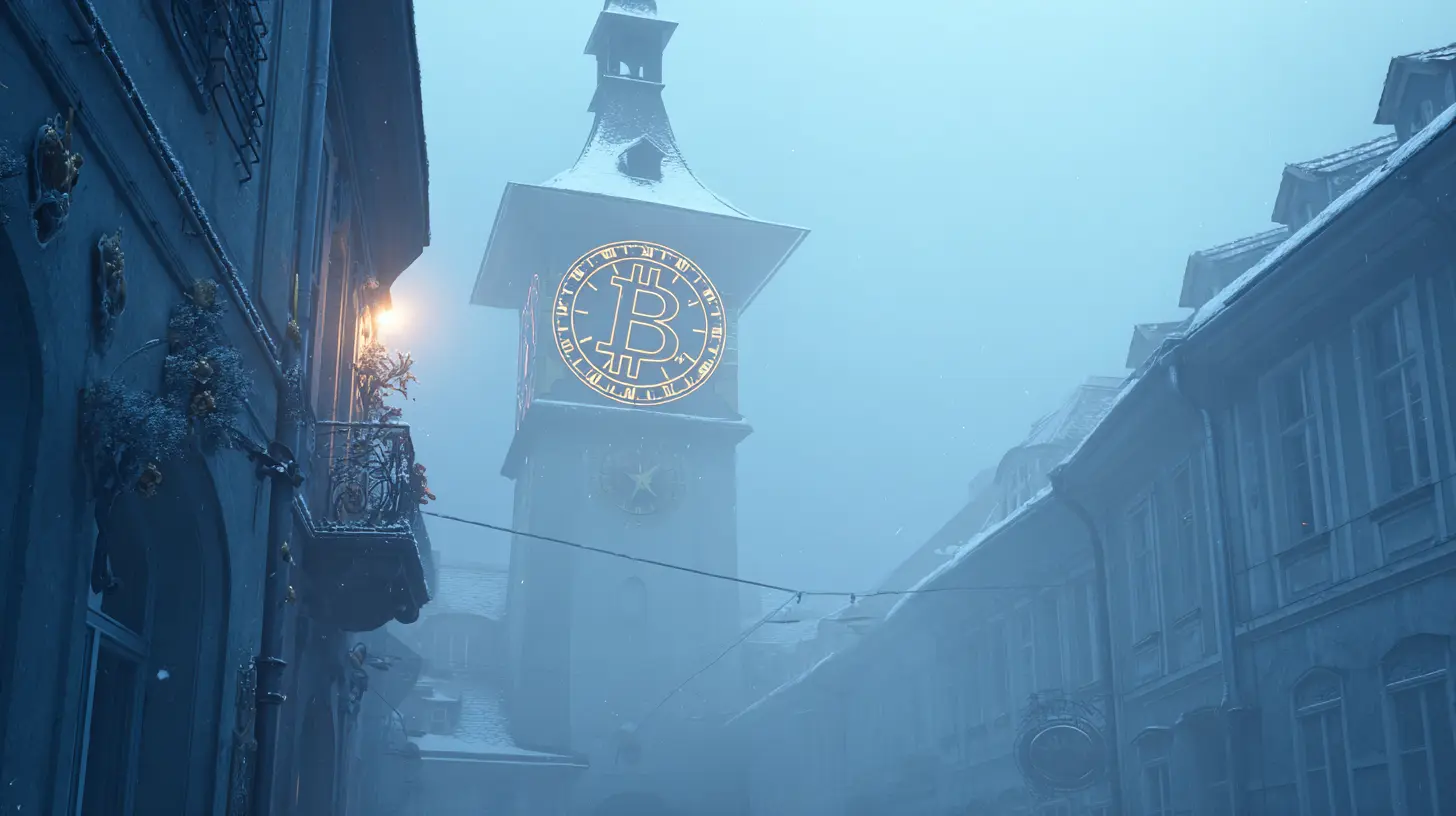
December 29th is one of those days when nothing much seems to happen. Christmas is behind us, New Year's Eve is still ahead. The weather doesn't help, but it doesn't hinder either: foggy, five degrees, grey. The world hasn't stopped, but it feels slowed down. And yet we collectively pretend that something fundamental changes in two days. As if the calendar hits a reset button on January 1st.
That idea is persistent. And historically speaking, it's also a misconception.
For centuries, the new year didn't begin on January 1st in large parts of Europe. In England, and elsewhere, the administrative year ran until March 25th, Lady Day. Contracts, debts, wages: everything counted until that date. Only then did a new year officially begin. People sometimes lived for months in what we would now call "the wrong year," without anyone losing sleep over it.
The consequences of this are still visible today. Take the British tax year. It doesn't start on January 1st, nor on March 25th, but on April 6th. That seems arbitrary, until you go back to 1752: the year Great Britain switched to the Gregorian calendar. Eleven days were deleted to realign with the sun. Lady Day shifted along. And to avoid "shortchanging taxpayers by eleven days," the fiscal year was adjusted.
Result: in the financial heart of Europe, tax returns in 2025 are still determined by a medieval calendar arrangement.

This shows that calendars aren't natural laws, but agreements. Established by those in power, adjusted by committees, and passed down from generation to generation through tradition. Julius Caesar, Pope Gregory, parliaments and kings determined when a year began and ended. Not because it was objectively "correct," but because someone had the authority to impose that agreement.
In that sense, time as we experience it administratively is a fiat construct. Just like money.
The euro, the dollar, the pound: these too are agreements. Anchored in institutions, supported by legislation, and executed through complex technical systems. They function as long as the underlying order holds and the rules are broadly accepted.
There's an interesting parallel with bitcoin here, and at the same time an important difference.
Bitcoin doesn't just introduce a different monetary system, but also a different concept of time. No calendar days, no fiscal years, no symbolic new year transitions. Bitcoin knows block time. Time measured in blocks, not in days. In progress, not in agreements. Each block follows from the previous one. Practically irreversible, verifiable, and without a central authority that can easily intervene.


This different concept of time immediately raises a broader question: not only how time is measured, but who determines which rules apply and how they change.
Bitcoin also exists by virtue of collective acceptance. The distinction from fiat systems doesn't lie there, but in the mechanism by which rules are enforced and adjusted. With fiat money, this ultimately happens through hierarchy and political authority. With bitcoin, through verification and economic costs. There's no central party that "steers" the protocol; change only occurs when enough participants choose to update their software.
This doesn't make bitcoin apolitical or free from social dynamics. You could argue that bitcoin has its own institutions, like forks and rough consensus. But they operate at a different level of abstraction: without a monopoly on violence and without external enforcement. No one can force you to validate any particular ledger.
While we count down to midnight on New Year's Eve, an arbitrary moment that mainly has cultural significance, the network's clock just keeps ticking. Block after block. Not faster because it's a celebration, not slower because it's foggy. The only correction that takes place is protocol-based: the difficulty adjustment, designed to keep the tempo stable. No human intervention required.
That's why January 1st is mostly noise in this context. A social moment. The real metronomes of the bitcoin network aren't our holidays, but events like the halving or the difficulty adjustment. These don't care about political cycles, election years, or fiscal calendars. They happen when they need to happen; they're moments that follow from code, not from convention.
This doesn't make bitcoin comfortable for many people in the sense of being accommodating or forgiving, but it does make it interesting. It doesn't ask for faith or good intentions. It guides behavior through fixed rules and incentives. The focus shifts from quick, immediate rewards to predictability and longer time horizons. This often provides peace of mind in decision-making, but above all structural stability.

Bitcoin's character often only becomes truly visible when the market seems colorless. On days when liquidity is absent, offices are closed, and decision-making is on pause. And especially on days when the world looks extremely chaotic. That's when the protocol just keeps running. Not because it's optimistic, but because it's indifferent.
So yes, enjoy the oliebollen. Watch the fireworks. Celebrate the symbolism of a new year. But also realize that the real new year doesn't begin on the calendar.
It begins again and again. Block after block.
More Alpha
Are you a Plus member? Then we continue with the following topics:
- Regulation in 2025: The year of framing
- What the market knows, you don't
- 2026 will be a pivotal year
1️⃣ Regulation in 2025: The Year of Framing
 Contribution by
 Erik
In recent years, many news items in this section were about opposition from American legislators and regulators. But in 2025, it shifted to a good-news regime. Chainalysis summarized the legal news year in its regulatory round-up. The main conclusions? Stablecoins have been framed, tokenization is trending, and American banks are allowed to work with crypto.
In our latest blog, we break down 2025's landmark crypto regulations and what's ahead. From MiCA implementation to the GENIUS Act, it was a transformative year as frameworks moved from theory to practice. See what's coming in 2026: https://t.co/VEnoKgvcU6
— Chainalysis (@chainalysis) December 23, 2025
Although Chainalysis monitors the entire (blockchain) world, there's relatively much attention for home country America. But why always that focus on a single country? It's an understandable question, which we sometimes get from our Alphas. After all, we live in the Netherlands, right?
Sure, but the last two years have once again shown how important the US is as a capital market. Before the US allowed spot bitcoin ETFs in 2024, similar ETFs had been available in other countries for several years, for example in Canada. But only when American giants like BlackRock and Fidelity entered the market did the price of BTC start moving. BlackRock's bitcoin fund holds 770,000 BTC, almost forty times as much as the largest Canadian exchange fund.
Trend 1: Implementation is difficult
Chainalysis sees several global trends. The first: legislation is one thing, implementation is something else entirely. In Europe, MiCA came fully into force at the beginning of 2025, but member states are still struggling with the transition from fragmented anti-money laundering rules to one central crypto framework. The question of how MiCA relates precisely to existing payment and investment legislation hasn't been answered everywhere yet.
As a global headache file, Chainalysis mentions the so-called travel rule. Behind this lies the obligation for crypto service providers to send data about sender and recipient with transactions, similar to bank transfers. Logical in theory, stubborn in practice. Not all countries implement this rule at the same time. Even within the EU, timing varies, and outside Europe some countries don't participate at all yet. The result: a party in a "travel rule country" must collect and pass on data, while the counterparty isn't technically or legally set up for it yet.
Trend two: Stablecoins framed, USDT vulnerable
The second trend revolves around stablecoins. These have grown into a central pillar of crypto policy. In the US, the GENIUS Act provided the first federal framework for stablecoin issuers, and according to Chainalysis, that law immediately served as an example for other countries. In 2025, concrete plans followed in Korea and the UK, among others. Several regions, including Japan, the EU, and Hong Kong, now have working legislation.
At the same time, the playing field is shifting. Within US borders, access to offshore stablecoins is being restricted, without directly banning them; stablecoin issuers are given time to comply with the new rules. In Europe, markets are moving toward stablecoins that meet MiCA requirements, with the result that USDT, for example, is no longer available. The full sorting—which stablecoins stay and which disappear—will probably take years.
Trend three: Banks in the US may engage with crypto
2025 was the year when banks no longer gave crypto a wide berth, but cautiously began incorporating the technology into their existing business. In the US, regulators moderated their earlier strict tone: banks may (again) work with custody, stablecoin payments, and tokenization, as long as they have a grip on the associated risks. An example of new services can be seen at U.S. Bancorp and JPMorgan, including on-chain money market funds.
In Europe, MiCA has a similar effect: one clear regulation makes it easier for banks and asset managers to seriously experiment with euro stablecoins, tokenized bonds, and on-chain funds.
Expectations for 2026
For 2026, Chainalysis expects further refinement of stablecoin rules and more emphasis on anti-money laundering regulations, now that crypto is penetrating deeper into traditional financial infrastructure. The current fragmentation between countries remains an issue, the company thinks. The technology may be cross-border, but the rules are not. According to Chainalysis, 2026 will be the year that shows whether regulators can transcend this, with more cooperation, or whether the patchwork of rules becomes even more complex.
2️⃣ What the Market Knows, You Don't
 Contribution by
 Peter
Kevin Mak, who has Stanford students trade in real-time market simulations, considers price discovery the most important topic he teaches. How prices emerge. And especially: why the market is almost always smarter than the individual.
Stop reading about Iron Condors and Silver, and learn something about markets.
— Kevin Mak (@KevinLMak) December 27, 2025
They all result in approximately the same amount of alpha (zero), but at least knowledge about price discovery can build towards something more meaningful. https://t.co/NQpyAWPIBj
In his class, he has students trade in a simulated market. Everyone has information, but never the complete picture. Only when students trade, and thereby unconsciously reveal their knowledge, does one price emerge that brings everything together. No one knows everything, except the market.
That insight is uncomfortable. Especially for smart people. Because it means that your analysis, however good, always competes with information you don't have. And that the price you see isn't an opinion, but the result of clashing convictions, interests, and limitations.
Mak's second lesson: calculation alone isn't enough. Many students neatly apply an expected value approach. They buy when the price is below their 'fair value' and sell above it. And yet they lose money. Not because their calculation is wrong, but because they forget to ask one crucial question: who's on the other side of this trade, and what do they know that I don't?
That's the moment when thinking shifts. From individual to relational. From "what do I think it's worth?" to "what is the market telling me that I apparently don't understand yet?"
The professor emphasizes that real alpha rarely comes from publicly available data. Low valuations, nice ratios, attractive charts; everyone sees them. If that were enough, the price would already be higher. Alpha only arises when you have information that the market hasn't processed yet, and understand why others miss, ignore, or can't use that information.
But perhaps the most important lesson: the market doesn't distinguish between smart and dumb orders. A well-informed buyer and a random gambler with the same order volume have exactly the same impact on price. Price discovery is blind to intention. It only responds to behavior.
Those who understand this look at markets differently. Not just at news, but at flows. Not just at numbers, but at incentives. Not just at what's happening, but at who's forced to trade, who trades voluntarily, and who's sitting on the sidelines.
And that's how this lecture touches Bitcoin Alpha.
We don't deal in secret information, price targets, or predictive magic. That would be an empty promise in a market that processes information around the clock. The 'Alpha' lies elsewhere. In helping distinguish signal from noise. In interpreting regime changes, not daily movements. In understanding why prices move, not just that they move.
We don't teach you to be smarter than the market; that's impossible. But you do learn to better understand what the market is trying to say. And that's perhaps the most sustainable form of alpha that exists.
Not an edge over others.
But an edge over bad ideas!
3️⃣ 2026 Will Be a Pivotal Year
Contribution by Peter
Around New Year's, something peculiar always happens in crypto land. Loud price targets fade into the background and make way for something rarer: reflection. The parties that shape the market, from investment funds to large payment processors, lay their cards on the table with seemingly visionary predictions.
If you place those predictions for 2026 side by side, one thing immediately stands out. They're remarkably unanimous.
The first major theme is that stablecoins definitively break out of their niche. What started as lubricant for traders is growing into full-fledged payment rails. Visa, Galaxy, and multiple research groups expect that in 2026, stablecoins will not only be used globally but will also process volumes that can compete with existing payment systems. In other words, they're becoming infrastructure used by people who have no idea what a blockchain is. Just as the internet once began as something for techies, and ended up as something that "just works."
Related to this, attention is shifting toward tokenization and real-world assets. These are definitively breaking out of the confines of pilots, demos, and PowerPoint slides. In 2026, parties like Messari and Forbes expect tokenized government bonds, funds, and other financial products to really become part of daily practice. The reasons? They're cheaper, faster, and more efficient. Less friction always wins, the forecasters think.
The third thread is perhaps the most underestimated. Bitwise, Coinbase, and others see 2026 as the year when institutional participation is no longer a narrative, but a given. ETFs, regulation, and clear frameworks ensure that large allocations no longer depend on sentiment, but on policy. This makes the market less spectacular, but also less fragile. The role of retail euphoria diminishes; that of long-term capital increases.
At the same time, technology continues to advance. a16z and Silicon Valley Bank point to the convergence of AI and crypto. Not in the form of talk about "smart coins," but through something much more concrete: autonomous software that independently executes transactions. Machine-to-machine payments, microtransactions, automatic settlement. This requires a programmable, neutral money layer. And that already exists.
Finally, there's a prediction that generates little enthusiasm but says even more about maturation: consolidation. Mergers, acquisitions, and scaling up. The Financial Times already sees this movement accelerating and expects it to continue in 2026. This means fewer mid-sized players, more large platforms combining licenses, liquidity, and users. Boring? Maybe. Inevitable? According to the forecasters, absolutely.
If we bring these five threads together, we don't see the picture of the next bull run emerging. These are all ideas whose first signs were already visible in 2025: crypto is ceasing to be a separate world. It's becoming infrastructure. Invisible, embedded, and functional. Crypto is finding its place; not alongside the system, but within it.
Want to dive into the predictions yourself? Here are the most important ones, alongside those from Coinbase, Blockworks, Messari and the FT:





 Alex Thorn Head of Firmwide Research
 Anthony Vassallo
🍟 Snacks
To wrap up, some brief snacks:
- Trust Wallet hacked, $7 million stolen. Only version 2.68 of the browser extension was compromised; mobile apps and other versions are unaffected. Attackers exploited a flaw in the process by which updates are published, allowing malicious code to be distributed through the official Chrome Web Store. Trust Wallet has confirmed the hack and states it will fully compensate all victims.
- Sberbank issues loan with bitcoin as collateral. Russia's largest bank wants to issue rubles this way more often. The first loan has been provided to bitcoin miner Intelion Data. During the loan term, the deposited bitcoins are held in the bank's vault. The exact amounts and terms have not been disclosed.
- Bitmain dumps miners and broadens revenue model. The largest manufacturer of mining hardware has significantly lowered ASIC miner prices and is simultaneously trying to sell package deals with hosting. Due to the low 'hashprice,' hardware sales are temporarily less attractive. Hosting provides more stable, recurring revenue. Bitmain is thus shifting somewhat from hardware supplier to infrastructure player.
- China accelerates digital yuan and reiterates its aversion to crypto. Beijing makes clear it's going all-in on central bank digital currency. The use of cryptocurrencies and stablecoins is deliberately suppressed. Not due to technological backwardness, but out of desire for control: dollar stablecoins threaten monetary sovereignty, facilitate capital flight, and undermine oversight. China relies on its own financial infrastructure and sees no role for private alternatives.
- US and Russia talk about nuclear plant, bitcoin mining appears in passing. According to Kommersant, the US wants to use electricity generated by the Zaporizhzhia nuclear plant for bitcoin mining. It's going too far to call it a joint initiative. However, it does underscore bitcoin's role as a flexible consumer of surplus energy, even in the context of geopolitically charged dossiers.
- The crypto market was dominated by derivatives in 2025. According to CoinGlass, about $85 trillion worth of derivative products was traded this year, with peaks of up to $748 billion in a single day. The market started cautiously but ended at full throttle. According to CoinGlass, futures and perps are now the place for price formation; spot prices mainly follow what happens there. This makes the market more technical and loses some of its 'wild west' character.
- EU sharpens crypto taxation with DAC8. From January 1, 2026, crypto platforms must automatically share data about users and transactions with tax authorities. Exchanges have until July to get their systems in order. Crypto thus becomes fiscally as transparent as a bank account. Trading is allowed, but any anonymity associated with it disappears.
- Metaplanet doubles down on bitcoin. The Japanese company wants to own no less than 210,000 bitcoin by the end of 2027 and is significantly expanding its share structure for this purpose. With new A and B shares, dividends, and built-in options, Metaplanet is trying to make bitcoin attractive for institutional capital. The board has signed off on the plans. Visionary or overconfident? Time will tell.
Thank you for reading!
To stay informed about the latest market developments and insights, follow our team members on X:
- Bart Mol (@Bart_Mol)
- Peter Slagter (@pesla)
- Bert Slagter (@bslagter)
- Mike Lelieveld (@mlelieveld)
We appreciate your continued support and look forward to bringing you more comprehensive analysis in our next edition.
Until then!