
Bitcoin: The Domain of Dark Blue Suits
Bitcoin 2026 showed how blue suits are embracing bitcoin. But the real bull market needs to happen in usage, privacy, wallets, and peer-to-peer adoption — where bitcoin actually began.
 Contribution by
 Peter
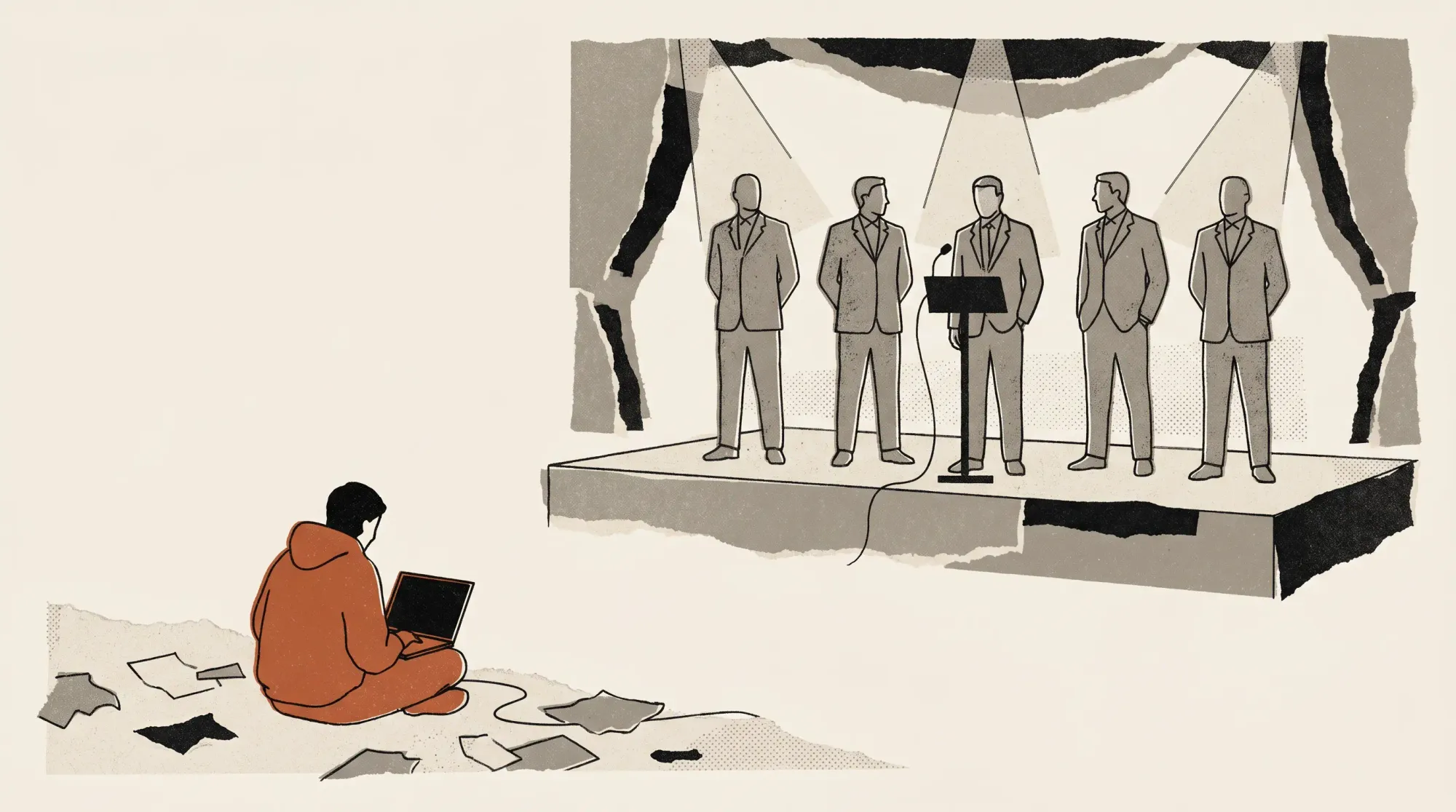
Powerful men wear dark blue. I don't think it's a law, but spend one afternoon watching a climate summit, NATO meeting, press conference, or election debate and you'd almost believe it is. The blue suit is the safe choice. Black is too solemn, gray is exhausting, green won't get you taken seriously, and brown is for people with too much self-confidence. Dark blue reinforces what the wearer wants to project: calm and reliability.
It's the color of executives who make tough decisions. Of bankers who won't promise anything but remain "constructive." Of politicians who want to give the impression they understand the world, even when their actions suggest the opposite.
And yes, bitcoin has now become the domain of the blue suits too.
That much was clear last week in Las Vegas, where Bitcoin 2026 was held from April 27 to 29. These kinds of conferences used to be the stage for developers, idealists, cypherpunks, libertarians, and pioneers. Most attendees treated distrust as a healthy default attitude and preferred writing code to reading policy papers.
Now the stage featured Michael Saylor, Eric Trump, U.S. senators, White House advisors, regulators, central bankers, and asset managers. The conference leaned heavily toward bold price predictions, legislation and regulation, policy choices, and institutional adoption. Early bitcoiners grumbled about it on social media. To them, the conference increasingly resembled a gathering of the very organizations bitcoin was originally designed to route around.
Let's face it, this Bitcoin conference is compromised.
— Simon Dixon (@SimonDixonTwitt) April 26, 2026
Bitcoin is open source code, on the worlds largest distributed super computer with the rules enforced by tens of thousands of nodes.
It's a big mistake not to understand the diffrence. https://t.co/BJnE0apa86
And that chafes. Take the congressman who said he'd been mining bitcoin for twenty years — impressive, given that bitcoin has only existed since 2009. Or a Trump family member who threw around big numbers as if he could move the bitcoin price with a campaign speech. And then there are the familiar names, treated by the audience as prophets. Saylor is the most prominent among them. Their shared message? The bitcoin price is compressed, a spring pushed all the way down. Massive waves of new capital are waiting for the chance to let that spring fly.
It leaves a somewhat uncomfortable feeling. Numbers are mangled, bordering on the charlatan-esque. A protocol without a CEO has still found its preachers. But fortunately, there were also blue suits who lived up to their appearance.
Aleš Michl, the president of the Czech central bank, soberly explained why bitcoin could theoretically play a role in a central bank portfolio. According to a study by his own central bank, a model portfolio with 1 percent bitcoin delivers a higher expected return without increasing overall risk. Michl called bitcoin risky and volatile, but also an asset that any central bank should at least be thinking about. "Be conservative in monetary policy. Be innovative in how we work. This is the future," he said.
A central bank. And Bitcoin.
— Aleš Michl (@MICHLiq_) April 30, 2026
My speech at The Bitcoin Conference 2026 in Las Vegas on 28 April 2026. Video and text; the slide link is below:
Today, I want to talk about a strange combination:
A central bank. And Bitcoin.
Most people do not put these two things together. I do.… pic.twitter.com/1JUeOp2rkd
SEC Chairman Paul Atkins spoke about a new era at the regulator. He reiterated that the days of lawsuits stifling innovation are over. He announced a program to encourage innovation around tokenized securities and emphasized a new, constructive collaboration with the CFTC.
The CFTC was also present at the conference, represented by Chairman Mike Selig. He spoke about the classification of crypto assets and reiterated that bitcoin should be treated as a commodity. He explicitly voiced his support for self-custody, software development, and clear rules for DeFi, stablecoins, and the use of bitcoin as collateral for credit. Together with Atkins, he pointed to the Clarity Act, which was further explained at the conference by Senators Lummis and Moreno.
This is the useful side of the blue-suit era. Bitcoin gains access to capital, legal clarity, and institutional infrastructure. There was plenty of fuel in Las Vegas for a new bull market in financial terms.
But bitcoin wasn't born in conference hotels or boardrooms. Bitcoin comes from a different world. The world of the cypherpunks. People who saw privacy, cryptography, and open networks as a line of defense against power. They wore hoodies, wielded code as their primary weapon, and never asked permission to use it.
That original character is still at its core: decentralized money, circulating on an open network, usable by anyone. A working alternative to state-issued money, financial gatekeepers, and the abuses that come with them.
Fortunately, Jack Dorsey was there too. Via video link, admittedly — unshaven, in a simple T-shirt. He spoke about bitcoin as an open protocol. About WikiLeaks, Julian Assange, financial sovereignty, and freedom of information. About bitcoin as a tool for keeping money and information beyond the reach of powerful intermediaries.
If you're looking for a financial bull market, just follow the blue suits. That's where the capital is. That's where the policy is. That's the path toward more adoption in pension funds, sovereign treasuries, corporate balance sheets, and asset managers' vaults.
But if you're looking for a bitcoin bull market in ethos, technology, and actual usage, you need to look beyond the main stages. That's where you'll find a quiet minority. People who don't buy bitcoin because Saylor talks a chart upward, but because they want to use — or need — an alternative.
It's precisely there that this bear market may cut the deepest. The use of bitcoin as money that moves from person to person without a gatekeeper. There's no shortage of stories about that, but there is a shortage of daily use. The blue suits can make bitcoin bigger on balance sheets and in policy documents. But the next real bull market also needs to happen where bitcoin once began: in the hands of people who use it because it lets them do something that otherwise wouldn't be possible.
More Alpha
Are you a Plus member? Then we continue with the following topics:
- Regulator deploys AI to assess crypto applications
- THORChain a popular off-ramp in major DeFi hacks
- Rules for euro stablecoins need to be relaxed
- Should the Dutch invest more?
Below that, you'll find the news snacks — a handy overview of the news that actually mattered last week.
1️⃣ Regulator deploys AI to assess crypto applications
 Contribution by
 Erik
The U.S. derivatives regulator CFTC will deploy AI for, among other things, assessing registration applications for crypto-linked futures. Chairman Mike Selig told CoinDesk that Microsoft Copilot is being rolled out across the CFTC and that the regulator is building its own AI systems to assist with supervisory work.
The catalyst is a structural lack of capacity. The Department of Government Efficiency — named after Dogecoin, abbreviated DOGE — may have been on its last legs since last November, but it left its mark during its brief existence. Since early 2025, DOGE has eliminated roughly a quarter of the CFTC's staff. Headcount is at its lowest level in fifteen years.
CFTC turns to AI for crypto registrations applications in an effort to offset workforce cuts: report https://t.co/W0htIZnPMK
— The Block (@TheBlockCo) April 28, 2026
Growing workload
On top of the reduced headcount comes a growing workload. The CFTC has traditionally been the regulator for futures and swaps on commodities. Derivatives on crypto assets also fall within the CFTC's portfolio, and several applications for such products are already in the pipeline.
It's likely that the regulator's mandate will soon be expanded. The Clarity Act, which passed the House of Representatives in July 2025, would also make the CFTC responsible for crypto spot markets.
The Clarity Act hasn't passed Congress yet, but either way the CFTC appears to be on track to become the linchpin of U.S. crypto oversight. The CFTC's current claim of exclusive jurisdiction over prediction markets like Polymarket is more contested. Lawsuits against individual states are ongoing on that front.
The irony
Currently, the CME lists BTC, ETH, and SOL futures, among others. It's only a matter of time before the first application for Dogecoin derivatives lands on the CFTC's desk. Elon Musk will laugh sardonically: because of DOGE, the CFTC's staff no longer has time to review a DOGE application.
On a more serious note, the U.S. government is openly embracing AI. And even setting aside the recent budget cuts, it's hard to see how it could be otherwise. If companies are using AI to launch ever more crypto projects, the government will have to do the same to keep up with the workload.
2️⃣ THORChain a popular off-ramp in major DeFi hacks
Contribution by Erik
THORChain is establishing itself as the favorite highway for DeFi criminals making off with their loot. After the KelpDAO hack on April 18, approximately $175 million in stolen ETH was converted to bitcoin via the network. THORChain isn't a mixer, but a decentralized exchange connected to multiple networks.
THORChain's use in the KelpDAO case is no isolated incident. After the Bybit hack in February 2025, approximately $1 billion in stolen funds was converted to bitcoin via THORChain. According to TRM Labs, North Korea is responsible for 76% of the value of all crypto hacks in 2026. This puts THORChain in a difficult position; more on that below.
Beyond the deep liquidity on the exchange, two characteristics explain why THORChain is popular with hackers. First, the absence of intervention capabilities at the transaction level. LayerZero, Wormhole, and centralized bridges have operators who can freeze funds. Layer-2 networks like Arbitrum often have a "Security Council" — a small group of people who can perform administrative functions. In the KelpDAO case, $71 million of the stolen funds was seized through that mechanism.
Second, THORChain offers native swaps to bitcoin. A direct conversion to on-chain BTC — no wrapped tokens or other representations. Once on bitcoin, criminals can obscure and siphon off their haul at their leisure.
What's hanging over THORChain's head
Readers who've been around for a while will remember Tornado Cash, which landed on the U.S. OFAC sanctions list in 2022. A court ruled in November 2024 that OFAC had overstepped its authority: immutable smart contracts are not "property," and in March 2025 the sanctions were lifted. But unfortunately for the developers: Roman Storm was convicted in New York in August 2025 for operating an unlicensed money transmitting business. Co-founder Alexey Pertsev received 64 months in prison in the Netherlands for money laundering.
THORChain's situation is somewhat different. It's not an immutable smart contract but a blockchain network with validators, governance, and regular protocol updates. For instance, ZCash support was recently added.
While transactions on THORChain cannot be frozen, a blocklist could theoretically be implemented at the protocol level — listing, for example, addresses linked to the North Korean hacking group Lazarus. But that doesn't happen, and that could land THORChain's founders and validators in trouble.
A former U.S. Treasury Department official said last year to CoinDesk: "Anybody making money on fees related to the movement of hacked funds that have already been publicly attributed to Lazarus and North Korea potentially has an OFAC issue."
The current Trump administration is sending mixed signals. The Department of Justice announced in April 2025 it would no longer pursue such cases through criminal law. On the other hand, North Korea is a problem; the hackers are professional, and the stolen funds presumably flow directly into the development of military capabilities.
The question is how long THORChain can stay out of the crosshairs.
3️⃣ Rules for euro stablecoins need to be relaxed
Contribution by Peter
You've probably heard of the Laffer curve. It describes the theoretical relationship between tax rates and tax revenue. Zero percent tax yields nothing, but so does 100 percent — nobody would bother working anymore. Somewhere in between lies the point where revenue is maximized. Go beyond it, and the activity you were trying to encourage disappears.
According to a new report on European stablecoin regulations, that's exactly what went wrong with MiCA.


The criticism comes from within. Ulrich Bindseil, for years an influential economist at the ECB, co-authored the report with Erwin Voloder of Blockchain for Europe.
The authors draw a direct parallel with the Laffer curve, but applied to regulation. Without rules, you get risk and abuse. With rules that are too strict, something else happens: the activity you wanted to regulate simply takes place elsewhere. You end up with rules, but no market.
And with stablecoins, this is particularly sensitive. They operate on public networks and are global by definition. Companies can relatively easily choose where to set up shop. If Europe makes it too difficult, the activity shifts to the U.S. or far beyond. The result: euro stablecoins barely register on the world stage. Less than one percent of total volume. That's completely out of proportion to the economic size of the eurozone.
Highly recommend this new @BlockchainforEU report on how to reform MiCA for euro stablecoins co-authored by Ulrich Bindseil (ex ECB) & Erwin Voloder (B4E).
— Patrick Hansen (@paddi_hansen) April 28, 2026
It takes an honest look at where things stand today and lays out concrete reforms to address the underperformance of euro… pic.twitter.com/hAEQUzuwvF
According to the authors, the solution isn't so much scrapping rules as adjusting their severity. They advocate allowing interest on euro stablecoins so they can compete with alternatives. They also want to eliminate the mandatory allocation of 30 to 60 percent to bank deposits, arguing the rule is inefficient and concentrates risk.
Additionally, they propose broadening the range of permitted reserve assets so issuers can diversify what they hold as collateral. Reporting requirements should be made more consistent and risk-based. And issuers should, within clear frameworks, gain access to central bank infrastructure to better manage their liquidity.
Bindseil and Voloder are clear: MiCA needs to be made workable for stablecoins. Otherwise, Europe will be left with a neatly regulated market… that largely operates outside its own borders.
4️⃣ Should the Dutch invest more?
Contribution by Peter
A regulator sitting in the investment advisor's chair in 2026 was not on my bingo card. "Many households are missing out on higher returns," wrote the AFM (Dutch Authority for the Financial Markets) on Friday. "Approximately 800,000 Dutch households have sufficient financial means to invest, but don't. Even though they may fall short of money in the long run."


According to the regulator, a lack of knowledge is the most commonly cited reason for not investing. Savers also feel that investing is too risky, and some simply have no interest. Notably, a portion says they don't have enough money to start — even though the AFM believes they do.
You might wonder why a regulator needs to have and broadcast an opinion about citizens' wallets. But it fits a broader trend of institutions positioning themselves as busybodies.
De AFM geeft de burger beleggingsadvies. De FNV maakt zich druk over de hypotheekrente aftrek. Het Voedingscentrum mengt zich in de klimaatdiscussie. Pensioenbestuurders die niet het rendement voor de pensioengerechtigden voorop stellen maar de morele lat langs bedrijven willen…
— Tadek Solarz (@TadekSolarz) May 2, 2026
That said, it doesn't mean it's all nonsense. In Brussels, encouraging investment has been high on the agenda for some time. And in his weighty report, Draghi treated activating private savings as a priority. Not a bad idea, since inflation melts the value of savings like snow in the sun. Especially for the things people save for — luxury goods, financial assets — prices rise faster than savings balances.
That makes it all the more ironic that the current government wants to reform wealth taxation in a way that actually discourages investing. The tax burden goes up, the effectiveness of investing goes down, and the administrative burden increases. Bloomberg deliberately cited commentary on the plan on Friday: "a fiscal Frankenstein," a monster of a bill.
The latest news from The Hague, by the way, is not that the bill is being rewritten. Minister Heinen spoke out of turn about that; what is happening is an attempt to iron out design flaws. That won't deliver an ideal tax climate, but perhaps a Frankenstein monster with a decent haircut.
So from January 1, 2028, investors will need to account for a different tax regime. As that date approaches, the question of what's smart to do becomes more concrete. Some investors are already getting a head start. We understand from Amdax that the number of new corporate clients — people transferring their investments to a personal holding company — has been trending upward, right through the bear market. A special procedure has been set up for them to streamline the onboarding process.
🍟 Snacks
To wrap up, some quick bites:
- Bunq opens banking infrastructure to third parties; Blockrise is the first client. The asset manager can now offer its clients a fully integrated bank account covered by the Dutch deposit guarantee scheme. In the future, adjacent services will follow — from savings accounts to payment cards. More and more companies are offering bank-like services. Lightspark and Stripe launched stablecoin accounts and payment rails for businesses last week. As expected, the line between bank, fintech, and crypto platform is blurring fast.
- Crypto is the most muted topic on 𝕏. Since the introduction of the snooze feature, crypto tops the list of topics silenced by users. That fits the current sentiment: retail interest is low, exchange volumes have shrunk, and the hype has vanished from timelines. But that could mark the end of this phase; when nobody's watching anymore, the next move beneath the surface has often already begun.
- Curve wants to settle hack damage in a decentralized way, as an alternative to orchestrated bailouts. The proposal would make it possible to package problem positions as tokens and make them tradable, so investors can decide for themselves at what price they enter or exit. The model resembles existing practices in traditional finance, where distressed loans are sold to specialized parties. Curve brings that principle on-chain — a new way to handle losses within DeFi.
- New bitcoin proposal protects against quantum computers with a clever proof mechanism. So-called PACTs work as a kind of sealed declaration: users commit now to owning certain private keys, without revealing them. If bitcoin ever needs to freeze funds as a precaution, that proof can be used to unlock those funds. The approach offers an alternative to drastic measures requiring holders to actively move their funds. Quantum safety has risen high on the agenda among bitcoin developers in recent months.
- Creators on Facebook and Instagram can be paid with the stablecoin USDC. Four years after Meta's own stablecoin Libra collapsed under political pressure, the company is finally working with a digital dollar. So-called creators can choose Circle's USDC for their payouts. Meta has quietly launched the integration with Solana and Polygon. Behind the scenes, the company uses Stripe's infrastructure. "We aim to offer the most relevant payment methods," a spokesperson said. "That's why we're exploring how stablecoins fit into our offerings."
- Taiwan is exploring the possibility of adding bitcoin to its national reserves. A legislator has presented a report to the premier and the central bank, proposing to shift part of foreign reserves into bitcoin. The report points to risks from an over-reliance on the U.S. dollar and describes bitcoin as a geopolitically resilient addition. The central bank had previously raised objections over volatility and practical feasibility but is open to further research.
- Agreement on stablecoin interest brings U.S. crypto legislation closer to the finish line. After months of wrangling, a compromise has been reached between banks and crypto companies on paying rewards on stablecoins. Passively paying interest on stablecoin balances remains prohibited. But users may earn from using their stablecoins. The specifics will be left to regulators to work out. Crypto firms like Coinbase see enough room in that arrangement to cooperate. The Clarity Act is intended to, among other things, clarify the division of responsibilities between U.S. regulators within the crypto sector.
- Brazil bans the use of crypto for international payments. Starting October 1, financial institutions may no longer use bitcoin and stablecoins to send money across borders. The central bank is cracking down on a growing market where fintechs sought efficiency outside the traditional system. Crypto trading remains permitted, but its role as payment infrastructure is being curtailed. In other words, innovation is welcome in Brazil — as long as it doesn't bypass the existing system.
Thank you for reading!
To stay informed about the latest market developments and insights, follow our team members on X:
- Bart Mol (@Bart_Mol)
- Peter Slagter (@pesla)
- Bert Slagter (@bslagter)
- Mike Lelieveld (@mlelieveld)
We appreciate your continued support and look forward to bringing you more comprehensive analysis in our next edition.
Until then!