
America Is Cracking
The conflict between Trump and Fed Chair Jerome Powell escalates after criminal prosecution threats. What does this moment reveal about central bank independence, institutions, and trust in America?
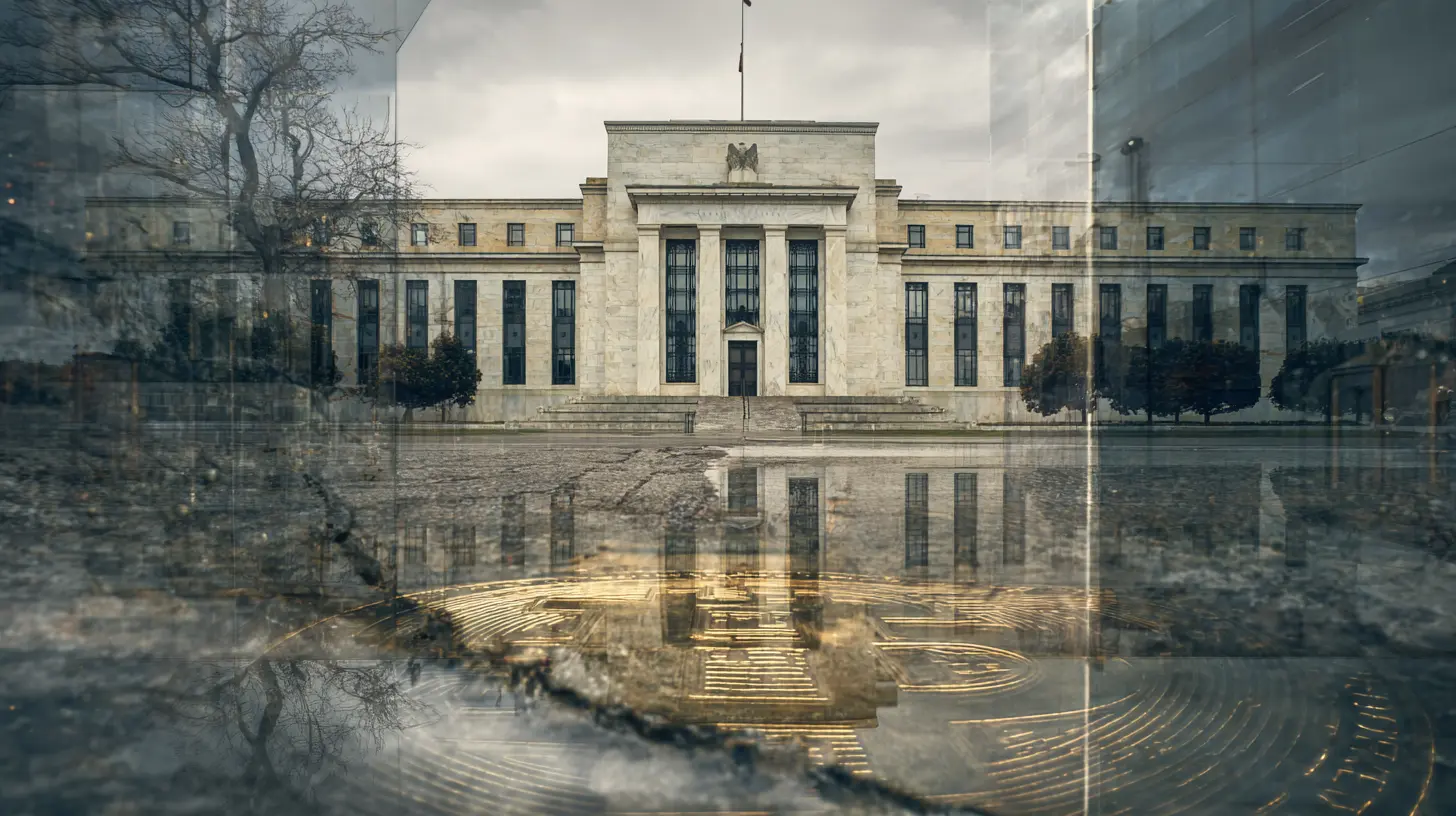
Sunday evening, just before the financial markets opened, Fed Chair Jerome Powell appeared unexpectedly in a video message. No interest rate decision, no explanation about inflation or employment. The chairman of the Federal Reserve spoke about criminal threats. About subpoenas in a Justice Department investigation. And about the threat of a formal indictment.
Video message from Federal Reserve Chair Jerome H. Powell: https://t.co/5dfrkByGyX pic.twitter.com/O4ecNaYaGH
— Federal Reserve (@federalreserve) January 12, 2026
The investigation concerns Powell's testimony in the Senate about the renovation of the Fed headquarters in Washington. A project that ran significantly over budget and has long been used by the White House to attack the central bank. A subpoena is NOT a conviction and says nothing about guilt. It only means the Justice Department wants to proceed. Nothing more.
But Powell chose his words carefully. He could have kept it to "legal pressure" or "an investigation." By explicitly speaking about criminal prosecution, he made clear how seriously he weighs this step. This wasn't a legal detail, but a form of institutional self-defense.
What followed was an unusually fierce message for a central banker. Powell stated that the renovation is a pretext to put the Fed on the spot. That the threat isn't about his testimony, but about interest rates. About the fact that the Fed bases its policy on economic data, not on the president's preferences.
And that... is a red line.
The reactions came quickly. From a simple "Wow!" to warnings that America is behaving like a third-world country. Macro analysts, journalists, politicians, investors, and shitposters; everyone had an opinion. The consensus is striking: this is not something you expect to see in the United States.
absolute insanity
— mary (@howdymerry) January 12, 2026
the department of justice served the federal reserve chair with a grand jury subpoena threatening CRIMINAL indictment over a historic building renovation
jerome powell is appealing directly to the american people and bluntly stating that the criminal charges… https://t.co/j1sNT9dpky
And here context plays a major role. In 2016, a conflict between president and Fed chair might have been dismissed as political theater. In 2020, as crisis management. But in 2026, this message lands in a world already on edge. A world where institutions are under pressure, norms are being stretched, and power is visibly and shamelessly abused.
That explains why markets didn't read this as a sudden rupture, but as confirmation of a risk that has been hanging over the market for some time. Stocks fell slightly, the dollar weakened somewhat, gold and silver rose. No major panic, no major flight. Investors aren't pricing in a collapse, just another bit of extra uncertainty.
What's remarkable about Powell's appearance isn't just what he says, but that he says it at all. Fed chairs normally speak in neutral, technocratic sentences. Careful, measured, without emotion. Powell broke that pattern. He chose a direct video message, outside the usual protocol, at a moment he knew markets would be watching. You only do that when staying silent feels riskier than speaking out.
At the same time, nuance is important. This isn't a coup. The US isn't a monolithic system where political power directly translates into monetary policy. Congress, the judiciary, the Fed, and the Justice Department aren't direct extensions of each other. It's precisely this institutional layering that has kept America stable for centuries.
But that's exactly why this moment feels so uncomfortable. Because it reveals where those layers are starting to grind against each other. America is cracking.
Turns out the last line of defense against authoritarian pressure is a mild-mannered former investment banker armed with spreadsheets. https://t.co/dn7IrxJCvj
— Cristina Cordova (@cjc) January 12, 2026
Powell's term as chair expires in May. There's a good chance his successor will be closer to the White House. That in itself isn't a break from the past. But the way this transition is now being orchestrated—with legal threats, public attacks, and explicit loyalty tests—changes the tone.
History books are rarely written the moment systems collapse. They're written the moment someone says out loud what is normally kept quiet. Powell did that Sunday evening. This far, and no further, is his message. The line has been reached.
This is no longer a quiet defense. Powell has brought the conflict into the open, precisely because procedures only hold as long as someone is willing to publicly uphold them. The outcome remains uncertain. And as long as a former investment banker with spreadsheets forms the last line of defense, it's too early to write off the system.
What does this mean for bitcoin? More on that after the break!
More Alpha
Are you a Plus member? Then we continue with the following topics:
- What Powell unintentionally reveals about bitcoin
- Zcash developers walk out
- Do AI agents need money?
1️⃣ What Powell unintentionally reveals about bitcoin
 Contribution by
 Peter
The confrontation between Jerome Powell and the White House is primarily a story about institutions. About power, checks and balances, and the question of who ultimately controls the levers. That makes it relevant for bitcoin too, although that connection is less direct than social media sometimes suggests.
This isn't a moment where bitcoin "wins." There's no acute flight from dollars, no panic in government bonds, no sudden revaluation of the monetary system. The market reaction was measured. Bitcoin behaved as it often has lately: as part of the broader financial landscape.
Bitcoin is catching the "Jerome Powell facing criminal charges" bid 👀 pic.twitter.com/60QFDstAVM
— Bitcoin News (@BitcoinNewsCom) January 12, 2026
What Powell exposed Sunday evening is how personal the defense of our monetary system can sometimes become. The Fed's independence doesn't just consist of laws and statutes, but of people willing to guard those boundaries. In this case, one man, visible, under pressure, who decides not to fight this battle behind closed doors but in full view.
That's not weakness. It's how institutions actually function. But it does reveal where their vulnerabilities lie.
Bitcoin is designed differently. Not as a reaction to one president or one conflict, but as a system that relies as little as possible on trust in individuals. No chairman, no board, no formal meetings where pressure can be applied. The protocol keeps running, regardless of who's angry, who's under fire, or who stays silent.
Fed Chairman under criminal investigation & you're bearish on bitcoin… https://t.co/V5ii5SiMGB
— Nate Geraci (@NateGeraci) January 12, 2026
That doesn't make bitcoin a solution for everything. And it says nothing about how such a system would hold up if it truly became central to the global economy. But it does explain why bitcoin keeps coming up whenever institutional tension becomes visible. This time not because fiat money is failing, but because it's becoming clear how much it relies on human discipline.
Ten years ago, bitcoin was primarily seen as a protest. Against banks, against policy, against inflation. In recent years, that frame has become too narrow. Bitcoin now overlaps with the system rather than simply standing against it. With ETFs, custodians, regulation, and large capital flows, it has become part of the same world now watching Powell.
And precisely because of that, its role is shifting. Bitcoin isn't an escape route for every political incident, but a reference point and contrast agent. A system where no statements are needed, no video messages, no lines of defense. It does nothing, and that's precisely where its significance lies.
Bitcoin rallies ~1% despite no official comment on Fed subpoena; sources say no change to issuance schedule. pic.twitter.com/Vfp6JX3q9V
— matthew sigel, recovering CFA (@matthew_sigel) January 12, 2026
Powell's appearance reveals how vulnerable power becomes when it must be carried personally. Bitcoin shows what an alternative design looks like, where that burden doesn't rest on a few shoulders but is largely encoded in software. It doesn't manifest as a judgment on the outcome of this battle, but as a reminder that money can also be organized differently.
And sometimes that's enough!
2️⃣ Zcash developers walk out
 Contribution by
 Erik
The entire team at Electric Coin Company (ECC), one of the key development teams behind privacy coin Zcash (ZEC), has resigned. The coin's price crashed by nearly 30%, after having risen significantly since September 2025. The trigger for the split? A conflict over the operation of a wallet, between the developers and Bootstrap, the non-profit that oversees ECC.
Over the past few weeks, it's become clear that the majority of Bootstrap board members (a 501(c)(3) nonprofit created to support Zcash by governing the Electric Coin Company), specifically Zaki Manian, Christina Garman, Alan Fairless, and Michelle Lai (ZCAM), have moved into…
— Josh Swihart 🛡 (@jswihart) January 7, 2026
ECC CEO Josh Swihart didn't call it a firing but a constructive discharge, which translates to: we were made unable to do our jobs. He emphasized that the Zcash protocol itself "isn't affected" by the departure.
According to the Bootstrap foundation, the dispute mainly revolves around plans that were on the table in recent weeks regarding external capital and initiatives to potentially privatize the Zcash wallet Zashi. Bootstrap says that as a non-profit, it's bound by strict legal requirements around intellectual property, and warns that a poorly structured deal carries the risk of lawsuits from the foundation's funders.
The development team sees it differently: they want to build and scale faster, possibly with venture capital as fuel and a profit-oriented structure around Zashi. The foundation's board put on the brakes, and the conflict escalated to the point where the developers saw little choice but to pack their bags. According to Swihart, they're continuing as a new entity.


The governance of a blockchain project
Zcash is a respected privacy project dating back to 2016. At birth, it was based on bitcoin, with a privacy layer on top. ECC built and maintained the original node software zcashd, among other things, and developed products like Zashi, a self-custody Zcash wallet with privacy as the default.
These kinds of conflicts, which occur relatively often in the crypto world, stem from the setup where a foundation oversees a company. Crypto projects prefer not to present themselves as a company that "controls the project," because that looks like concentration of power. That's why many blockchain ecosystems have a foundation that supports the ecosystem while keeping distance from 'the product' itself: the blockchain. The Ethereum Foundation, for example, presents itself as a non-profit that guides ethereum's continued development, but not as the party that controls ethereum or unilaterally determines the roadmap.
Another example of friction between a foundation and developers occurred at Tezos in 2017/2018. The conflict led to reputational damage, delays, and legal proceedings. And within Zcash, there was already trouble in 2018 over funding for a then-popular Zcash wallet.
That it escalates around a wallet again at Zcash isn't entirely surprising. Within an ecosystem, a wallet serves an important function. A wallet is the on-ramp for users and one of the most recognizable 'brands' of a coin: a magnet for investments and partnerships.
Without a strong wallet, a coin becomes practically unusable or unattractive for many people. And for privacy-focused projects like Zcash, the wallet also determines how good the privacy actually is in daily use.
Consequences
For Zcash users, the key question is: does this conflict affect the blockchain's continuity? In the short term, there are probably few problems to expect. Zcash users don't need to worry that their coins are stuck or that the network will stop; it keeps running thanks to miners and nodes.
If no quick solution to the problem emerges, potential long-term consequences lie in the 'engine room': the speed and coherence of maintenance, upgrades, wallet development, and integrations. When a core team leaves, execution risk emerges: who picks up which tasks and how quickly are security and network upgrades still rolled out? While there is a second node implementation and zcashd is therefore not a single point of failure, that's no guarantee the roadmap will continue to be smoothly followed.
3️⃣ Do AI agents need money?
Contribution by Peter
Once machines can do everything, money becomes obsolete. No more misunderstandings, no friction, no need for a shared unit of account. If all economic decisions will soon be made by perfectly informed AI agents, why would we still need money?
A recent experiment by researchers Alex Imas and Rohit Krishnan shows how tempting—and how wrong—that idea is.
 Alex Imas
By "AI agents" they don't mean chatbots that help you with emails, but autonomous entities that independently pursue goals, negotiate about them, and make decisions. Digital economic actors, in other words. In theory, they're lightning-fast, rational, and possess an enormous amount of knowledge. If anyone can bypass the classic economic problems, it should be such an agent.
The researchers set up such an "agentic economy" in its simplest form. Each agent has one asset, wants another, and is allowed to negotiate for it. A form of barter, then. That works surprisingly well as long as there are only two or three agents. But as soon as the group grows—think eight to twelve—the system collapses. Fewer than half of transactions succeed. And this is, in economic terms, as the authors themselves emphasize, "the absolutely simplest setting."
So how about central coordination? One all-knowing hub that maintains oversight and coordinates transactions. Somewhat better, but still chaotic. Then credit and IOUs, inspired by the idea that money once emerged from debt relationships. That doesn't deliver a breakthrough either. Most striking: money doesn't emerge spontaneously. Not even with agents who know that a numéraire has been solving their problem for centuries.
The researchers put it dryly: these AIs lack the instinct to transform credit into a shared medium of exchange. "They don't even have the same instinct as sea otters, who in the wild already demonstrate how a scarce object—a stone—can grow into an informal medium of exchange." The result: fumbling, stalled negotiations, and an economy that can't organize itself.
Here is the link: https://t.co/wquJ0mTdV9
— Alex Imas (@alexolegimas) December 19, 2025
Money solves the "double coincidence of wants" problem. But with the computational power of agents, perhaps simple exchange will work? Or a system of exchange with credit (IOUs)? @krishnanrohit and I decided to run an experiment to… pic.twitter.com/JkyVBbMmau
Only when a market is explicitly introduced—with prices, bids, and a unit of account—does the problem disappear. Transactions suddenly always succeed, and much faster. Money turns out not to be a primitive human workaround, but a necessary institutional technology. Even for superintelligent systems.
Cryptocurrencies aren't mentioned in the research, but the connection is almost too neat to ignore. AI agents can hardly open a bank account, but they do need identity, settlement, prices, reputation, and permissionless marketplaces that are open 24/7. Exactly the infrastructure that crypto has been trying to provide from the start.
Maybe that's the most interesting twist to this story. Crypto isn't just an alternative monetary system for people who distrust the current system. It might also just be the first monetary system suitable for an economy where humans are no longer the only participants.
🍟 Snacks
To wrap up, some quick bites:
- South Korea scraps ban on corporate crypto investments. Listed companies and professional investors were sidelined for nine years. Now they can invest up to 5% of their equity in the twenty largest cryptocurrencies, provided they're traded on the five major Korean exchanges. In total, about 3,500 parties are eligible. Whether dollar-backed stablecoins fall under the new rules is still under discussion.
- Tennessee cracks down on prediction markets. The US state wants Kalshi and Polymarket to stop offering contracts on sporting events. According to the regulator, these constitute unauthorized sports betting, even though the platforms claim they fall under federal oversight by the CFTC. The providers must cease activities for Tennessee residents, void outstanding contracts, and return funds by January 31 at the latest.
- Andreessen Horowitz raised over $15 billion in new capital in 2025. The venture capitalist is using that money for an ideological mission. In an extensive manifesto, the firm states that "America MUST win" in key technologies like AI and crypto, or else face economic, military, and geopolitical decline. a16z sees itself as the guardian of that technological future, with investments in infrastructure, crypto, AI, defense, and biotech.
- BNY Mellon supports tokenized bank deposits. The American major bank has launched a service allowing clients to move and use deposits via blockchain infrastructure. The deposit tokens can be used for payments, collateral, and leveraged transactions, with faster settlement as the main advantage. These aren't disguised stablecoin holdings, but real bank deposits given a digital form.
- Stablecoins hit record volume, with USDC leading the pack. Global stablecoin transaction volume rose 72% in 2025 to a record $33 trillion, reports Bloomberg based on data from Artemis. Notably: USDC was used more frequently than USDT with $18.3 trillion in transactions versus $13.3 trillion, mainly because USDC dominates in DeFi. Bloomberg expects stablecoin volume to grow toward $56 trillion by 2030, a scale that rivals traditional payment systems.
- Morgan Stanley takes next step toward crypto. According to Barron's, the bank wants to enable trading in bitcoin, ether, and solana via E*Trade in the first half of 2026. Later in the year, a proprietary digital wallet will follow. Morgan Stanley is also looking at tokenizing shares in private markets. It fits into a broader strategy integrating crypto into wealth management and capital markets.
- Strategy shares remain part of MSCI indexes for now. The committee considered removing Strategy, which has characteristics of an investment fund, from leading indexes. That decision has been postponed, because it proves difficult to make a neutral distinction between so-called operating companies and investment companies. Additional market consultation is needed for that, writes MSCI.
- Another data breach at hardware wallet manufacturer Ledger. This time hackers managed to obtain sensitive data via a payment processor. This doesn't mean your hardware wallet has suddenly become unsafe. It does mean you should be extra vigilant in the coming weeks about communications that appear to come from Ledger. You might receive postal mail, phone calls, or be prompted in other ways to take action. Stay alert!
Thank you for reading!
To stay informed about the latest market developments and insights, follow our team members on X:
- Bart Mol (@Bart_Mol)
- Peter Slagter (@pesla)
- Bert Slagter (@bslagter)
- Mike Lelieveld (@mlelieveld)
We appreciate your continued support and look forward to bringing you more comprehensive analysis in our next edition.
Until then!