
A New Shock to the Global Economy
After the U.S.-Israeli strikes on Iran, oil and gold surge while markets turn red. What's the plan for Iran? What does the Strait of Hormuz threat mean for inflation, markets, and bitcoin?
Saturday morning, after most financial markets had closed, it began. The United States and Israel carried out a series of heavy strikes on Iran. Within 24 hours came the news that 86-year-old Ayatollah Ali Khamenei had been killed, along with other top regime figures.
"Khamenei, one of the most evil people in History, is dead. This is not only Justice for the people of Iran, but for all Great Americans, and those people from many Countries throughout the World, that have been killed or mutilated by Khamenei..." - President Donald J. Trump pic.twitter.com/oXZTFGg5pS
— The White House (@WhiteHouse) February 28, 2026
What happened is now clearer than the "why" and especially the "what next." The operation was a decapitation strike: influential Iranians were taken out in quick succession, followed by targeted attacks on Iranian military assets and targets.
Trump immediately attached grand ambitions to it. He wants to eliminate the ballistic missile threat, end nuclear ambitions, and have the Iranian people take power themselves. That last part sounds heroic in a video message, but can also be read as an awkward admission: there's no clear plan in place for the day after the escalation.
Iran responded as you'd expect from a regime with its back against the wall. Retaliation in the region followed, along with threats concerning the Strait of Hormuz. That's where this war and the global economy intersect. Roughly one-fifth of global oil trade passes through that waterway. Everyone agrees: whoever touches Hormuz also affects inflation, growth, and interest rate expectations.
Analysts worldwide are therefore anxiously awaiting how financial markets will react. Meanwhile, we've gotten through the first trading hours. We're seeing the classic risk-off playbook in action: stock futures down, oil up, gold up, dollar up.
Dow futures drop 500 points as oil prices spike following U.S. attack on Iran.
— Houstonomics (@Houstonomics) March 2, 2026
🔻Dow: - 571 points, or 1.2%
🔻S&P 500 futures: lost 1%
🔻Nasdaq 100 futures: - 1%
📈 U.S. crude jumped roughly 8% pic.twitter.com/yrJUgFWXfT
For oil prices, analysts typically look at Brent. Brent what? The name comes from the Brent oilfield in the North Sea. This Shell oilfield was once one of the UK's most productive, and was closed in 2017 after being depleted. But the name lives on: crude oil from Europe, Africa, and the Middle East is priced based on Brent oil quality.
This oil price shot up about 8% toward $80 per barrel. Traders are focused mainly on the status of Hormuz and the physical disruption to shipping. Dutch newspapers too, because higher oil prices quickly translate into higher fuel prices at the pump.
Higher energy prices are also devastating for stock prices. Analysts look at the effect on inflation. If it proves more persistent as a result, central banks will find it harder to cut policy rates. More expensive oil also means significantly higher procurement costs for some businesses. Several economists laid out that scenario quite matter-of-factly in conversation with the FT: a $100 barrel of oil isn't just a headline, but a shock that could damage global growth and disrupt the rate path.
And bitcoin? It functioned, as it often does, as a kind of pressure valve. Over the weekend, bitcoin is the only large, liquid asset being traded. It serves as a sort of mirror for trader sentiment. A barometer for how risk appetite among investors is rising or falling.
Initially, bitcoin's price dropped toward $63,000. Then it recovered above $68,000 when news of Khamenei's death broke and traders assessed the escalation as manageable for now.
BREAKING: Bitcoin officially reclaims $65,000, erasing 80% of its losses since the US and Israel began strikes on Iran. pic.twitter.com/SDFR1jpZyO
— The Kobeissi Letter (@KobeissiLetter) February 28, 2026
A textbook price reaction, says Merkle Tree Capital CIO Ryan McMillin. According to McMillin, markets hate uncertainty more than bad news. When the conflict didn't immediately spiral completely out of control, buyer interest returned. Markus Thielen, head of research at 10x Research, even sees demand for bitcoin call options increasing in recent days. "Investors are positioning themselves for the Fed's next rate decision," Thielen says in conversation with Bloomberg. That sounds confident, but Hayden Hughes of Tokenize Capital provides the necessary skepticism in the same conversation: the real market reaction will only become visible when U.S. stock markets and ETFs reopen.
Many analyses can be boiled down to one variable: will the oil price stay high, and if so, for how long? If attacks on essential infrastructure and shipping continue, the global economy gets an inflation shock handed to it. Markets will logically go defensive and investor risk appetite will decline. Bitcoin typically suffers from this in the short term, because it now consistently lands in the same risk basket as tech and growth stocks.
The good news is that if tensions ease and logistics recover, the risk premium often disappears as quickly as it arrived. But the stakes are high, because this isn't about an isolated incident, but a campaign with unclear end goals.
In the short term, bitcoin will most likely continue to function as a stress meter, potentially with sharp moves outside business hours. If the stress persists, something uncomfortable may apply to the existing order. The more chaotic the world stage, the more attractive the idea of an asset without counterparty risk can become. But the value of that "thesis" rarely grows in the moment markets panic. First comes the reflex; the narrative follows later.
More Alpha
Are you a Plus member? Then we'll continue with the following topics:
- U.S. bitcoin ETFs see inflows again
- Vitalik wants to make Ethereum quantum-resistant
- Where's the 'flood' of institutional money?
1️⃣ U.S. bitcoin ETFs see inflows again
 Contribution by
 Erik
It may be a bear market, but traditional investor interest in bitcoin doesn't seem to have vanished. After five consecutive weeks of net outflows from U.S. spot bitcoin ETFs, a turnaround became visible last week. The exodus stopped and turned into a substantial net inflow of approximately $800 million.
Markets: U.S. spot Bitcoin ETFs are on track for their biggest week in 6, pulling in $1.1B in net inflows over three straight days with BlackRock's $IBIT accounting for more than half, per @SoSoValue. pic.twitter.com/D8GXb5GM1Z
— CoinDesk (@CoinDesk) February 28, 2026
The period of money flowing out of the funds coincided with a steep correction: bitcoin dropped from its peak around $126,000 to around $60,000 at its low point, a decline of about 50%. Since this was the first crash of this magnitude since the launch of U.S. bitcoin funds, it was interesting to see how ETF holders would react. What did we learn? "The boomers," as ETF watchers often call them, held their ground remarkably well. The price halved in a matter of months, but the amount of BTC in the ETFs dropped by only 7%, from 1.37 million BTC total to approximately 1.28 million.
Declining open interest points to genuine inflows
We should add a caveat to the one-dimensional interpretation of inflow and outflow charts. Not all ETF dollars are created equal. A significant portion of the inflows in 2024 and 2025 came from parties executing a so-called basis trade: they bought the ETF while simultaneously going short, for example via CME futures. This is a market-neutral (delta neutral) strategy to capture the price difference between the spot and futures markets.
That makes the current situation interesting. The number of outstanding contracts on CME has actually decreased, while ETF inflows are picking up again. So the recent ETF inflows are only partially coming from these basis traders. This suggests the buyers are parties who actually want to own bitcoin, rather than just playing arbitrage games.
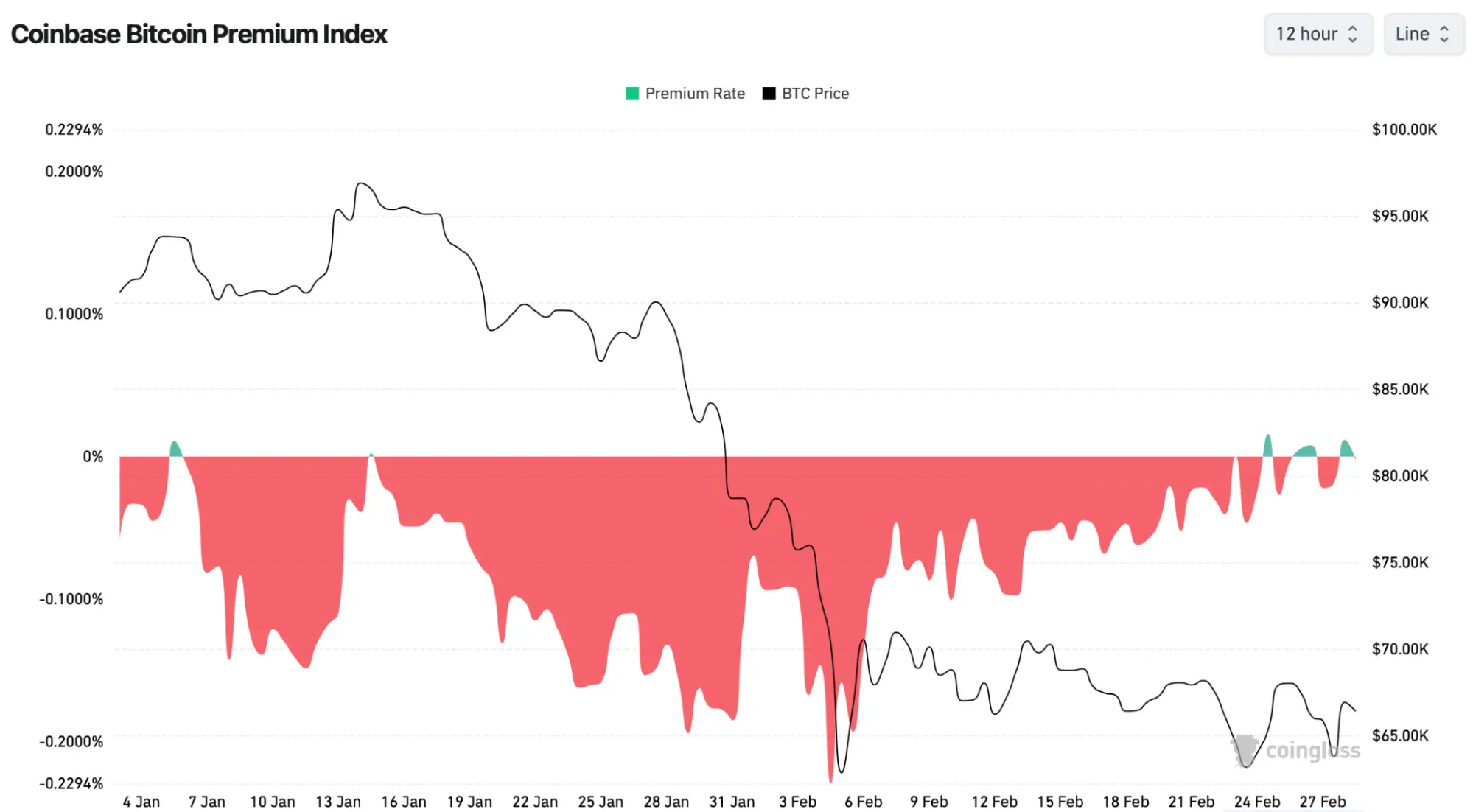
An additional signal that interest is returning: the Coinbase Premium Index, after forty days below zero, is now balancing on the edge of turning positive again. This index measures the price difference between bitcoin on Coinbase and the broader global market. It's a useful indicator for U.S. sentiment, which is apparently turning more positive.
Who are the current ETF buyers? The Q4 quarterly reports offer an indication. Abu Dhabi's sovereign wealth fund increased its IBIT position by 46 percent in the middle of the correction. Other institutional players also expanded their positions. These are parties that trade based on allocation models, and those models apparently still point toward bitcoin. We wrote about this last week.
And yet, one swallow doesn't make a summer. We'll have to wait and see whether this increased ETF inflow marks the beginning of a structural price recovery, or a short-lived bounce in a longer downward trend. The Iran conflict is certainly not a driving factor in that regard.
2️⃣ Vitalik wants to make Ethereum quantum-resistant
Contribution by Erik
Ethereum frontman Vitalik Buterin isn't sitting still and presented a roadmap last Thursday to protect the network against quantum computers. While they don't pose an urgent threat yet, Vitalik is urging to start the necessary renovation now. This makes the plans more concrete than those for bitcoin.
Four vulnerable points, one common thread
Vitalik identifies four components that are vulnerable:
- The signatures validators use to confirm blocks;
- The system that guarantees the correctness of stored data;
- The signatures regular users use to sign transactions;
- The zero-knowledge proofs of privacy protocols and layer-two networks.
For each component, he proposes a different quantum-resistant alternative. The common thread is always the same: switch to cryptography that isn't vulnerable to quantum attacks, and offset the higher costs with recursive aggregation.
Recursive what? Behind that term lies the idea of no longer verifying signatures and proofs individually, but bundled into a single proof that demonstrates the validity of everything at once. This is especially necessary for quantum-resistant proofs, because according to Vitalik, those are dozens of times larger. Without aggregation, costs would skyrocket.
EIP-8141: the foundation of the entire plan
Essential to the plan is EIP-8141, a proposal for a new transaction type that kills two birds with one stone.
First, it makes Ethereum accounts flexible. They're no longer tied to the current signature algorithm, but can also use quantum-resistant variants. Second, it introduces so-called validation frames. These are delineated verification steps within a transaction that can later be collectively replaced by a single proof. This relates to the recursive aggregation mentioned above, which is needed to keep costs manageable.
Vitalik says EIP-8141 should be rolled out within a year, in the Hegotá upgrade. That's remarkably fast and specific; Vitalik usually isn't this outspoken about deadlines.
Now, account abstraction.
— vitalik.eth (@VitalikButerin) February 28, 2026
We have been talking about account abstraction ever since early 2016, see the original EIP-86: https://t.co/HYLSTLHgWH
Now, we finally have EIP-8141 ( https://t.co/jYqeS55j6P ), an omnibus that wraps up and solves every remaining problem that AA was…
He describes the approach as the Ship of Theseus. Component by component, Ethereum's consensus layer is being replaced with a better, quantum-resistant alternative. Meanwhile, the network keeps running. After the renovation, you might ask: Is it still the original ship? In form, yes. Emotionally, perhaps. But materially, no longer.
Ethereum versus bitcoin
Ethereum is tackling quantum-era preparation more proactively than bitcoin. Last week, bitcoin officially added BIP 360 to its BIP library. That proposal introduces a new address type that keeps the public key hidden, so there's nothing for a quantum computer to crack. It's a cautious first step that allows existing holders to move their BTC to a safe address type, but kicks fundamental unresolved issues down the road.
Heavy construction on the ship
The quantum plan is just one of many things coming to Ethereum. Earlier this month, Vitalik already presented sweeping proposals for scaling Ethereum's state. So there's serious building going on. Or, to stick with Vitalik's own analogy: heavy construction on the ship.
3️⃣ Where's the 'flood' of institutional money?
 Contribution by
 Peter
For years, finfluencers spoke of the coming flood of institutional money that would wash over the bitcoin economy. The image was spectacular: once big banks and asset managers get in, a rapid and massive revaluation of the bitcoin price would follow. The only way is up!
But in practice, something different is unfolding. Institutional players move slowly. Not out of disinterest, but because that slowness serves a purpose. Decision-making runs through committees that must account for risk frameworks and reputational considerations. New activities must fit within supervision, capital requirements, and internal control mechanisms. That process takes time. Anyone expecting a bank to "just" add bitcoin underestimates the organizational reality.
Last week brought two examples of this. Take Morgan Stanley. The American banking group has around 80,000 employees, operates in more than forty countries, and manages over $2 trillion in assets. Crypto still plays a modest role there. In fact, the first step has yet to materialize: sometime in the first half of 2026, clients should be able to purchase crypto through their own broker E-Trade. For the required infrastructure, they're partnering with third parties.
During Strategy World 2026, Morgan Stanley veteran Amy Oldenburg explained that this is just a first, small step. The bank is building its own infrastructure for custody and trading. Clients need to be able to trust Morgan Stanley as the counterparty. If you offer crypto under your own name, you also want control over the chain. After that, additional services come into view, such as lending or yield-generating products. The pace is slow, but the trajectory is structural.
Morgan Stanley's new Head of Digital Asset Strategy confirms the bank is building out Bitcoin trading, lending, yield, and custody services. pic.twitter.com/v1qrS2MQ4t
— TFTC (@TFTC21) February 25, 2026
A similar message comes from Emirates NBD, one of the largest banks in the United Arab Emirates, with around nine million clients. In an interview on CNBC's Squawk Box Asia, CIO Maurice Gravier discussed various aspects of the global economy. But his eyes only lit up when asked about NBD's bitcoin activities. He characterized it as "digital gold," referenced proof-of-work and its limited supply.
Gravier explains why he's happy about the bear market bitcoin is in. "For us, the price has become more attractive," Gravier says. It's now well below the value that flows from our valuation model. "We still need to finalize that," he explains. After that come the first allocations; "half a percent to start."
JUST IN: $16 BILLION EMIRATES NBD BANK JUST ANNOUNCED LIVE ON CNBC THAT IT WILL BUY #BITCOIN SOON
— The Bitcoin Historian (@pete_rizzo_) February 24, 2026
"WE ARE CONSIDERING A 1% ALLOCATION"
"WE LOVE BTC"
ONE OF THE LARGEST ASSET MANAGERS IN THE MIDDLE EAST 🔥 pic.twitter.com/00zNvtbWbZ
That's how big players talk. Not in memes, but in percentages. Not "all-in," but half a percent now, and maybe 1 percent tomorrow.
"Institutional money is coming" sounds like a retail fantasy about getting rich quick. Reality is less spectacular, but more interesting. Big banks, asset managers, and sovereign wealth funds are cautiously entering the bitcoin economy. Some are already doing so with serious amounts, but most are still at the beginning. Sometimes even still in the exploration phase.
So no flood. More like a slowly rising tide. You don't see it in the moment, until you notice the water is structurally higher than it was a few years ago.
🍟 Snacks
To wrap up, some quick bites:
- At Strategy World, the focus was on the STRC stock. "We have a PhD in hodling." With these words, Michael Saylor opened the conference. In the same breath, he positioned STRC as a better alternative for companies seeking bitcoin exposure. In other words: buy the stock, and Saylor will buy the bitcoins. The CEOs and CFOs attending confirmed this picture. They proudly announced that part of their treasury is in STRC, while BlackRock brings the vehicle to Euronext.
- Is Jane Street responsible for bitcoin's bear market? The market maker is under fire following the announcement of a lawsuit related to Terraform Labs. Online, theories are circulating that Jane Street is suppressing the bitcoin price daily through ETF trading. Evidence is lacking, and Wall Street veterans call the idea "ridiculous." However, there is a federal case pending in which Terraform claims Jane Street used insider knowledge to accelerate and deepen the Terra implosion.
- Meta wants to get back into stablecoins. According to insiders, the company is working on a stablecoin "comeback." The company is reportedly working on integration with dollar stablecoins and a new wallet. Stripe is mentioned as a potential partner. This initiative of course recalls the Libra/Diem fiasco. The difference: this time Meta doesn't want to issue its own coin, but use existing infrastructure. With three billion users, that could further accelerate stablecoin adoption.
- JPMorgan expects the Clarity Act to provide structural support for the crypto market. Analysts at the bank expect the law to pass around summer. According to JPMorgan, this would facilitate institutional entry, reduce the compliance burden, and strongly accelerate innovation. Sticking points in the legislative process remain stablecoin interest and conflicts of interest in Washington. But if the bill passes, it could become a significant catalyst according to the bank.
- Prediction markets under fire after 'profits' on Iranian leader's death. A Polymarket user earned over $550,000 by betting on Ayatollah Ali Khamenei's exit, shortly before he was killed. In the U.S., this led to political calls to ban trading on events involving war and death. Competitor Kalshi paused a similar market and decided not to pay out. It remains to be seen whether the Polymarket trader will actually receive his payout; the market outcome has been disputed.
- Tether has already frozen $4.2 billion in USDT holdings upon request. The lion's share, $3.5 billion, has been frozen at authorities' request since 2023. Most cases involve fraud, including so-called 'pig butchering' scams. Tether previously announced it blocked wallets linked to human trafficking and terrorism. Despite its murky image, Tether also takes action against crime. It also reveals the nature of most stablecoins: the issuer is the boss, not the holder.
Thank you for reading!
To stay informed about the latest market developments and insights, follow our team members on X:
- Bart Mol (@Bart_Mol)
- Peter Slagter (@pesla)
- Bert Slagter (@bslagter)
- Mike Lelieveld (@mlelieveld)
We appreciate your continued support and look forward to bringing you more comprehensive analysis in our next edition.
Until then!